


Written by Eric Sampson, Founder, Special Needs Care Network. Educational guide for U.S. parents - not legal advice. Confirm state and district rules with your Parent Training and Information Center or a special-education professional.
When the IEP sits in a binder and the school day does not match it, homeschool can start to look like the exit, and parent threads about that choice have been busy lately. The risk is withdrawing on frustration alone, before you know what changes the day enrollment ends.
This is a pre-withdrawal checklist: what to clarify, what to collect, what to ask in writing, and what else to compare. IDEA rules for homeschooled and privately enrolled students vary by state, so confirm every service answer with your district and your state's parent center.
Get matched with schools and therapy providers
Tell us your child's needs and location, and we'll match you with special-needs schools, ABA therapy centers, or speech-therapy providers in your area. Free for families.
Free for families.
1. Name which enrollment you are choosing
Parents often treat four different arrangements as if they were the same thing, and the IDEA rules that apply depend on which kind of enrollment you are walking into.
Homeschool usually means you are the primary educator under your state's homeschool law. Whether your state treats that child like a parentally placed private-school student under IDEA is a state question.
Homebound instruction is temporary teaching arranged by the public school when a student cannot attend in person, often for medical reasons. The child generally stays enrolled in the public system.
A public virtual or online school keeps the child in a public program delivered remotely. IEP responsibility and FAPE usually stay with that public agency, even if the child learns at the kitchen table.
When a public agency places a child in a private setting to provide FAPE, a different IDEA track applies than when parents unilaterally enroll in a private school or start homeschooling. Federal regulations keep those tracks separate (34 CFR §§300.145-300.147 versus §§300.130-300.144). For how an IEP-funded private placement can work in one state, see Maryland's nonpublic placement guide.
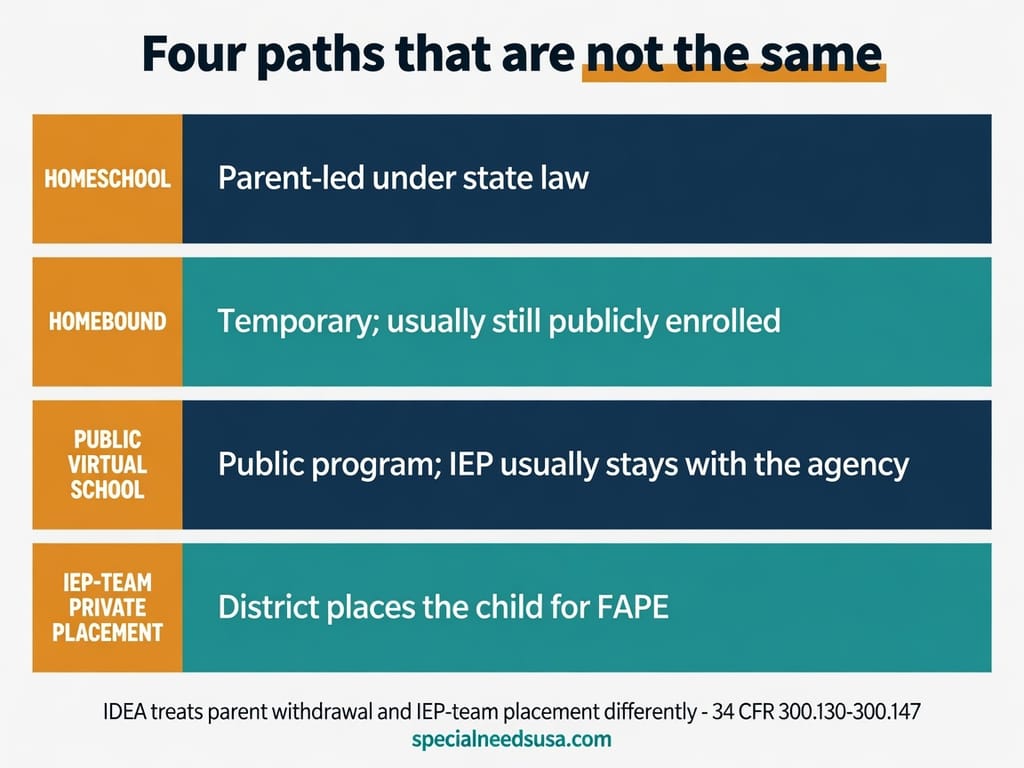
If you are unsure which box you are about to check, ask the district in writing to name the enrollment category and which IDEA pathway it triggers in your state.
2. Find out what happens to the current IEP
While your child is enrolled in public school and eligible, they generally have an individual entitlement to FAPE through an IEP. After parents place a child in a private school, federal IDEA says no parentally placed private-school child with a disability has an individual right to receive some or all of the special education and related services that child would receive if enrolled in a public school (34 CFR §300.137(a)).
Districts can still owe child-find and equitable services to parentally placed private-school children, paid from a proportionate share of Part B funds and shaped through consultation. What a homeschooled child can get depends on how the state classifies that enrollment. Services that are offered go in a services plan, and the LEA decides what is provided (34 CFR §§300.130-300.144; OSERS Q&A on parentally placed private-school children, revised February 2022).
Homeschool classification changes by state, because some treat homeschooled students as private-school students for these purposes and others do not. Arizona publishes a local write-up, and ADE guidance says homeschooled students are considered private-school students, quotes the federal "no individual right" rule, and points to proportionate-share / equitable-service provisions (AZ ADE General IDEA FAQ, citing A.R.S. §15-763(C) and 34 CFR §300.137(a)). Before you withdraw, ask what happens to the current IEP, what evaluation access remains, and whether any equitable services would still be available.
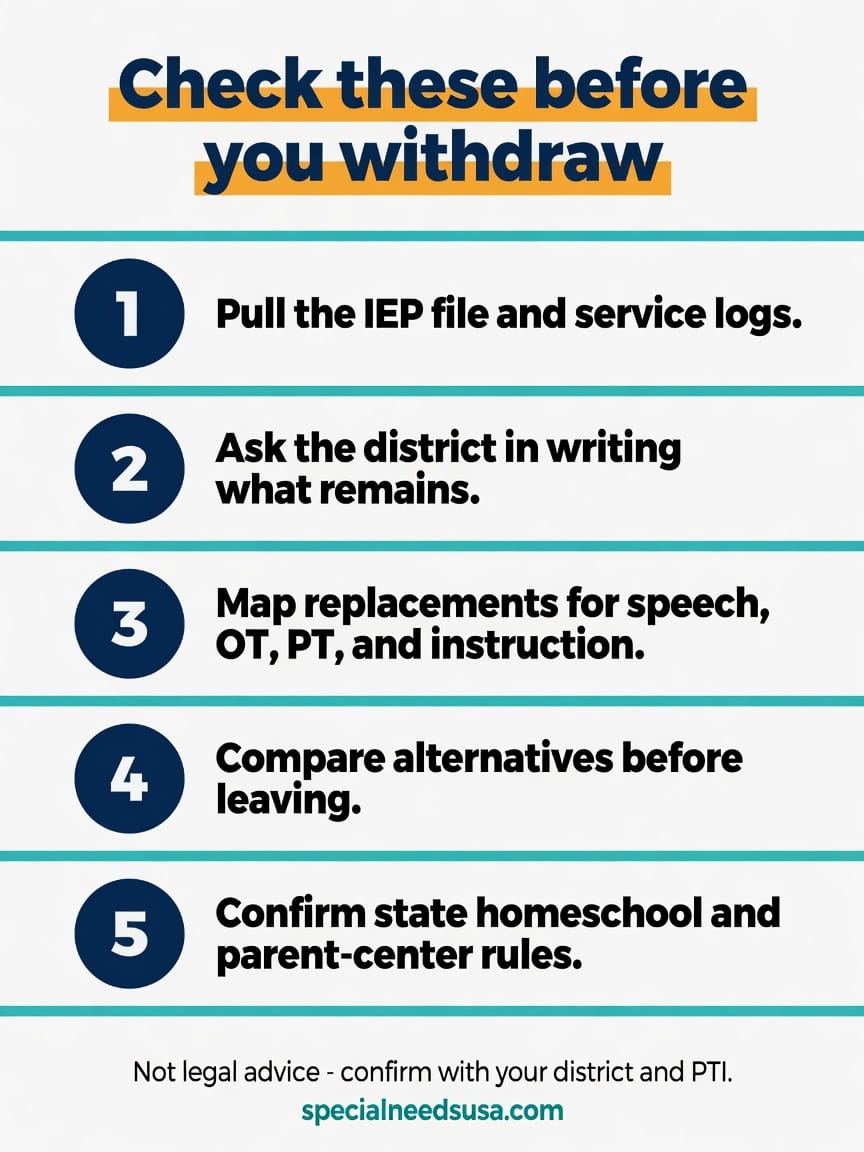
3. Pull the file while you still can
Request copies while the child is enrolled and staff can still find the documents:
Current IEP and amendments
Evaluation reports and eligibility determinations
Progress reports and goal data
Service logs or other proof of minutes delivered
Prior written notices and meeting invitations
Procedural safeguards notice
Behavior plans, FBAs, and manifestation determinations if they apply
Attendance, discipline, and health plans that affect instruction
You are preserving what the team said the child needed, what was delivered, and what notice you got. That baseline matters whether you stay, transfer, complain, mediate, or build a home program.
For what belongs in the plan itself, use the IEP guide. If the weak link is evaluation, start with how to request a special education evaluation. If the file you are fighting over is a 504 plan, the 504 vs IEP guide helps you sort which process you are in.
4. Ask the hard questions in writing
A short, dated email creates a record. Copy the prompts that apply, fill in the brackets, and send them:
If we withdraw to homeschool (or enroll privately) on [date], what happens to our child's current IEP under [state] law?
After withdrawal, what child-find or evaluation rights remain, and which LEA is responsible?
Would our child count as a parentally placed private-school student for equitable services in this district?
If equitable services exist here, what is the process and timeline for a services plan?
Which related services on the IEP (speech, OT, PT, counseling, specialized transportation, assistive technology) would continue through the district after withdrawal, and which would not?
What is the process if we later re-enroll in public school?
Please confirm in writing how this district distinguishes unilateral parent withdrawal from an IEP-team private placement.
Send a shorter version to your state's Parent Training and Information Center. PTIs help families understand special education rights and process, and they are a strong first call for state framing, not a substitute for a lawyer when you need individualized legal advice (IDEA Parents and Families).
5. Write a replacement for every service in use now
List every support the IEP authorizes. For each one, write who would deliver it after you leave, how you would pay (private insurance, Medicaid, ESA/scholarship if available, out of pocket), how you would measure progress, and what happens when a provider is out:
Specialized instruction and curriculum access
Speech-language therapy
Occupational therapy
Physical therapy
Behavior support or BCBA-supervised services
Counseling or social skills support
Assistive technology and training
Nursing or medical supports tied to school
Transportation
Progress measurement and documentation
Families sometimes leave because related services were spotty at school, then find the same staffing gaps at home with less backup. If community therapy is part of the plan, start with the therapy directory.
6. Line up alternatives before you decide to leave
Homeschooling can be the right next step, and depending on what is broken you may still want these other options first:
Request an IEP meeting to revise goals, services, placement, or implementation
Request an IEE if you disagree with the district's evaluation
Use mediation, a state complaint, or due process when rights or implementation are in dispute (pick the path with local guidance)
Transfer to another public school, program, or public virtual option
Ask the IEP team whether a different continuum placement, including a possible private placement for FAPE, should be on the table
Explore a private special-needs school or microschool while you transition
Our guide to choosing a special needs school covers tour questions. For a parent conversation about what to do when school is not working, see What to Do When the School Is Not Serving Your Child.
7. Check state homeschool rules and special-ed contacts the same day
Skip Facebook answers from another state. In one sitting, look up:
Your state's homeschool notice, affidavit, curriculum, and assessment rules
Your SEA pages on special education for private-school and homeschooled students
Your LEA's equitable-services / proportionate-share contacts
Your PTI or CPRC via the Parent Center locator
If you are also weighing ESA, voucher, or scholarship money, keep the funding rules and the IDEA service rules on two lists. Tuition dollars do not recreate an IEP entitlement. For how school-choice dollars are showing up in therapy and private-school budgets, see School-Choice ESA Funds Are Quietly Becoming a Major Way to Pay for Autism Therapy and Special-Needs School.
8. Write down what "failure" means for this child
Parents use "IEP failure" for missed minutes, stuck goals, unsafe behavior support, refusal to evaluate, a bad placement fit, or a team that will not revise the plan, and those problems point to different remedies.
Before you withdraw, write three short answers: What exactly is not working? What have you already asked the school to change? What would have to be true somewhere else for this to be better for your child? That note becomes the filter for every option above, and it keeps one viral success story from becoming your only evidence.
9. Use the directory when you need another program or outside services
When the checklist points toward a different school, a specialized day program, or community therapy while you sort the public-school relationship, start with listings instead of a closed thread. Browse special needs schools, therapy providers, or request a shortlist through concierge matching.
Bring the records packet and the service-replacement grid to every tour or intake. Ask how progress is measured, who delivers specialized instruction, and what happens when a therapist is out. The new setting should solve a problem you named in step 8.
Common questions parents ask
Do homeschooled kids keep their IEP?
Under federal IDEA, parentally placed private-school children do not have an individual right to the same special education and related services they would get in public school (34 CFR §300.137(a)). Ask your district and PTI how your state classifies homeschool for equitable services.
Is homeschool the same as homebound instruction?
Homebound is usually temporary instruction arranged while the child remains publicly enrolled. Homeschool is typically a parent-led program under state homeschool law.
What should I request before I withdraw?
At minimum: the current IEP, evaluations, progress data, service logs, prior written notices, and procedural safeguards. Pull them while staff still have easy access to the file.
What if the problem is a bad placement?
Ask for an IEP meeting, consider an IEE if you disagree with evaluations, and compare continuum options, including whether an IEP-team private placement for FAPE should be discussed, before you leave unilaterally. Maryland's nonpublic placement guide shows how one state frames IEP-funded private placement.
Where to start
Send the dated email in step 4 and request the records in step 3. Those two moves give you a file and a written answer from the district, which is enough to keep you from trading one unsupported plan for another while you work through the rest of the list.
Educational information for U.S. parents, not legal advice. IDEA implementation and homeschool rules vary by state and district. Consider a special-education attorney, qualified advocate, or credentialed special educator for your child's situation.
Sources
34 CFR §300.130 - Definition of parentally placed private-school children with disabilities
34 CFR §300.137 - Equitable services determined; no individual right to public-school-level services
34 CFR §§300.130-300.144 - Parentally placed private-school children
U.S. Department of Education / OSERS, Questions and Answers on Serving Children with Disabilities Placed by Their Parents in Private Schools (rev. Feb. 2022)
IDEA Parents and Families - Parent center overview
Find Your Parent Center - PTI / CPRC locator
Arizona Department of Education, FAQs: General IDEA Information - Homeschool treated as private school in Arizona (worked example only)
Find schools and therapy providers for your child
Tell us your child's needs and location, and we'll match you with special-needs schools, ABA therapy centers, or speech-therapy providers in your area. Free for families.


