


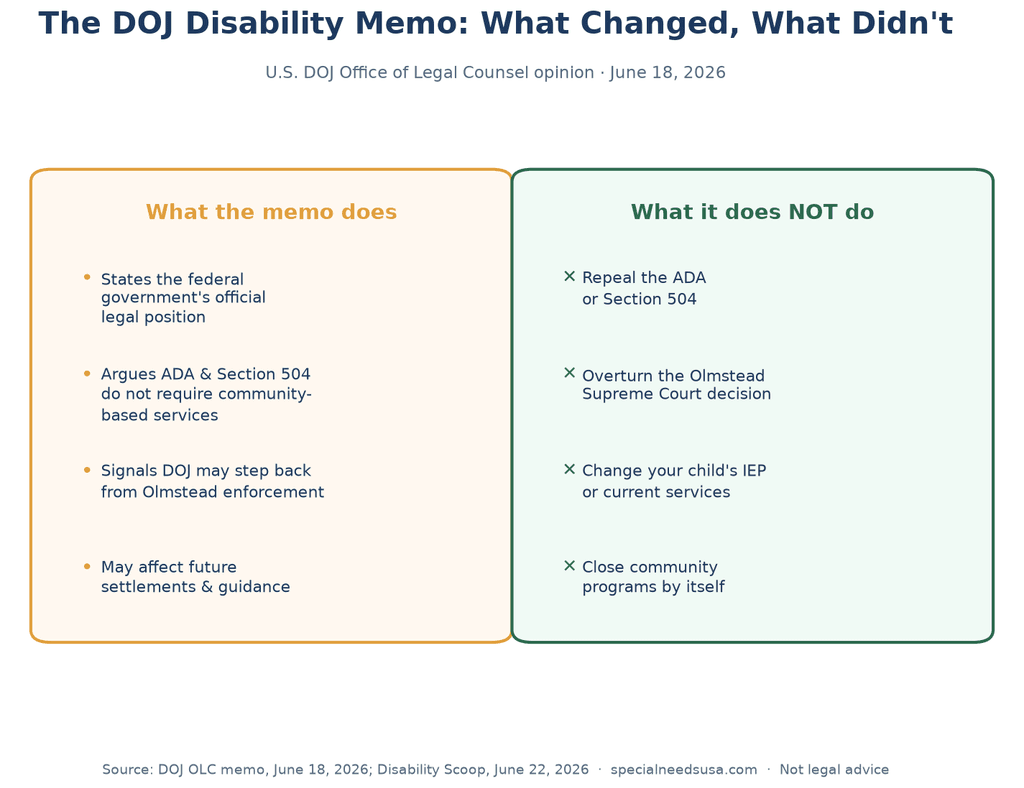
On June 18, 2026, the U.S. Department of Justice's Office of Legal Counsel issued a 39-page opinion arguing that the Americans with Disabilities Act (ADA) and Section 504 of the Rehabilitation Act do not require states to serve people with disabilities in their own homes and communities rather than in institutions.
If you are raising a child with a disability, or you care for a family member who relies on community-based services, you likely saw that argument in the news. Your child's current IEP still applies, and how hard federal agencies will push states on community placements is the part that can still shift.
What the memo says
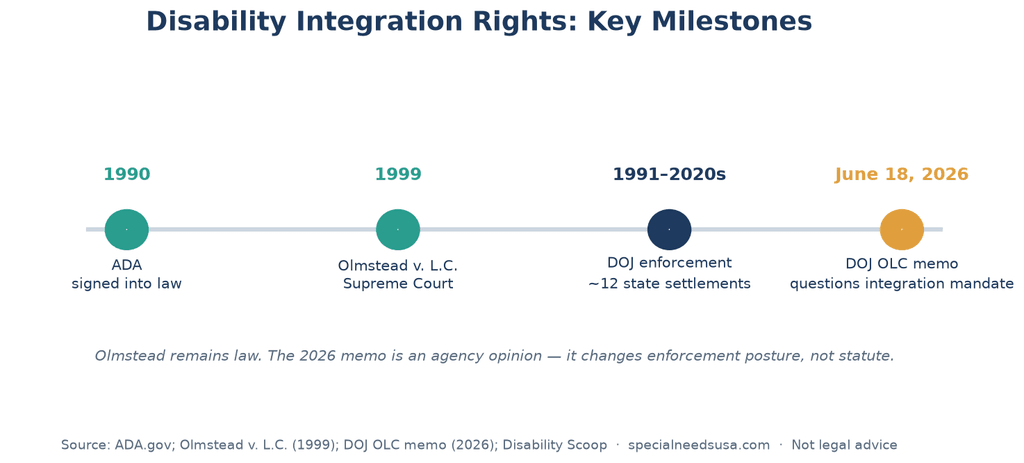
The opinion concludes that neither the ADA nor Section 504 contains a strict integration mandate. That mandate is the principle, affirmed by the Supreme Court's 1999 Olmstead v. L.C. decision, that people with disabilities have the right to receive services in the most integrated setting appropriate to their needs, which usually means at home and in the community rather than in an institution.
Get matched with schools and therapy providers
Tell us your child's needs and location, and we'll match you with special-needs schools, ABA therapy centers, or speech-therapy providers in your area. Free for families.
Free for families.
It is now the official legal position of the federal government (Disability Scoop, June 22, 2026; CBS News, June 2026). The opinion argues that Olmstead held only that "unjustified institutional isolation" can be a form of discrimination, not that states must always provide care in the most integrated setting, and that existing HHS and DOJ regulations enforcing an integration mandate go beyond what the statutes authorize.
What the memo does not do
A legal opinion from one agency cannot repeal the ADA, Section 504, or the Olmstead decision, and it cannot overturn a Supreme Court ruling. Only Congress can change the statute, and only the courts can reinterpret Olmstead. Disability-rights attorneys have noted that states treating this memo as a change in law would be putting themselves at significant legal risk (CBS News). The same document does not, by itself, close a community program, move anyone into an institution, or change your child's IEP, school services, or current Medicaid-funded therapies.
Federal agencies may push states less hard to expand and protect community-based services. The Arc and the American Association of People with Disabilities (AAPD) warn that this could weaken future protections if state budgets tighten, or if federal agencies revise the regulations that have enforced the integration mandate for decades.
Why families are watching this
Community-based services, home and community-based Medicaid waivers, in-home supports, and integrated school and therapy settings are how many children and adults with disabilities live at home and receive care in their own communities. Even if your child's plan is unchanged this week, those are the settings the memo is about.
The memo came out in the same month that special education oversight began shifting from the Department of Education to Health and Human Services, and civil rights enforcement to the Department of Justice. We covered that transfer in what the OSERS move to HHS means for your child's IEP. If you are trying to hold both stories in your head at once, the 2026 special-needs law and policy guide is a single place to see how these federal shifts connect.
The Arc and KNPR/NPR (June 2026) point to ongoing litigation, including Texas v. Kennedy (The Arc; KNPR/NPR). They stress that this is an OLC opinion, not a change in statute, so Olmstead remains the law of the land even if a memo changes how aggressively the government enforces it.
What you can do right now
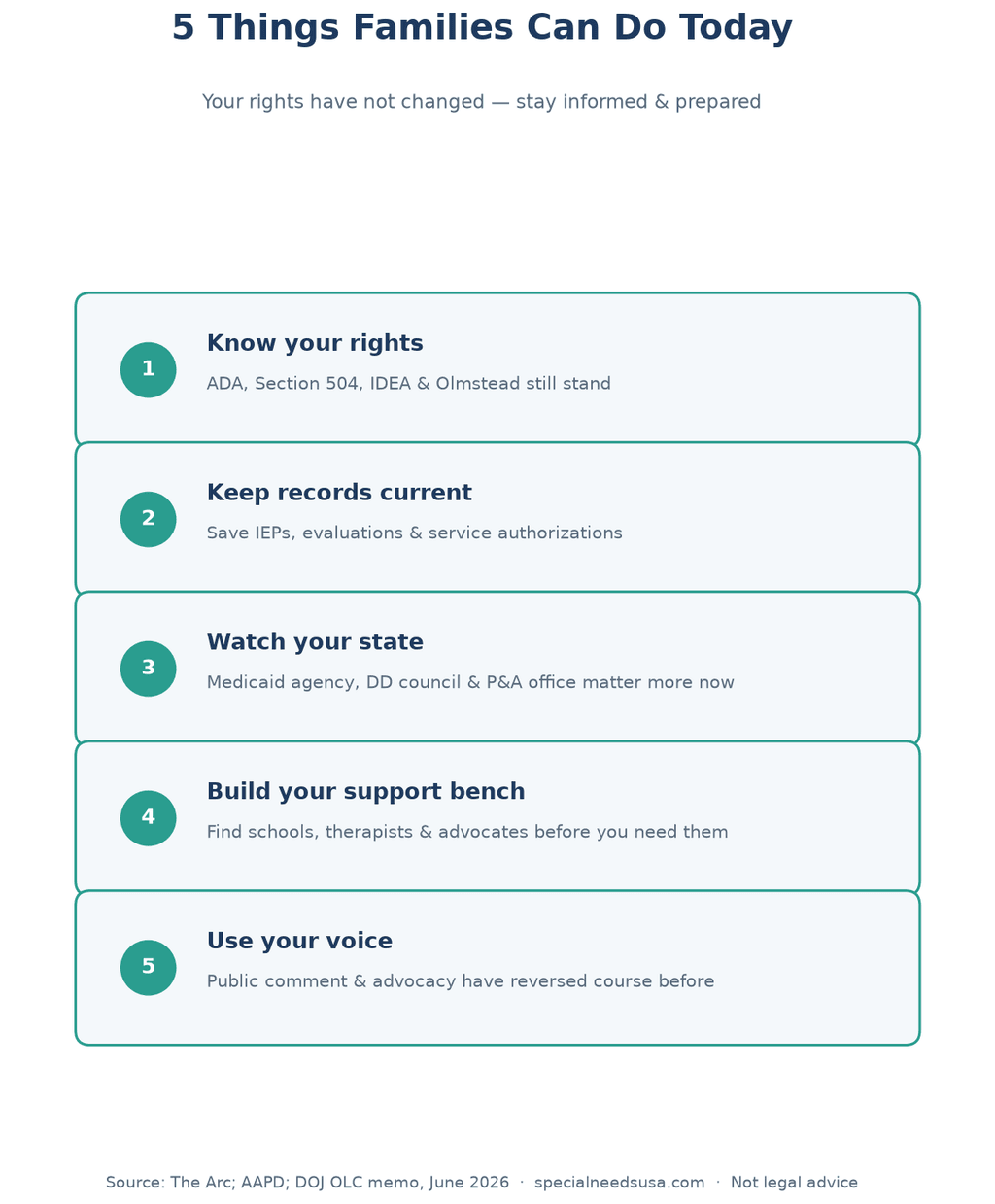
The ADA, Section 504, IDEA, and Olmstead remain in effect, so if your child is entitled to a service today, that entitlement is intact today. If the difference between a 504 plan and an IEP has never been fully clear for your family, the 504 plan vs. IEP guide is a better starting point than a news headline.
Keep IEPs, evaluations, service authorizations, and denial letters somewhere you can actually find them. Those records carry real weight when a district or agency questions whether a service is still owed.
Your state Medicaid office, developmental disabilities council, and Protection and Advocacy (P&A) organization will do more of the heavy lifting while federal enforcement softens. Look up who they are in your state before you need them, not after a denial letter arrives.
Bookmark the schools and therapy providers in your area, and keep an advocate or attorney's name in your contacts so you are not building a support network from zero under pressure. Families have changed federal course before when they show up organized for public comment periods and legislative windows.
How Special Needs USA helps
Special Needs USA has a directory of special-needs schools and therapy providers, plus state-by-state funding and policy resources. Families who want matching help can use the concierge matching service.
Search our directory of special-needs schools and therapy centers in your state, or request concierge help if you want a shortlist matched to your child's needs.
This article is for general information and is not legal or medical advice. For guidance on your specific situation, contact a special education attorney or your state's Protection and Advocacy organization.
Sources: U.S. DOJ Office of Legal Counsel opinion (June 18, 2026); Disability Scoop (June 22, 2026); CBS News (June 2026); The Arc of the United States; AAPD; KNPR/NPR (June 2026).
Find schools and therapy providers for your child
Tell us your child's needs and location, and we'll match you with special-needs schools, ABA therapy centers, or speech-therapy providers in your area. Free for families.


