


Sarah Sandelius sat down with SPCN founder Eric Sampson to talk about a school that can follow special education law to the letter and still leave a child without much to show for it. She is the founder and CEO of The Ability Challenge (ABC), a nonprofit she launched in 2019 that partners with schools, districts, and networks on inclusive special education programs.
Before ABC she spent more than 15 years working across law, policy, and education, including the New York City Department of Education's Alternative Schools District and, later, senior counsel for litigation and policy, where she helped move roughly 1,700 schools toward more equitable practices for students with disabilities.
When "legally compliant" isn't the same as serving a child
Her early work was in schools that did not look like typical schools, including programs inside correctional facilities. A student might be enrolled for three weeks, which made the usual annual IEP cycle the wrong unit of time, because a year-long plan does not mean much for a student who will be gone before the year is up.
Get matched with schools and therapy providers
Tell us your child's needs and location, and we'll match you with special-needs schools, ABA therapy centers, or speech-therapy providers in your area. Free for families.
Free for families.
"There was a real gap in what people thought they needed to do in order to be compliant and what they were doing to serve kids," she said. She came in as a lawyer, so her habit was to keep asking why a practice existed instead of accepting that it had always been done that way.
The pattern she kept hitting is one she calls box-checking. A leader finishes the IEP, files it, treats the legal job as done, and moves on. When she asks that same leader to pull up a struggling student's IEP, she sometimes gets a puzzled look, as if the document and the teaching belong to different jobs. An IEP team already sat around a table and decided which services the child needs. That document is the natural place to start when something is not working. If the plan no longer matches the child, bring the team back and revise it.
Turning the IEP into a working document
When ABC helps a leader build a master schedule, the IEPs are the starting data. How many sections of each class does a high school need? How many ninth graders need ninth-grade English, and how many of those need a co-taught classroom? Those answers live in the stack of student IEPs. Once staff have to open the plans to build the schedule, they start treating IEPs as documents they use all week.
Right after COVID, she worked with a semi-rural school that could not hire enough paraprofessionals to cover the one-to-one support written into students' IEPs. ABC went back through the documents and asked what each IEP team had been trying to accomplish when it assigned a para. She has seen a split between that original reason and the later habit of assuming a child needs one adult, one-to-one, for the entire school day.
The review let the school put its available staff where they were most needed while recruiting continued. In some cases two students briefly shared a paraprofessional, or a student got support in a different configuration, with a plan to build independence over time. Sarah was candid that this may not have been 100% legally compliant for every minute of every day. Her view is that students were more likely to be thriving under a plan built from their actual needs than under a rigid reading of paperwork the school had no way to staff.
The services written into an IEP are a legal entitlement, not a courtesy, and a family can raise a shortfall with the IEP team. Sarah's working rule is to start from what the documents say each child needs, then make decisions that match the school's real staff.
If you want a plain-language refresher on how these plans are supposed to work, our IEP guide walks through the parts of an IEP and what belongs in each one, and our guide on how to request a special education evaluation covers the step that comes before a plan exists at all.
Teachers asked for time to plan together
Before ABC had a name, Sarah ran a national survey of educators because she suspected schools were collecting piles of special education data without a clear sense of what any of it was for. That survey later grew into ABC's THRIVE framework, and she still leads with one result from it.
The survey asked educators which of several things would most improve special education at their school. One of the top answers was more time to collaborate with peers, and a later question asked whether they actually had those things. About 70% of respondents named dedicated collaboration time as one of the ways special education could be improved, while only around 30% said they had it.
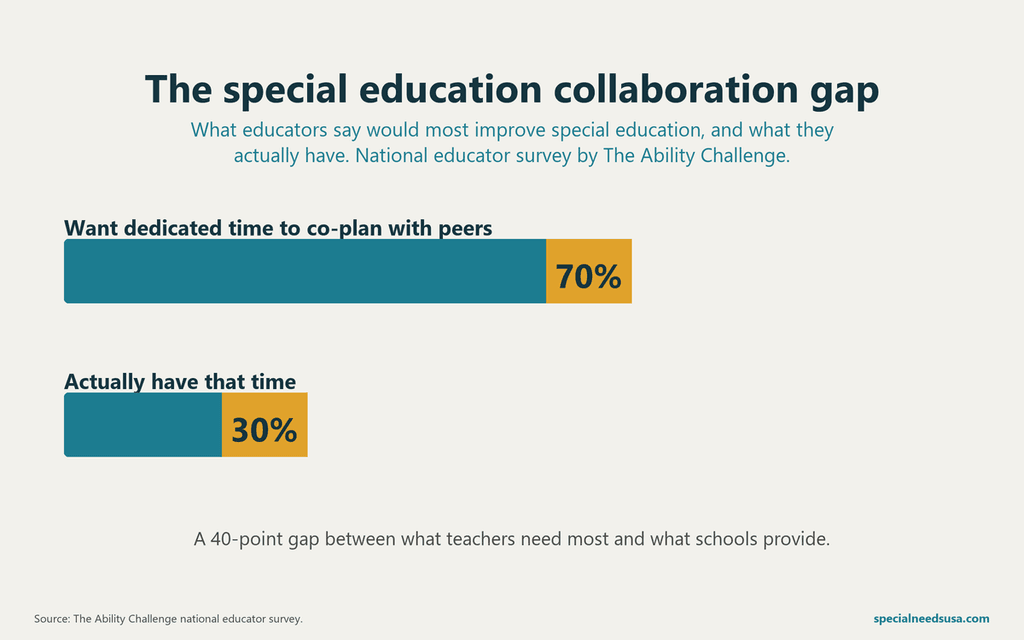
"Here I am thinking the thing that educators most want is a structural, systemic fix," she said. What they named was time for a general education teacher and a special education teacher to plan together. Inclusive teaching is supposed to put two kinds of expertise in the same room: a content-area teacher who knows the grade-level material, and a special education teacher trained in how disability affects learning. Neither can do the other's job, and they cannot combine that expertise without sitting down together.
ABC helps leaders find the scheduling room to create collaboration time, and it trains teachers on how to use it, because co-planning is a skill adults have to learn. Sarah's teams focus on shared language, a working agenda, and a basic common understanding of how special education plays out in a classroom, so a planning block becomes a change in instruction instead of another meeting on the calendar.
What she looks for from the classroom door
Sarah describes ABC's mission as building anti-ableist schools, and she is specific about what that looks like from inside a classroom. THRIVE has five core elements, including school culture and student-centered curriculum and instruction. The classroom element pulls together several evidence-based approaches for teaching diverse learners.
Her quick test takes about ten minutes. Walk in, sit down, and see whether every student, not only the ones in the front row, can tell you what they are learning and why. Then look at who can get into the lesson. A student with a reading difficulty in a social studies class might work from a different set of reading materials and still be in the same lesson as everyone else. She also listens for students talking to each other instead of a teacher filling the whole period, and for the other strategies that research links to real access to grade-level instruction.
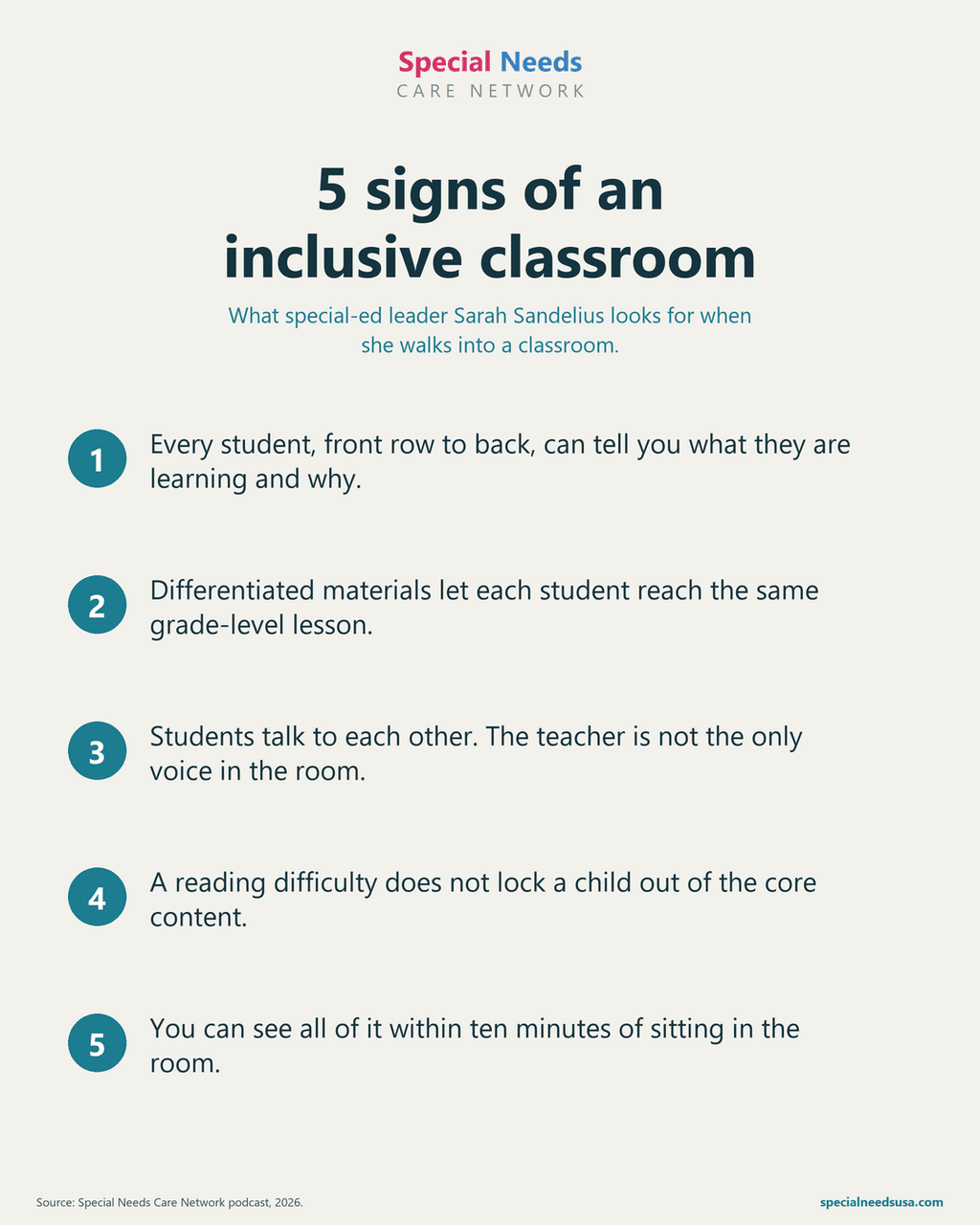
For a parent on a visit, that test is easier to run than asking whether the school "offers special education services," because the useful question is whether this child can understand and engage with the same content as their peers here. Our companion interview, what to do when the school is not serving your child, gets into what parents can do when the answer is no, and our guide on choosing a special needs school covers what to look for on a visit.
How D.C. funding shapes inclusion
Most of ABC's partnership work is in Washington, D.C. and the area around it. Sarah described D.C. as an unusual place to watch special education. It is roughly half charter and half traditional public, with a single school district, so her team sees a wide range of approaches in a small system.
She pointed to D.C.'s uniform funding formula, which, as she describes it, sends more dollars to a school as a student's assessed need rises. In her assessment, D.C. schools are relatively well funded for special education compared with some other places, though she was quick to add that no one would call it enough to fully meet the mandates schools carry. She also named the tension inside any need-based formula, where more services attract more dollars and can pull against inclusion. Every funding design carries trade-offs, and she wanted those named out loud. State and district funding structures change, so treat this as her read of D.C. as of this 2026 conversation. For how funding shifts are reaching families right now, see our reporting on what the OSERS move to HHS means for your child's IEP.
One million more graduates by 2045
ABC's target is getting one million more students with disabilities on track to graduate by 2045. Sampson asked how the organization measures progress, and Sarah said they have not fully solved that question yet.
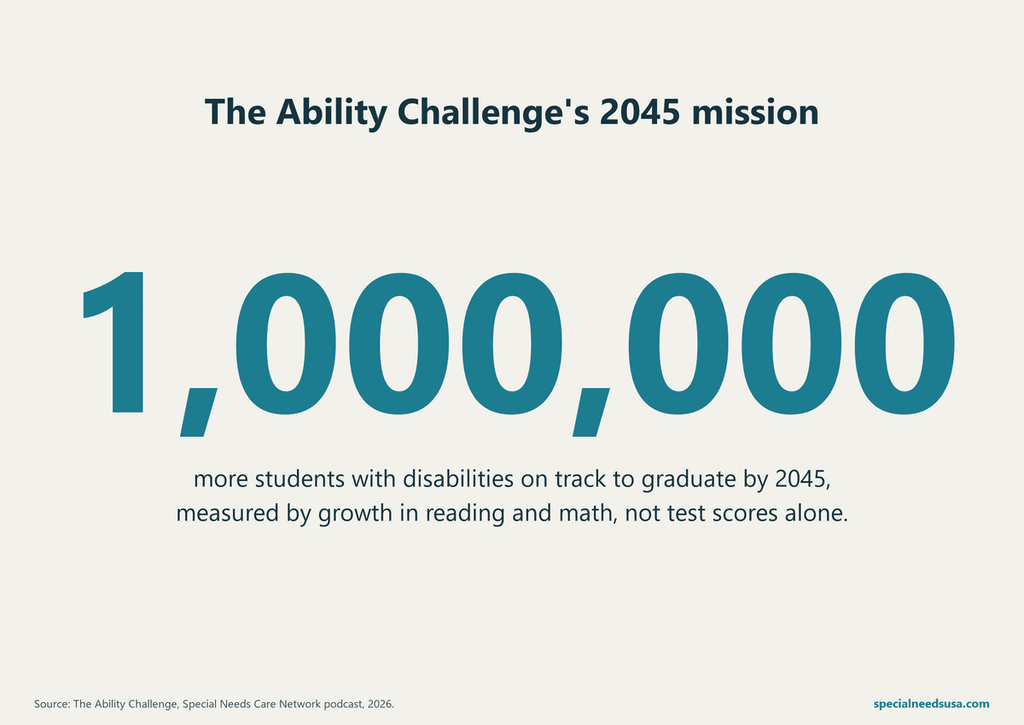
Part of the difficulty is that many students with disabilities are assessed in ways that show what they cannot do rather than what they know. A child who struggles with reading, handed a test that must be read in full, may be graded on the barrier instead of the content. So rather than lean only on test scores, ABC has moved toward measuring growth: the share of students with disabilities who meet their growth goals in reading and math, and whether that share rises after ABC starts working with a school. The team also tracks changes in adult behavior and the scale of its reach, on the idea that students keep gaining when the adults around them change how they work.
Sarah Sandelius is the founder and CEO of The Ability Challenge, a nonprofit founded in 2019 that partners with schools and districts to build inclusive special education programs. Learn more at theabilitychallenge.org.
This article is based on the SPCN podcast episode "Fixing Special Education: Compliance vs. Real Impact with Sarah Sandelius," hosted by Eric Sampson. Watch the full conversation on YouTube.
If you are weighing schools or providers and want help narrowing the field to places that fit your child, SPCN's concierge match can build a shortlist based on your child's needs and your location. You can also browse related conversations and guides on the SPCN blog.
Find schools and therapy providers for your child
Tell us your child's needs and location, and we'll match you with special-needs schools, ABA therapy centers, or speech-therapy providers in your area. Free for families.


