


If you are paying out of pocket for ABA, speech therapy, or a private special-needs school, there is a public funding stream many parents still have not checked: state education savings accounts, usually called ESAs. Over the past decade these school-choice programs have grown into one of the largest non-insurance, non-Medicaid ways families cover therapy and tuition for children with disabilities, and several of the biggest program changes landed in the last few weeks.
An ESA does not guarantee placement or get around eligibility rules. It is a real funding source for families stretching a household budget around services their district is not providing. Below: what ESAs are, where the money goes, and what families give up.
What an ESA is
An education savings account lets a state deposit public education funds into an account families spend on approved educational expenses. Depending on the program, that can include private school tuition, tutoring, curriculum, assistive technology, and, in many states, therapies such as ABA, speech, and occupational therapy. EdChoice tracks these programs nationally; Ballotpedia maintains a state-by-state overview.
Get matched with schools and therapy providers
Tell us your child's needs and location, and we'll match you with special-needs schools, ABA therapy centers, or speech-therapy providers in your area. Free for families.
Free for families.
A traditional voucher typically pays a private school's tuition bill. An ESA gives you a menu of approved expenses to choose from, which is why therapy funding shows up here more often than in older voucher-only states.
As of 2026, there are 21 ESA programs across 18 states. Some are open to most or all students. Others are limited to students with disabilities, IEPs, or specific diagnoses. The approved-expense list and provider rules vary widely. A BCBA-supervised ABA program that qualifies in Florida may not qualify in a state that only reimburses licensed clinics.
Why special-needs families are using ESAs heavily
Two patterns show up in the enrollment data.
Disability-category students dominate several programs
In Arizona, 52% of disability-category ESA students in Q3 of fiscal 2025 had an autism diagnosis, compared with roughly 13% of students served nationally under IDEA (NCES). Once eligibility opens to students with disabilities, autistic students draw down a large share of these accounts.
Ohio advocates have noted for years that a large share of school-choice dollars flows to students with autism and other special needs. On the ground, parents describe the difference in concrete terms: one family on X wrote that school choice meant their niece with autism could finally participate in class because teachers had the flexibility to teach to her needs rather than a one-size lesson plan.
The dollar amounts are no longer symbolic
Florida's Family Empowerment Scholarship for Students with Unique Abilities (FES-UA) reported 140,147 funded students for 2025-26, roughly $1 billion in scholarships, with awards averaging about $10,000 and the two highest support tiers averaging between $22,000 and $34,000 (Step Up For Students fast facts, 2025-26). For a family paying $25,000-$40,000 a year between therapy and tuition, an award that size covers a large part of the bill.
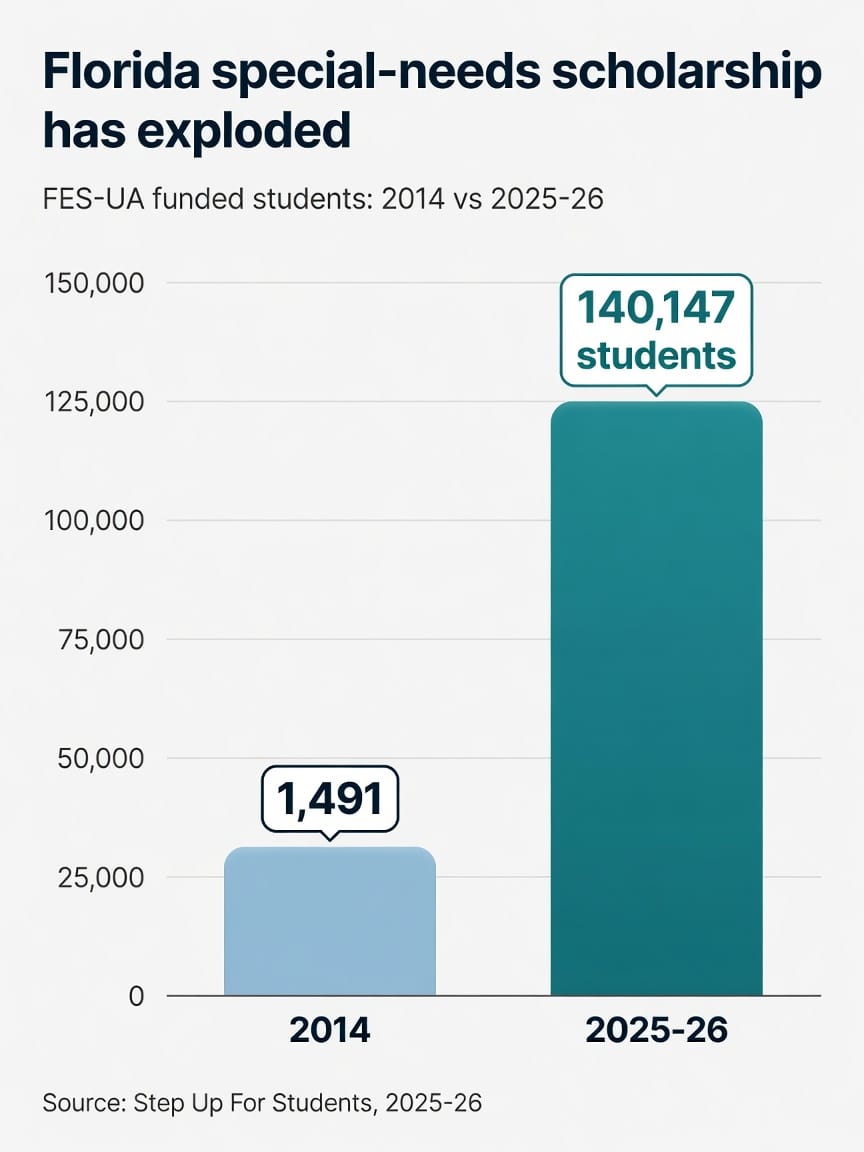
FES-UA served 1,491 students in 2014 (Step Up For Students). The 2025-26 count is nearly one hundred times that. Whether that scale is good policy or a warning sign about public-school capacity, it is the system parents are dealing with right now.
For therapy families, ABA is listed first among approved specialized services in Florida's purchasing guide when delivered by or under the supervision of a BCBA, including RBT hours (FES-UA Purchasing Guide). Our Florida FES-UA scholarship guide and Florida FES-UA approved expenses guide walk through eligibility, approved therapy categories, and direct-pay reimbursement rules line by line if you want state-specific detail.
For Florida families in the 2026-27 school year: make sure your SFO application is filed specifically for FES-UA (Fla. Stat. § 1002.394) rather than the Personalized Education Program (PEP, Fla. Stat. § 1002.395). PEP classifies the student as an independent private-school registrant, forfeiting school district Child Find and IDEA equitable services allocations. Also complete your quarterly direct-pay attestations in Step Up's EMA portal; unconfirmed service schedules trigger automatic payment freezes for community therapy providers.
Texas is the newest large entrant: a $1 billion ESA program created under Senate Bill 2 begins this fall (KUT News, 2025; Texas Education Agency guidance, 2025-2026). Families who have been driving to out-of-network ABA or paying private-school deposits while waiting on district evaluations should watch the TEA enrollment window closely.
Arizona families already in this lane should read our Arizona ESA special-needs guide alongside the state's quarterly reports. For the 2026-27 school year, Arizona ESA students also hold reinforced statutory rights under A.R.S. § 15-802.01 to participate in public school extracurriculars and interscholastic sports within their home district, reversing past district-level bans. Watch provider waitlists and ClassWallet documentation rules closely.
The catch: ESA money usually sits outside IDEA's protections
Understand this before you redirect funding.
When you fund services through a public school district under an IEP, your child is covered by IDEA's guarantee of a free appropriate public education (FAPE) and the procedural protections that come with it: timelines, prior written notice, dispute resolution, and the right to challenge a denial of services. When you take public dollars through an ESA and buy private services, those federal IDEA protections generally do not follow the money (Brookings; Council of Parent Attorneys and Advocates).
ESA approval also runs through the state program's purchasing rules, not a medical-necessity review or an IEP team's determination of what your child needs. A service can be clinically appropriate and still fail the program's provider-credential or documentation requirements.
An ESA can expand your options and help you pay for services a district was not providing, but it can also mean trading away some legal protections. For many families the flexibility is worth it; for others, keeping the district on the hook through the IEP is the safer path. There is no single right answer. It depends on your state's program rules, your child's needs, and whether you still have bargaining power with the district if something goes wrong.
A different 2027 program: the federal donor tax credit
Beginning January 1, 2027, individual taxpayers may be able to claim a federal tax credit of up to $1,700 for qualifying cash contributions to scholarship granting organizations. A state must choose to participate and provide the IRS with a list of eligible organizations. The IRS announced in June 2026 that 27 states had elected to participate, including Florida, Texas, Utah, and Virginia, and Ballotpedia counted 30 states, including North Carolina, as of September 14, 2026. This is a donor tax credit, not a direct ESA payment to a family. The IRS program page does not establish that a particular scholarship will pay for autism therapy. Families should check state participation and the scholarship organization's rules before counting on an award.
What about the federal special-education changes?
You may have seen the news that, as of June 16, 2026, the U.S. Department of Education began shifting day-to-day administration of special education programs to the Department of Health and Human Services, while civil-rights enforcement moves to the Department of Justice (EdWeek; Disability Scoop, June 2026). Parent forums lit up; one r/specialed thread on the change drew nearly 400 upvotes.
IDEA remains federal law. Congress allocated more than $15 billion for special education in February 2026, and officials have said that money continues to flow to states and districts (EdWeek). What is changing right now is which agency administers the dollars, not the underlying legal right to services. Your child's IEP does not disappear, and your state still has obligations under IDEA. We wrote a separate walkthrough of what the transfer means for day-to-day IEP work in our post on the OSERS move to HHS. In late July 2026, the Senate HELP Committee advanced bipartisan legislation (S. 5046) to prohibit the OSERS transfer, though administrative reorganization continues while the measure awaits full congressional action.
How to explore ESAs without guessing
Confirm whether your state has an ESA, a disability-specific scholarship, or a tax-credit scholarship, and whether therapy is on the approved-expense list. EdChoice's program map is the fastest national starting point.
Read the purchasing guide before you sign a therapy or school contract. Many programs require specific credentials (for example, a BCBA supervising ABA) and reject invoices that do not match the template.
Weigh parent-directed spending against the FAPE protections you keep by working through the district. If you are mid-dispute with a school, talk to a special-education advocate before you exit the public system.
Date everything. Award amounts, income caps, and approved-provider lists change every legislative session. What is true for 2025-26 may be revised before fall enrollment.
If you need help matching schools or therapy centers after you know what funding lane fits, our concierge matching service is free for families.
ESAs are not a promise of placement, eligibility, or funding level. The right choice depends on the family. For a growing number of families, they have become a practical way to afford the therapy and school setting their child needs, as long as they know which protections they keep and which they give up.
Where to start by state
If you are trying to figure out what funding your state offers for therapy and special-needs schooling, start with the guides that match your state: Florida FES-UA, Arizona ESA, and our broader special-needs law and policy overview for 2026. Use them as a checklist before you commit to a placement or sign a private-school contract.
Find schools and therapy providers for your child
Tell us your child's needs and location, and we'll match you with special-needs schools, ABA therapy centers, or speech-therapy providers in your area. Free for families.
