

Last updated: 2026-09-06
Florida FES-UA Scholarship Guide: Amounts, Rules & Application
Florida Statute 1002.394 funds education savings accounts worth $10,000 to $34,000 for students with documented unique abilities. Here is how funding tiers work, how to clear cross-check holds, and what changed for the 2026-27 school year.
Related resources
Guides, data, and tools to use next
Move from this guide to a checklist, data report, or state resource that supports the next decision.
Need help finding an FES-UA school or ABA therapy center?
Tell us your child's age, diagnosis, and county. Our team matches Florida families directly with verified special needs schools and clinical providers accepting FES-UA direct pay. Free, unbiased service.
Ask ChatGPT about your child's situation
We'll write the question for you, filled in with this guide's key facts. Copy it, paste it into ChatGPT, Claude, or Gemini, and get advice tailored to your family.
How Florida's FES-UA Scholarship Operates
Under Florida Statute § 1002.394, the Family Empowerment Scholarship for Students with Unique Abilities (FES-UA) establishes an Education Savings Account (ESA) for qualifying children with disabilities. The state deposits an annual per-student allocation directly into an account administered by an approved Scholarship Funding Organization (SFO), primarily Step Up For Students or AAA Scholarship Foundation.
Parents manage allocations through the Education Market Assistant (EMA) online platform. Rather than limiting funds to tuition, FES-UA covers licensed clinical therapies (ABA, speech, OT, PT), accredited private tutoring, state-approved homeschool curriculum, and assistive equipment.
Annual awards range from approximately $10,000 for standard base diagnoses (Matrix 251–253) up to $34,000 for students requiring intensive, round-the-clock support (Matrix 255). If you are looking for local therapy providers accepting direct pay in South Florida, explore our city directories for Davie ABA centers, Sunrise therapy clinics, and Pembroke Pines centers.
2026-27 Operational Rules Every Family Must Track
Mandatory Quarterly Public-School Attestation: Before every quarterly funding release, parents must log into EMA and certify that the student is not enrolled full-time in public school. Deadlines are July 31, 2026 (Q1), November 15, 2026 (Q2), February 15, 2027 (Q3), and April 15, 2027 (Q4). Step Up's August 18 policy directive states that unsubmitted attestations cause immediate forfeiture of that quarter's funds, which are returned to the state treasury. Three uncorrected notifications result in full scholarship cancellation.
October 31 Hard Cutoff for 2025-26 Claims: Parents paying out-of-pocket for the prior school year must submit all 2025-26 reimbursement requests before October 31, 2026. After this date, unspent balances from the prior year cannot be reimbursed.
One-Appeal Limit on EMA Denials: Reimbursement requests rejected in EMA are legally limited to a single appeal. Families must include complete itemized receipts, proof of cleared payment, and curriculum correlation in their initial appeal; a second denial is final.
Florida Prepaid Direct Pay Mandate: Effective June 30, 2026, the Stanley G. Tate Florida Prepaid College Program moved exclusively to Direct Pay. Step Up no longer reimburses parents for out-of-pocket payments made directly to Florida Prepaid plans.
Sources: Step Up For Students 2026-27 Family Handbook and Florida Administrative Code 6A-6.03028.
Who Qualifies for FES-UA in Florida?
To qualify for FES-UA, a child must be a Florida resident between the ages of 3 and 22 (up to high school graduation) with a documented qualifying disability. Under Florida Statute § 1002.394, the state recognizes over 20 specific developmental, neurological, physical, and sensory diagnoses.
Acceptable Medical & Clinical Documentation
Proof of eligibility requires either an existing public school Individualized Education Program (IEP) or a formal diagnosis form completed by a licensed practitioner. Under updated Florida Department of Education guidelines, the following Florida clinicians are authorized to sign diagnosis paperwork:
Note on age proof: First-time applicants who turn six on or before September 1 of the application year are no longer required to submit a birth certificate or passport if their age can be verified through school records.
Statutory Qualifying Diagnoses
Preschool Eligibility (Ages 3 to 5)
Children aged 3 through 5 qualify under the "High-Risk Child" category if they exhibit significant developmental delays in cognitive, language, or physical milestones, even without an established medical label. If your child is currently enrolled in the state Part C early intervention program, review the Early Steps Extended rules below before applying.
Legislative & Policy Changes Affecting Families
Florida's legislative sessions and the Florida Center for Students with Unique Abilities instituted several operational changes that govern the 2026-27 cycle.
Physician Assistant Diagnosis Certification
Florida-licensed Physician Assistants working under a supervising physician and autonomous APRNs can now sign diagnostic validation paperwork. Previously, Step Up rejected medical diagnosis letters signed by PAs, causing lengthy application delays. Families whose prior submissions were stalled for PA signatures can now resubmit their documents directly in EMA.
Early Steps Extended Option Exclusion
Under Senate Bill 112, children enrolled in the Early Steps Extended Option—which allows Part C early intervention services to continue until age 4—cannot concurrently receive FES-UA funds. Families must choose between remaining in Early Steps Extended services or transitioning to FES-UA upon turning 3.
Physical Education & Sports Supplies Reforms
The 2026-27 Purchasing Guide replaced the restrictive "sports equipment" category with "sports supplies." This eliminates the strict one-item-per-year purchase limitation on standard items like soccer goals, basketballs, and tennis nets. Furthermore, sports supply rentals (such as seasonal protective gear, helmets, and pads) are now eligible expenses.
Award Amounts: Understanding the Matrix of Services
FES-UA awards are not flat subsidies. The state funding formula adjusts allocations based on three variables: the student's county of residence, grade band, and Cost Factor tier on the Florida Department of Education Matrix of Services.
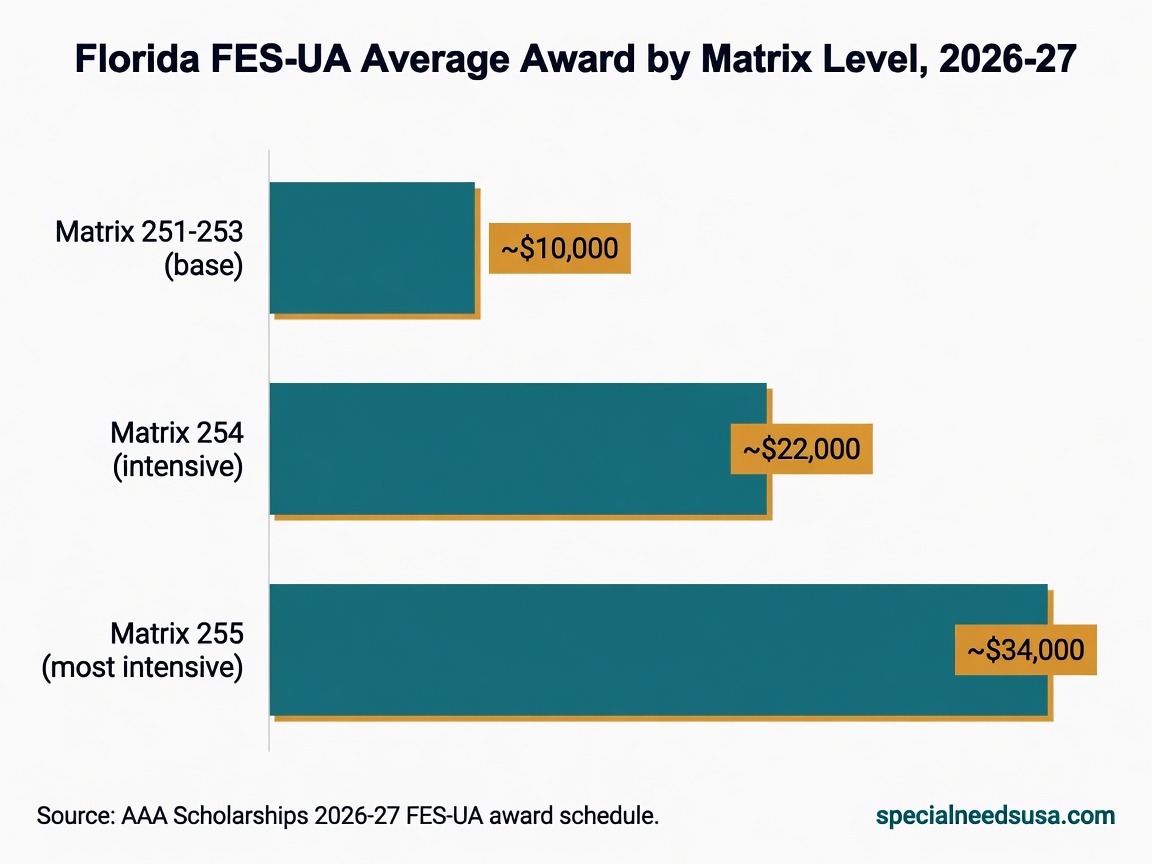
Cost Factors 251–253
Assigned automatically for private medical diagnoses (e.g. ADHD, mild ASD, speech delay). Covers standard private school tuition or mixed homeschool curriculum and weekly outpatient therapies.
Cost Factor 254 (Level 4)
Requires a public district Matrix evaluation. Covers extensive behavioral support plans, frequent therapeutic intervention, and specialized private day academies.
Cost Factor 255 (Level 5)
Highest state allocation tier. Requires documented round-the-clock 1:1 adult supervision, severe medical or behavioral management protocols, or non-ambulatory clinical care.
2026-27 Statewide Award Ranges by Cost Factor
| Matrix Level | Grade Band | Typical County Range | Qualifying Support Profile |
|---|---|---|---|
| 251–253 (Base) | K–3 | ~$10,400 – $14,300 | Standard classroom accommodations, outpatient therapy |
| 251–253 (Base) | Grades 4–8 | ~$9,800 – $13,700 | Resource room support, speech/OT accommodations |
| 251–253 (Base) | Grades 9–12 | ~$9,600 – $13,500 | Vocational support, specialized testing accommodations |
| 254 (Level 4) | All Grades | ~$20,500 – $24,800 | Extensive behavioral intervention, continuous staff support |
| 255 (Level 5) | All Grades | ~$31,200 – $36,900 | Pervasive 1:1 supervision, complex medical/nursing protocols |
Statewide figures compiled from AAA Scholarship Foundation and Step Up For Students 2026-27 county award schedules.
FES-UA vs. PEP: What Every Family Needs to Know
A common source of confusion and denied reimbursement claims in Florida is mixing up the Personalized Education Program (PEP) and the Family Empowerment Scholarship for Unique Abilities (FES-UA). While both are administered through Step Up For Students via Education Management Accounts (EMA), their funding purposes and allowable expenses differ fundamentally:
Requires a qualifying clinical diagnosis or IEP. Awards scale with need (Matrix 251–255: $10,000 to $34,000+).
Eligible: Specialized therapies (ABA, SLP, OT, PT), licensed paraprofessionals/aides, sensory equipment, assistive technology, specialized adaptive curriculum, and private school tuition.
For homeschool students without requiring a disability classification. Flat universal award (~$8,000).
Eligible: Standard curriculum, instructional materials, textbooks, standard tutoring, and testing fees. Cannot pay for clinical therapies, specialized aides, or clinical sensory equipment.
Critical Warning: Submitting clinical therapy or specialized sensory equipment on a PEP account will be denied. Conversely, attempting to purchase non-therapeutic consumer entertainment or electronics on an FES-UA account without medical/IEP correlation will trigger an audit rejection.
Do Families "Waive" All Rights Under IDEA When Using FES-UA?
A common misconception in parent forums is that accepting FES-UA means "waiving all civil rights." The legal reality under Fla. Stat. § 1002.394 and IDEA 34 CFR §§ 300.130–300.144 is more nuanced:
- FAPE in Private Settings: By choosing private school placement or home education with FES-UA, parents decline an individual statutory entitlement to a Free Appropriate Public Education (FAPE) provided by the public school district. The district is not obligated to fund or enforce an IEP outside public schools.
- Retained District Child Find: The local school district still retains a federal Child Find obligation to evaluate or re-evaluate your child for suspected disabilities at no cost.
- Equitable Services: School districts must allocate a proportionate share of federal IDEA funds to provide limited "Equitable Services" (via a Services Plan) to parentally-placed private school students.
- Civil Rights Protections: Private schools receiving federal assistance remain subject to Section 504 non-discrimination rules, and facilities open to the public must comply with Title III of the Americans with Disabilities Act (ADA).
How Families Unlock Matrix 254 or 255
Private doctors and psychologists cannot generate a Florida Matrix of Services document. When parents apply using only a private diagnostic report, Step Up automatically assigns the base 251-253 tier, leaving substantial funds on the table for children with high clinical needs.
The Matrix Upgrade Pathway:
1. Request District Evaluation
Contact your county school district ESE office or FDLRS center under IDEA Child Find mandates to request a formal evaluation.
2. Complete Matrix Scoring
The district Child Study Team evaluates 5 domains (Curriculum, Social/Emotional, Independent Function, Health, Communication) to complete the matrix form.
3. Submit to SFO for Recalculation
Upload the completed district matrix form showing Level 4 or 5 directly into EMA to update your annual scholarship award.
Federal law entitles parentally placed private school students and homeschoolers to district Child Find evaluations at no cost.
How to Apply: Portal Onboarding & Escalation Workflows
Florida operates through two approved Scholarship Funding Organizations (SFOs): Step Up For Students and AAA Scholarship Foundation. Step Up manages the overwhelming majority of FES-UA accounts through its online Education Market Assistant (EMA) portal.
1. Create Your Parent Profile in EMA
Visit Step Up For Students (stepupforstudents.org) or AAA Scholarships (aaascholarships.org). Set up your parent profile using a permanent personal email address. Applications are processed on a rolling basis.
2. Upload Mandatory Proof of Residency, Age & Diagnosis
Prepare clear PDF scans matching state audit criteria:
- Residency: Utility bill (electric, gas, water) or active residential lease in the parent or guardian's legal name.
- Age: Birth certificate or passport (waived for first-time applicants aged 6 on September 1 with school records).
- Clinical Eligibility: Existing public school IEP or an official diagnosis signed by an authorized physician, psychologist, APRN, or PA.
3. Track Verification & Accept Award Within 30 Days
Initial review takes 3 to 6 weeks, though peak August-September submissions often experience backlogs of 60 days. Once approved, you must log into EMA and formally accept the scholarship within the designated window to prevent forfeiture.
Visual Roadmap: Resolving a Dual-Enrollment Cross-Check Hold
Step Up automated FTE sweeps frequently freeze accounts of students withdrawing from public or charter schools. Follow this verified administrative path to clear the freeze:
District Lag
Student formally withdraws from public/charter school, but the district student database lags in updating state FTE records.
Account Freeze
Step Up runs its monthly automated FTE cross-check. Active enrollment flag triggers an immediate scholarship freeze without notice.
Direct ESE Contact
Bypass standard EMA tickets. Call your county school district ESE Director or school registrar directly.
Letterhead Release
Obtain an official letter on district letterhead confirming the exact withdrawal date. Step Up's July 22 policy clears the hold upon upload.
What Can You Buy with FES-UA Funds?
FES-UA operates under strict statutory purchasing guidelines developed by the Florida Center for Students with Unique Abilities. Families can authorize payments directly to registered providers or submit out-of-pocket receipts for reimbursement.
- Eligible private school tuition and registration fees
- State-approved homeschool curriculum and textbook packages
- Digital learning programs and educational software
- Part-time tutoring from Florida-certified educators
- Choice Navigator guidance services
- Applied Behavior Analysis (ABA) by licensed BCBAs
- Speech-language pathology and oral motor therapy
- Occupational therapy and sensory integration
- Physical therapy and mobility training
- Listening and spoken language specialist sessions
- Nationally norm-referenced standardized exams
- Diagnostic and psychological evaluations
- Assistive technology and AAC communication devices
- Sensory integration tools and adapted seating
- Sports supplies and seasonal athletic gear rentals
- Dual enrollment courses at Florida state colleges
- Career training and vocational certification programs
- Stanley G. Tate Florida Prepaid College plans (Direct Pay)
- Florida 529 savings contributions via EMA direct transfer
- Industry credential examination fees
Using FES-UA for ABA Clinical Therapy
Under Florida regulations, Applied Behavior Analysis (ABA) providers must be Board Certified Behavior Analysts (BCBAs) licensed in Florida. Many families direct FES-UA funds to cover behavioral therapy hours not authorized by private commercial insurance. If you are comparing local clinics, review provider profiles across South Florida:
Prohibited Expenses Under Florida Purchasing Rules
Purchasing rules updated for the 2026-27 school year explicitly prohibit the following items:
Important: Appendix B requires pre-authorization for specialized sensory items or non-standard equipment exceeding routine classroom supply thresholds.
Florida School Choice Matrix: Comparing State Programs
Florida offers multiple state scholarships. This visual comparison clarifies key differences between disability-based funding and general school choice options.
| Program | Eligibility | 2026-27 Award | ABA/Therapy | Homeschool Use | ESA Balance Rollover |
|---|---|---|---|---|---|
| FES-UA (Unique Abilities) | Documented disability (ages 3–22) | $10,000 – $34,000 | Yes (BCBA, SLP, OT) | Yes (F.S. 1002.41) | Yes (Annual roll) |
| PEP (Personalized Education) | Homeschool/independent students | ~$8,200 | No clinical care | Primary focus | Yes |
| FTC / FES-EO | All Florida K–12 students | ~$8,200 | No | Private school only | Direct to school |
| Hope Scholarship | Bullying/harassment incidents | ~$8,200 | No | Transfer only | No |
2026-27 Payment Schedule & Key Deadlines
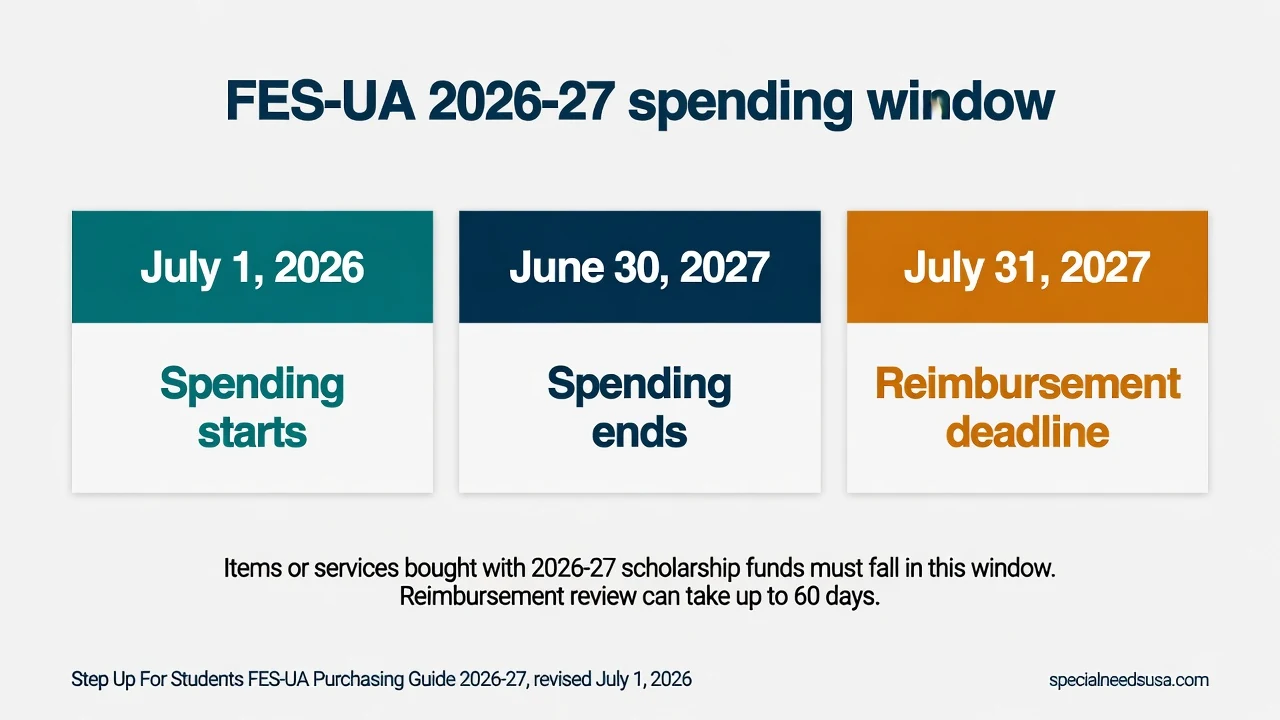
FES-UA scholarship funds disburse quarterly. For funds to release on schedule, families must satisfy both the enrollment verification cutoff and the mandatory quarterly public school attestation.
| Distribution Quarter | Public School Attestation Due | Anticipated Fund Release | Reimbursement Cycle |
|---|---|---|---|
| Quarter 1 (Fall) | July 31, 2026 | September 2026 | Opens July 1, 2026 |
| Quarter 2 (Winter) | November 15, 2026 | November / December 2026 | Active submissions |
| Quarter 3 (Spring) | February 15, 2027 | February / March 2027 | Active submissions |
| Quarter 4 (Summer) | April 15, 2027 | April / May 2027 | Closes July 31, 2027 |
Find FES-UA Approved Schools in Florida
Connect with verified special education schools and therapeutic day academies in Florida accepting FES-UA direct billing.
Miami-Dade County
Specialized autism schools, bilingual ESE classrooms, and clinical therapy academies across Miami.
Broward County
Sensory-adapted private schools and inclusive therapeutic campuses in Fort Lauderdale, Davie, and Sunrise.
Orange & Central Florida
Neurodevelopmental day programs, learning disability centers, and behavioral schools in Orlando.
Hillsborough & Tampa Bay
Independent special education academies and speech-focused private schools in Tampa and St. Petersburg.
Palm Beach County
Comprehensive developmental school programs and transitional academies in West Palm Beach and Boca Raton.
Duval & Northeast Florida
Private special education centers and autism learning institutes in Jacksonville.
Our free concierge matches families with verified schools and clinical providers. We do not administer state scholarship accounts.
Official Florida State & SFO Sources
Regulatory rules, statute citations, and payment schedules reflect official releases from the Florida Department of Education and Step Up For Students.
- Step Up For Students: FES-UA Family Handbook (2026-27 Operating Rules) →
- Step Up For Students: Purchasing Guides & Summary of Changes (Updated Aug 2026) →
- Florida Statute 1002.394 (Family Empowerment Scholarship Program) →
- Florida Department of Education: Office of Independent Education and Parental Choice →
- AAA Scholarship Foundation: 2026-27 Florida FES-UA Award Schedule →
- Florida Diagnostic & Learning Resources System (FDLRS Child Find) →
Frequently Asked Questions
Direct answers regarding Florida FES-UA eligibility, funding mechanics, and portal guidelines.
Frequently Asked Questions
Common questions about this guide
What is the FES-UA scholarship and how does funding work?
FES-UA is Florida's state-funded special needs education savings account established under Section 1002.394, Florida Statutes. Rather than sending state FEFP dollars to your local county school board, the Florida Department of Education deposits the child's per-pupil allocation into a restricted account administered by Step Up For Students or AAA Scholarship Foundation. Parents draw against that balance inside the EMA portal to pay participating private school tuition, hire Florida-licensed BCBA behavior analysts, pay certified tutors, or buy curriculum.
How much money does FES-UA provide per student?
Scholarship amounts are calculated directly from Florida's FEFP matrix formula. Base awards for Cost Factors 251 to 253 average $9,600 to $10,400 depending on county and grade. For children documented with extensive or pervasive support needs, Matrix Level 4 (Cost Factor 254) jumps to roughly $22,000, while Matrix Level 5 (Cost Factor 255) averages $34,000 to $36,000 per school year.
How do I get a Matrix 254 or 255 score for a higher award?
A private medical diagnosis form defaults your child to the base 251-253 tier (~$10k). Private doctors cannot legally complete a Florida Matrix of Services form. To unlock Cost Factor 254 or 255, you must contact your local Florida school district ESE office or FDLRS Child Find specialist and request a formal matrix evaluation under IDEA rules, even if your child will attend private school or homeschool.
Why was my scholarship account frozen with a cross-check hold?
When a student withdraws from a public or charter school, district databases often take weeks to report the change to Tallahassee. During Step Up's monthly state FTE cross-checks, any lingering enrollment code flags the student as dually enrolled and freezes the scholarship account. To release the hold, ask your school district ESE Director or school registrar for an official letter on district letterhead confirming the exact withdrawal date and verifying non-enrollment. Step Up officially accepts this documentation to restore funding.
What is the mandatory quarterly public school attestation?
Starting in the 2026-27 school year, parents must complete an attestation in the EMA portal before each quarterly distribution confirming the student is not enrolled full-time in public school. Deadlines are July 31 for Q1, November 15 for Q2, February 15 for Q3, and April 15 for Q4. Missing an attestation deadline halts funding for that quarter and returns the funds to the state treasury.
Can FES-UA funds pay for ABA, speech, or occupational therapy?
Yes. FES-UA funds can cover Applied Behavior Analysis (ABA), speech-language pathology, occupational therapy, and physical therapy from Florida-licensed providers. For ABA, the clinician must be a Board Certified Behavior Analyst (BCBA) licensed in Florida. Parents can pay clinics directly through the EMA marketplace or submit reimbursement claims.
What is the deadline for 2025-26 school year reimbursements?
Reimbursements for the 2025-26 academic year close permanently on October 31, 2026. Any reimbursement request from that school year submitted after October 31 will be denied and cannot be appealed.
What happens if my reimbursement request is denied in EMA?
EMA portal policy allows only one appeal for a denied reimbursement request. If your claim is denied due to an incomplete invoice, missing proof of payment, or lack of prior approval, you must provide all required documentation with your single appeal. If the appeal is rejected, the denial is final.
Can I use FES-UA for the Florida Prepaid College Program?
Yes, but with an important operational change: as of June 30, 2026, Florida Prepaid (Stanley G. Tate 529 plan) contributions must be handled via Direct Pay through EMA. Step Up no longer reimburses parents for out-of-pocket Florida Prepaid payments.
Who is legally allowed to document a diagnosis for FES-UA?
Diagnoses can be documented by a Florida-licensed physician (MD or DO), licensed psychologist, autonomous Advanced Practice Registered Nurse (APRN), or a Florida-licensed Physician Assistant (PA) acting under a supervising physician. Diagnosis paperwork signed by an authorized PA is now accepted.
Can homeschoolers use FES-UA without enrolling in private school?
Yes. Families registered with their school district as a home education program under Florida Statute 1002.41 can use FES-UA funds for curriculum, online instructional programs, tutoring, and therapies. You do not need to enroll in a private school to access the scholarship.
What expenses are strictly prohibited under FES-UA?
FES-UA cannot be used for general food or meals, transportation and gas, non-educational childcare, smart/augmented reality glasses, concerts, meet-and-greet events, pet supplies, theme park VIP upgrades, or toy weapons. Refer to the Step Up Purchasing Guide before purchasing questionable items.
Does using FES-UA waive my child's IDEA and FAPE rights?
Yes. Placing a student in a private school or home education setting with FES-UA means you decline an individual entitlement to a Free Appropriate Public Education (FAPE) and the procedural protections of an IEP under IDEA. School districts retain Child Find duties to evaluate students, but they are not obligated to provide specialized services outside public placement.
Explore Florida Special Needs Programs
Whether you need an accredited private school, specialized ABA clinic, or home education support, our team connects Florida parents with verified providers matching your child's clinical needs.
Free, independent matching service. No obligation.