


This week's headlines called the new CMS document a "federal crackdown on autism therapy." If you have a child in ABA, you then had to hunt for a sentence about your kid's hours, because almost every article was written for clinic owners, state officials, or people arguing about government spending.
The parent question is whether this document ends ABA for kids on Medicaid, and it does not. On August 4, 2026, CMS released the 173-page State Medicaid and CHIP Applied Behavior Analysis Toolkit. The toolkit is guidance for states, with no effective date printed in it, and it does not cancel an existing authorization. Each state still decides what to adopt.
A handful of positions deeper in the document will change how some clinics schedule, bill, and justify your child's hours, probably within the next year. Those are the parts to understand before the next reauthorization, while you can still ask questions.
Get matched with schools and therapy providers
Tell us your child's needs and location, and we'll match you with special-needs schools, ABA therapy centers, or speech-therapy providers in your area. Free for families.
Free for families.
What CMS says the toolkit leaves in place
CMS put the limits of the toolkit in its August 4 announcement:
"This toolkit is not a restriction on autism services. It does not establish new federal requirements; reduce Early and Periodic Screening, Diagnostic, and Treatment (EPSDT) obligations; endorse any single treatment approach to ABA; or direct states to limit access to medically necessary care."
EPSDT is the federal Medicaid provision that entitles children under 21 to any medically necessary service that treats or improves a condition found during screening. There is no dollar cap and no hour cap, and a state cannot invent one.
ABA is not named in the underlying statute. The individual services delivered inside an ABA plan are coverable under other categories, and when those services are medically necessary, a state must cover them for an EPSDT-eligible child "even if the state does not choose to offer ABA as a distinct, named benefit."
On who qualifies for a comprehensive plan rather than a narrow one, the toolkit says decisions "should not be restricted by an individual's age, co-occurring conditions, ASD diagnosis, or cognitive level." If a clinic or health plan has ever told you your child is too old, too complex, or too impaired for a full program, that sentence is now in a federal document.
Why CMS published this now
Between 2021 and 2025, Medicaid and CHIP spending on ABA rose 421%, from roughly $1.94 billion to $10.1 billion. Over the same period, the number of children with an autism diagnosis receiving services grew 67%.

Part of that jump is ordinary growth. More children were diagnosed, more providers enrolled, and ABA coverage is now available in all 50 states. Average weekly hours reached 17.33 in 2025, a 22% increase since 2021. We covered the money side of this story in more detail in our look at who profits when ABA billing surges.
Federal auditors have also flagged improper ABA-related payments. In Maine, a January 2026 HHS Office of Inspector General audit found $45.6 million in improper payments in a single year, with problems in all 100 sampled cases. Similar audits have landed in Colorado and Wisconsin.
An audit of clinic billing is a separate question from whether your child's hours were clinically appropriate. CMS is chasing those billing problems with documentation rules, so families are more likely to feel this as extra questions at reauthorization.
The 40-hour line
One sentence in the toolkit is going to come up at authorization reviews:
"Forty hours of ABA per week is not a best practice."
CMS's stated reason is that children "must be allowed time for activities of daily living such as toileting, napping, and eating." The toolkit also warns that 40-hour plans expose states and health plans to audit findings.
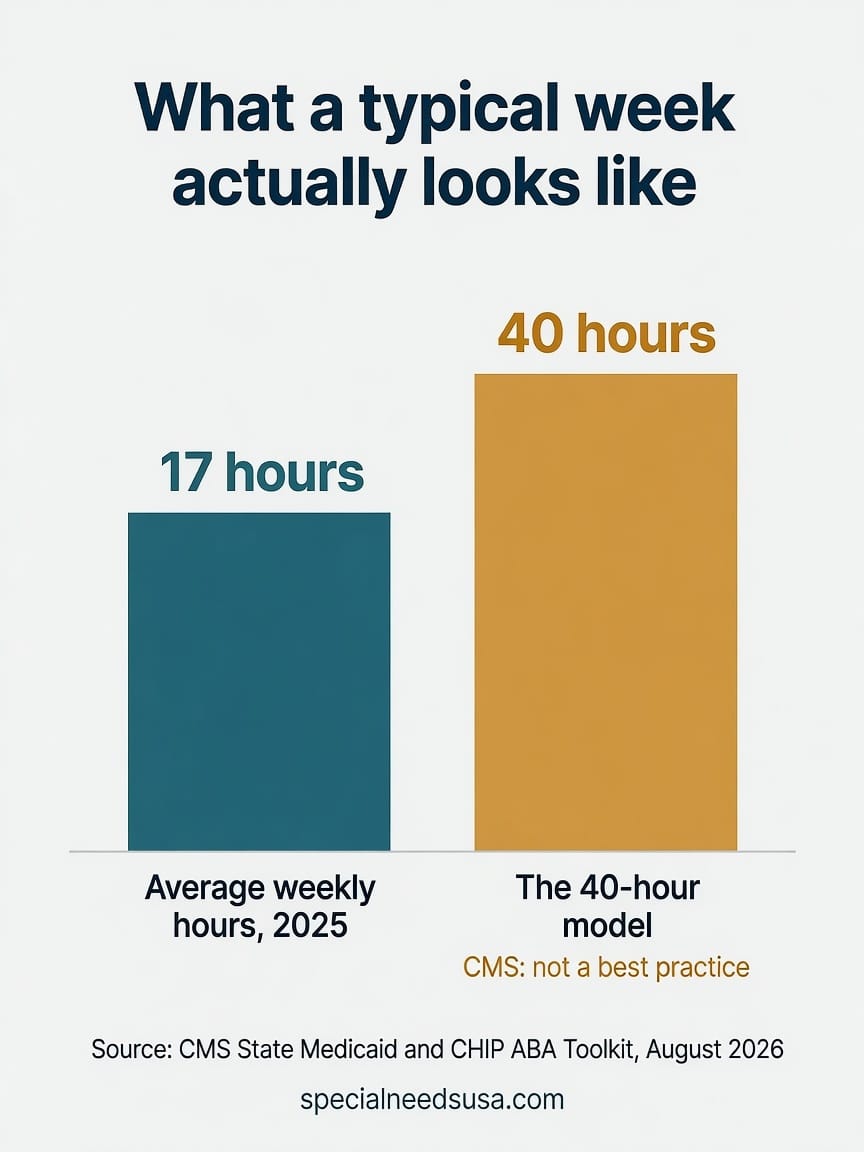
The toolkit still describes appropriate intensity as a range, from about five hours a week to 40, and says the number must follow the individual child. It asks states to prohibit long stretches of consecutive billing units without a break, and to stop letting clinics bundle all their 15-minute units onto a single claim line, because bundling makes it impossible to show a child ever stopped for lunch.
If your child is currently authorized for 30 or more hours a week, expect that number to get more scrutiny at your next reauthorization. The hours can still stand when the clinical justification in the file is specific to your child. CMS guidance specifically directs state Medicaid reviewers to scrutinize authorizations that lack documented titration or fading schedules demonstrating progress toward stepping down clinical hours.
Telehealth is likely to change first
Telehealth ABA grew into a roughly $300 million line item by 2025, and this is where the toolkit is most specific:
"States should treat telehealth as a limited adjunct to, not a substitute for, in-person ABA."
Over video, the toolkit still supports caregiver coaching and training, data review, some supervisory contact that includes direct observation, and connecting kids with peers for social skills work.
It discourages establishing an autism diagnosis, completing the initial comprehensive assessment or care plan, intensive daily treatment blocks, group services, and routine supervision of technicians. Direct therapy delivered over telehealth by a Registered Behavior Technician should be permitted less consistently, CMS says, because of treatment fidelity concerns.
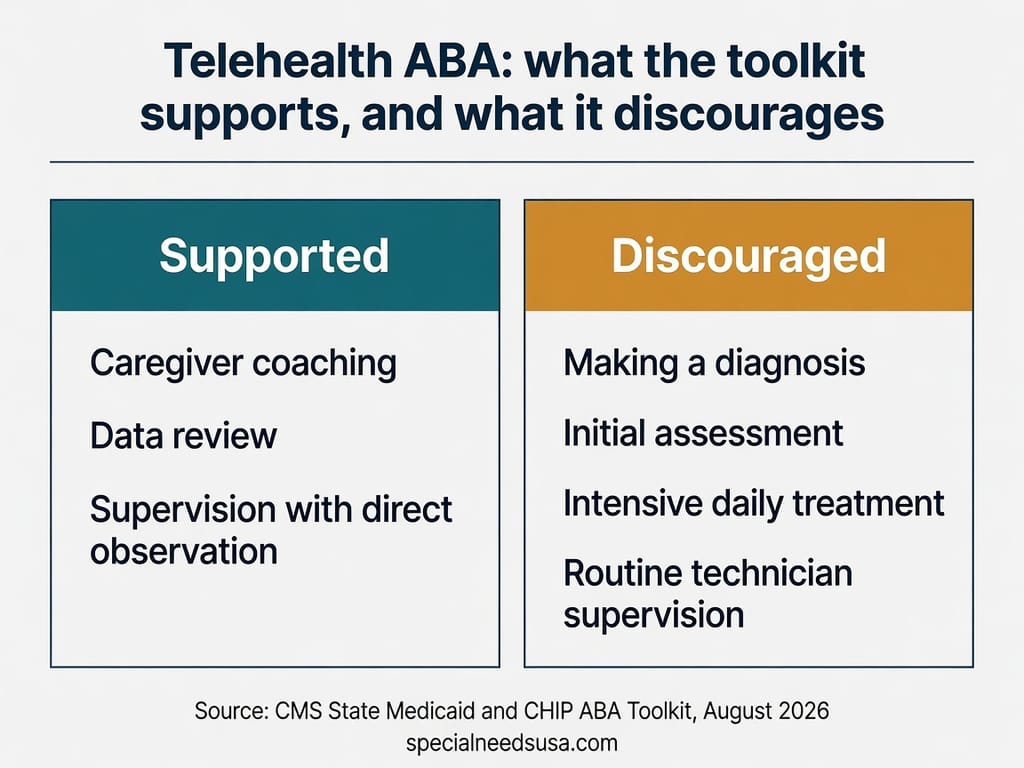
If a meaningful part of your child's week is virtual, ask your provider how those hours map to the uses CMS still supports, and what the clinic would do if your state narrows telehealth. Some states will move on this quickly.
Hour thresholds and the exception path
Virginia and Nebraska already run versions of the review model the toolkit is pushing other states toward. Above 20 hours a week, Virginia wants the clinic to describe each activity, tie it to a treatment goal, and explain the therapeutic function of the requested time. A general schedule will not get that request through. Virginia has also written the toolkit's diagnosis position into its 2026 budget: the toolkit tells states to tie sustained ABA coverage to a confirmed autism diagnosis, and Virginia's Appropriation Act directs its Medicaid agency to require an autism diagnosis before authorizing ABA, with a one-year provisional diagnosis allowed for children age 5 and younger. Per a DMAS provider bulletin, that rule waits on CMS approval.
Nebraska sets a 6-hour daily and 30-hour weekly limit on direct ABA, then allows providers to request more when it is medically necessary.
That exception path is the whole ballgame. Under EPSDT, a state can use a number as a review trigger. If your state adopts an hour threshold and your child needs more, the request has to be reviewable on medical necessity, and a denial has to be appealable. Watch for any state policy that sets a limit without publishing how to exceed it. Families who have been through this in states that cut rates first will recognize the pattern, and our guide to protecting your child's therapy hours walks through the appeal steps in detail.
Supervision percentages
The toolkit separates two numbers that often get mixed together. A Registered Behavior Technician must receive supervision equal to at least 5% of their service hours, which is the certification floor. Clinical practice guidelines recommend 10% to 20%, or roughly one to two hours of BCBA supervision for every ten hours of direct treatment.
Plenty of programs run near the 5% floor. Ask for the percentage of your child's direct hours, because the answer tells you how closely a BCBA is watching the program. Use it when you are comparing clinics, alongside the cost questions in our 2026 guide to what ABA therapy costs.
Caregiver participation
The toolkit suggests states consider requiring extra documentation when the share of sessions involving a parent or caregiver drops below a set percentage. Texas already expects caregiver participation as a normal part of effective ABA, with case-by-case exceptions.
For working parents, single parents, and families with several kids, a participation rule can create a problem that has nothing to do with your child's clinical need. If your state ties continued authorization to caregiver training hours, find out early what counts and what accommodations exist. The toolkit tells states to build in flexibility, including short sessions at drop-off or pick-up, and to account for foster and kinship placements where caregiver availability is outside anyone's control.
September 2026: CMS also put ABA in its oversight spotlight
On its Medicaid High-Risk Services Spotlight, CMS says ABA can improve outcomes, especially at younger ages, but should not be viewed as the only appropriate treatment for autism spectrum disorder. That is an agency oversight statement, not a finding that your child's care is improper. CMS also said its August toolkit creates no new federal requirements and does not reduce children's EPSDT protections. Ask your child's clinician how treatment goals and intensity fit their needs and other supports.
What to do before the next reauthorization
Ask your provider when your current authorization expires. The next reauthorization is where any of this shows up.
Ask what share of your child's hours are delivered by telehealth, and whether the clinic has a plan if your state narrows it.
Ask to see your child's treatment plan and confirm the hours are justified for this child. If the plan reads like a template, raise it now rather than after a denial.
Ask how much BCBA supervision your child's program actually receives, as a percentage of direct hours.
Keep your own file of evaluations, treatment plans, progress data, authorization letters, and denials. Every family who has ever won an appeal had paperwork.
Ask your BCBA about the clinical fading or titration plan. CMS's August 2026 guidance stresses that comprehensive programs should define clear milestones for stepping down intensity and transitioning skills into school and community environments, rather than assuming 30 to 40 weekly hours continue indefinitely without an exit path.
If you do receive a reduction or denial, it is appealable. EPSDT does not go away because a state changed its paperwork.
What we do not know yet
We do not know which states will act, or how fast, because guidance carries no deadline. We do not know whether tighter documentation will slow access in states that already have BCBA shortages and long waitlists, and nobody has modeled it. We also do not know how managed care plans, which cover most children on Medicaid, will translate any of this into their own utilization rules, which is where families usually feel policy first. We will update this piece as states publish changes.
Finding a provider
If you are looking for a new clinic, or a second opinion on your child's current hours, you can browse ABA and therapy providers by state in our directory, or start with choosing an autism therapy center.
This article explains federal guidance. It is not legal or medical advice, and it cannot tell you what your specific plan will approve. For questions about your child's authorization or an appeal, talk to your provider, your state Medicaid agency, or a special education attorney or advocate.
Find schools and therapy providers for your child
Tell us your child's needs and location, and we'll match you with special-needs schools, ABA therapy centers, or speech-therapy providers in your area. Free for families.
