


If your child gets ABA therapy through Medicaid, you may have already felt it: a longer waitlist, a delayed authorization, a clinic that suddenly stopped taking new clients, or a letter from your provider about changes to their hours. You are not imagining it.
Facing budget shortfalls and close to $1 trillion in looming federal Medicaid cuts, states across the country are moving to rein in spending on Applied Behavior Analysis (ABA), the most common therapy for autistic children. For state budget officials this is a line item that has grown fast. For your family it is the difference between steady progress and a sudden gap in care.
Families are not powerless here. In the states where the cuts have gone furthest, organized parents have paused them, reversed them, and forced changes. This guide covers what is happening in 2026, why it is happening, what your rights are, and the concrete steps that have helped other families protect their child's hours.
Get matched with schools and therapy providers
Tell us your child's needs and location, and we'll match you with special-needs schools, ABA therapy centers, or speech-therapy providers in your area. Free for families.
Free for families.
Why states are cutting ABA right now
Two things are colliding.
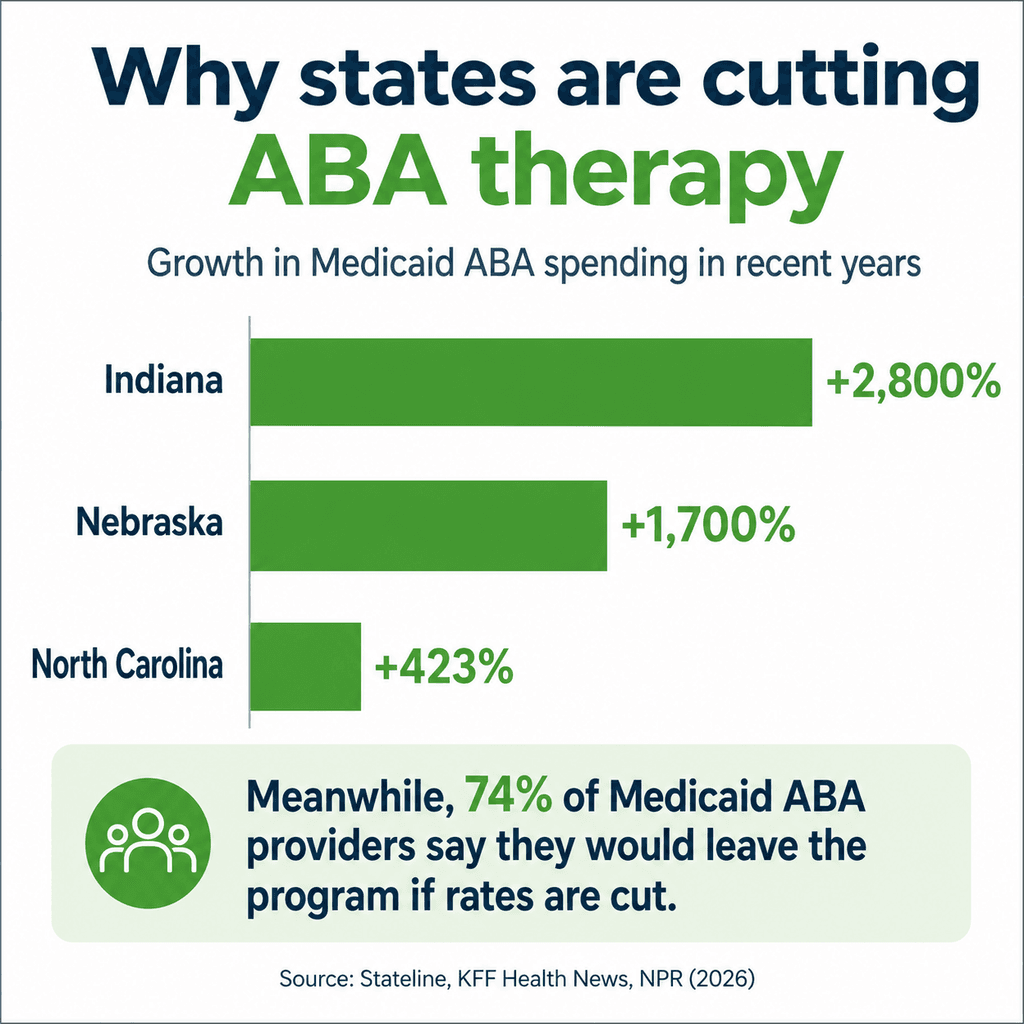
The first is cost. Medicaid spending on ABA has risen dramatically in a short window. In North Carolina, payments went from about $122 million in 2022 to a projected $639 million in 2026, a 423 percent increase. Nebraska saw spending jump roughly 1,700 percent, and Indiana's rose around 2,800 percent, per Stateline. Some of that growth reflects more children getting diagnosed and finally getting access to care, which is a good thing. Some of it reflects oversight and billing problems that states are now trying to address.
The second is the federal budget picture. With large federal Medicaid reductions on the horizon, states are looking hard at optional services. ABA for children is delivered through Medicaid, and when budgets tighten, behavioral services are often among the first places states look to trim, per NPR.
The result is a wave of state-level changes that look different from place to place but add up to the same pressure on families.
What is happening, state by state
North Carolina attempted a 10 percent cut to ABA provider payments, then reversed course after legal and public pressure (more on that below). The state is now proposing tighter ABA rules, including restrictions on telehealth and new accountability standards, per KFF Health News.
Nebraska cut payments by nearly 50 percent for some ABA providers.
New York moved to a 25 percent Medicaid ABA rate reduction for 2026, paired with a Centers of Excellence model, per Acuity. A third cut takes effect October 1, 2026: direct ABA (CPT 97153) drops 33 percent, from $14.45 to $9.63 per billing unit, about $38.52 an hour, after 12.5 percent cuts on October 1, 2025, and April 1, 2026, per Behavioral Health Business. That makes New York's rate the lowest in the nation, below West Virginia's $9.90.
Vermont stopped allowing providers to bill for a BCBA and a behavior technician at the same time, effective January 1, 2026.
Colorado and Indiana have reductions on the table.
This reaches your family even if your hours have not changed yet. In a joint survey, 74 percent of responding Medicaid ABA providers said they would leave the program if rate cuts went through. When providers exit Medicaid, the families who remain face longer waitlists, fewer in-network options, and more travel to reach care. Providers in affected regions are already reporting longer waitlists, slower authorizations, and heavier paperwork, all of which can disrupt the continuity that makes ABA effective.
Families have changed the outcome
It is easy to read this news and feel that the decision has already been made for you. It has not.
In North Carolina, 21 children sued through their parents and guardians. In November 2025 a judge granted a preliminary injunction, and in early December the governor canceled the cuts, citing the families' lawsuits. The families did not stop there. They have kept the case alive into 2026, because without a lasting ruling the state could try again. As their attorneys put it in a court filing, without the case the state could once again seek to impose devastating reductions.
There are quieter wins too. North Carolina reporting describes one mother whose persistence, calling person after person in the state Medicaid system, made the case for her daughter's care. Your child's story is evidence, and the steps below show how to use it.
Know your rights: EPSDT in plain language
For children enrolled in Medicaid who are under 21, there is a federal benefit called EPSDT (Early and Periodic Screening, Diagnostic, and Treatment). Under EPSDT, states are generally required to cover services that are medically necessary to treat a child's condition, even services the state lists as optional for adults. ABA is often delivered through this pathway.
What that means in practice:
A blanket state budget cut does not erase a child's individual right to medically necessary care.
Strong, current documentation of medical necessity is your most powerful tool.
If your child's medically necessary hours are reduced or denied, you generally have the right to appeal, and in many states the right to keep current services while the appeal is pending.
EPSDT rules and timelines vary by state, so confirm the specifics with your Medicaid plan. But knowing the benefit exists changes the conversation from the state cut the budget to my child has a documented, medically necessary need.
6 steps to protect your child's hours right now
1. Confirm the right Medicaid pathway. Ask your plan to verify your child is enrolled in the correct program and that ABA is authorized under the right benefit (often EPSDT for children under 21). A simple enrollment or coding issue can quietly cost you hours.
2. Get the medical-necessity paperwork airtight. Updated diagnostic evaluations, a current treatment plan, and recent progress notes are your strongest protection if authorizations tighten. Ask your provider for copies and keep your own organized file. Documentation that shows real progress is hard to argue with.
3. Know and use your appeal rights. If hours are reduced or denied, file the appeal, and ask whether your state lets you maintain current services during the process. Do not treat a reduction notice as the final word.
4. Line up a backup provider before you need one. If your current clinic is at risk of dropping Medicaid or shrinking, knowing who else nearby has open capacity protects your child from a gap in care.
5. Explore additional funding paths. Depending on your situation, private insurance, state Medicaid waivers, or other supplemental programs may help fill gaps. Many children are eligible for more than one source of support.
6. Speak up locally. Contacting state representatives and joining family advocacy groups has moved policy before. You do not need to be an expert, just a parent who can tell a clear story about what your child stands to lose.
What to do if you are still on a waitlist
Families who do not yet have a provider are squeezed hardest when cuts shrink the pool of clinics. A few things help:
Get on more than one waitlist, and ask each clinic how they prioritize EPSDT-eligible children.
Ask whether the provider offers in-home, center-based, or telehealth options, since flexibility can shorten your wait.
Keep your child's diagnostic paperwork ready to go, so you can start the moment a spot opens.
Use a matching service to widen your search beyond the two or three clinics you already know.
How Special Needs Care Network can help
You should not have to start from zero when a clinic closes its waitlist or stops taking your plan. Special Needs Care Network helps families find ABA providers near them that are currently accepting new clients, so a budget decision in your state capital does not have to mean months without therapy for your child. Tell us a little about your child and where you live, and we will help you find options in your area.
Frequently asked questions
Are ABA Medicaid cuts happening everywhere?
No. The changes are state by state. As of 2026, North Carolina, Nebraska, New York, and Vermont have made the most notable moves, with Colorado and Indiana considering reductions. West Virginia already paid the lowest ABA rate in the country before New York's latest cut, and fewer than half of its roughly 20 ABA centers accept Medicaid, per West Virginia Watch. Check your own state's Medicaid agency for the current rules where you live.
Can the state legally cut my child's therapy?
States can change provider payment rates and tighten oversight, but for Medicaid-enrolled children under 21, medically necessary services are generally protected under the federal EPSDT benefit. A budget cut does not automatically override an individual child's documented need. Confirm specifics with your plan and consider speaking with a special-education or disability-rights attorney if your child's hours are denied.
What should I do first if I get a notice that my child's hours are being reduced?
Do not panic, and do not ignore it. Request the reduction in writing, gather your child's current evaluations and progress notes, and file an appeal within your state's deadline. Ask whether you can keep current services during the appeal.
My provider just dropped Medicaid. Now what?
Ask for your child's complete records, get on waitlists with more than one new provider, and use a matching service to find clinics still accepting your plan. The faster you start the search, the shorter the gap in care.
This article is for general information and is not legal or medical advice. Coverage rules vary by state and change quickly. Confirm details with your Medicaid plan and your child's care team, and consult a qualified attorney for legal questions about your child's services.
Find schools and therapy providers for your child
Tell us your child's needs and location, and we'll match you with special-needs schools, ABA therapy centers, or speech-therapy providers in your area. Free for families.


