


Doctors recommend Applied Behavior Analysis (ABA) more often than any other autism therapy, and CDC autism counts have climbed, so more families are looking for it. Paying without insurance can run tens of thousands of dollars a year, and many families wait months for an evaluation and then wait again for a therapist. If you need a clinic with an opening, a directory and a free matching form are later on the page.
How common is autism in 2026?
The CDC Autism and Developmental Disabilities Monitoring Network reviewed 8-year-olds in 2022 and published the results in 2025. Autism met the case definition in 1 in 31 U.S. children that age (32.2 per 1,000). The same series was 1 in 36 in 2020 and 1 in 150 in 2000, the highest prevalence this network has recorded.
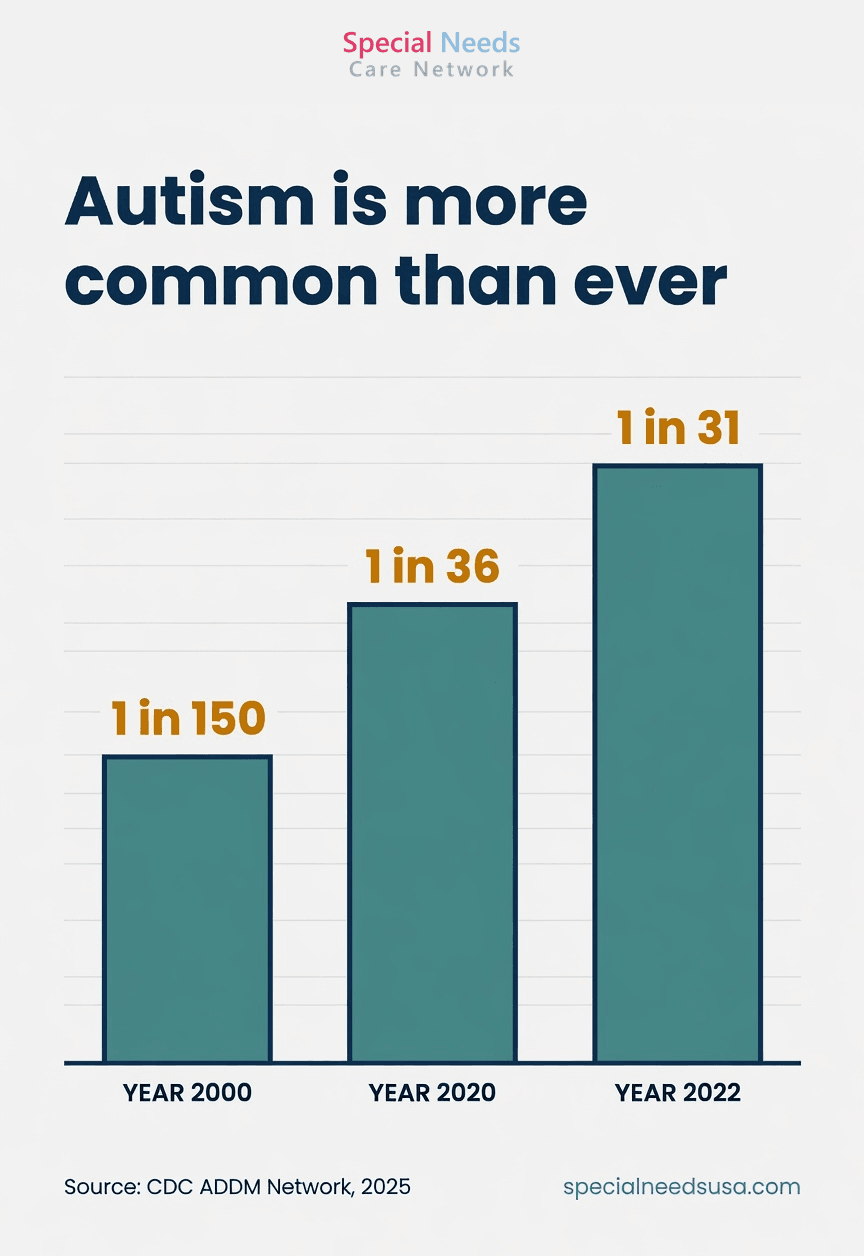
CDC ADDM counts for 8-year-olds, 2000 through 2022. Source: CDC.
Get matched with schools and therapy providers
Tell us your child's needs and location, and we'll match you with special-needs schools, ABA therapy centers, or speech-therapy providers in your area. Free for families.
Free for families.
The rate is not even from site to site, with about 1 child in 100 meeting the definition in parts of Texas and 1 in 19 in California. The CDC says a large share of that spread is about who can get diagnosed, because places with more clinics and specialists identify more children, and a lower local number can mean fewer people who can diagnose children there. See how autism rates compare by state in our data report.
How much does ABA therapy cost?
Without insurance, ABA therapy costs 120 to 250 dollars an hour, and 120 to 150 is the band families hear most often. Programs billed at that full rate, at 10 to 40 hours a week, add up to about 62,400 to 249,600 dollars a year. The ABA therapy cost parent guide covers copays, authorized hours, and what a bill looks like once insurance is involved.
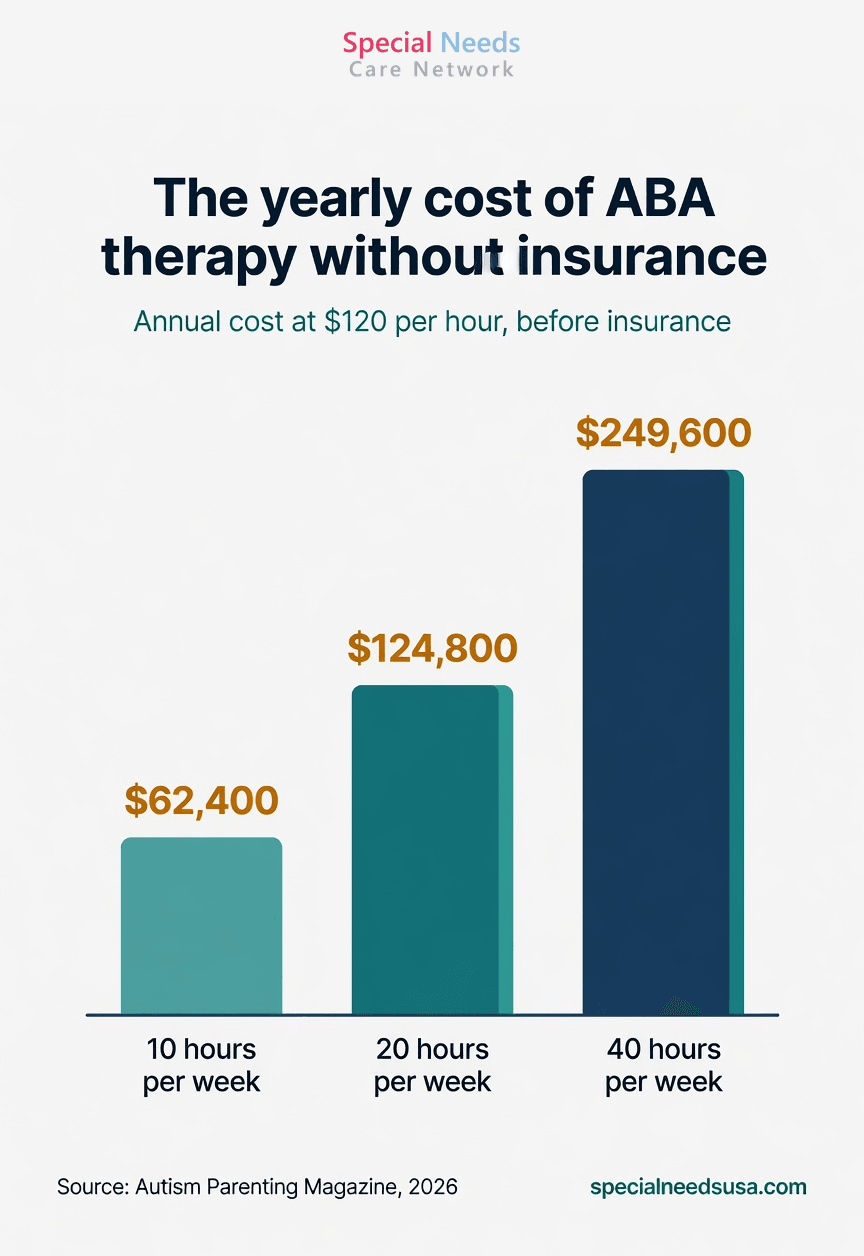
Annual totals at 120 dollars an hour, by weekly hours. Source: Autism Parenting Magazine.
10 hours a week: about 62,400 dollars a year
20 hours a week: about 124,800 dollars a year
40 hours a week: about 249,600 dollars a year
The CDC estimates raising a child with autism costs roughly 17,000 to 21,000 dollars more per year in care than raising a neurotypical child. Autism Parenting Magazine cites that CDC range in the same cost write-up used for the hourly table.
Does insurance cover ABA therapy?
Yes. All 50 states require private insurance to cover autism treatment, with ABA as the benchmark, and all 50 cover ABA through Medicaid for children who qualify. Under Medicaid's EPSDT rule (Early and Periodic Screening, Diagnostic, and Treatment), children under 21 are entitled to all medically necessary services, including ABA.
Hour caps and age limits still show up in plan documents, and families on Medicaid often wait longest because Medicaid pays providers less. Several states cut Medicaid reimbursement for ABA in 2026 after spending climbed sharply. North Carolina's ABA spending hit 505 million dollars in 2025, up from under 2 million just five years before. Families tracking federal Medicaid ABA guidance can read our parent explainer of the CMS ABA toolkit.
How long do families wait for ABA therapy?
Most families wait at two points, and nationally it takes 6 to 12 months to get an autism assessment, then 3 to 9 more months after diagnosis before ABA begins. A 2025 study in the Journal of Applied Behavior Analysis found that about 73 percent of families were placed on a waitlist, that the average wait was nearly six months, and that children's behavior often got worse the longer they waited.
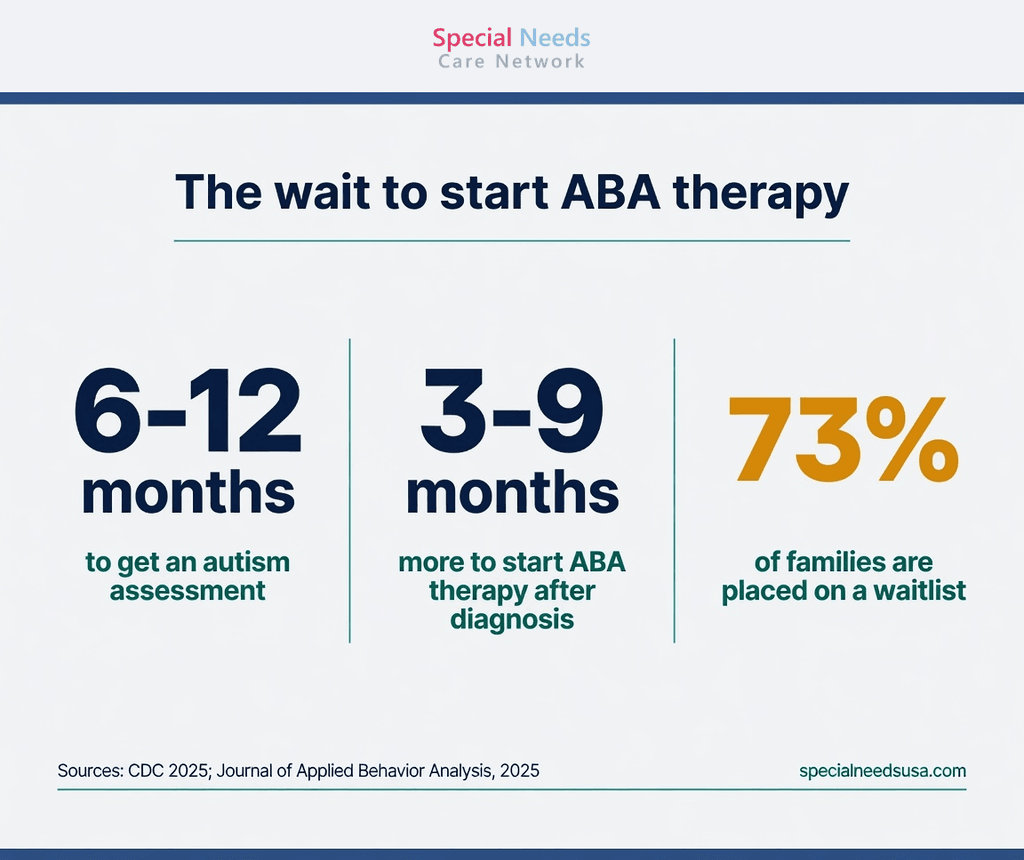
Assessment wait, ABA start wait, and share of families waitlisted. Sources: CDC; Journal of Applied Behavior Analysis.
Why is it so hard to find an ABA provider?
There are not enough board-certified behavior analysts for the caseload. Demand has risen every year since 2010 and grew 28 percent year over year, leaving an estimated 50,000 positions unfilled. Five states account for close to 40 percent of national demand, which leaves thinner pipelines in the rest of the country. Rural families drive farther for fewer specialists and sit on the longest waitlists.
Where can families get help finding ABA therapy?
Openings change by town and by week, so a lot of the work is finding a clinic that is taking new clients near you. Special Needs Care Network runs a free concierge matching service that connects families with autism and ABA providers using location, insurance, and what you say you need. You can also browse ABA providers by state in the directory and call clinics yourself about waitlists.
Frequently asked questions
What is ABA therapy?
Applied Behavior Analysis (ABA) is a therapy that teaches skills in communication, social interaction, and daily living, and that works on behaviors that get in the way of learning. A board-certified behavior analyst runs the program or supervises the staff who deliver it.
Is ABA therapy covered by insurance?
Every state requires private insurers to cover autism treatment, including ABA, and every state covers ABA through Medicaid for children who qualify. Hour caps, age rules, and prior-authorization steps still differ by state and by plan.
How much does ABA cost with insurance?
Insured families usually pay deductibles and copays instead of the full hourly rate, which can cut the annual bill by tens of thousands of dollars. What you pay depends on the plan and how many hours are authorized.
How can I find an ABA provider near me?
Search a directory, call clinics and ask how long the waitlist is, or use a free matching form. Special Needs Care Network matches families with providers who are taking new clients in their area.
Methodology and sources
Numbers on this page come from public documents dated 2022 through 2026, and cost ranges match independent 2026 write-ups that use the same hourly band. Special Needs Care Network did not include its own lead or waitlist data.
Autism prevalence and state variation: CDC ADDM Network, MMWR 2025
BCBA workforce demand: Behavior Analyst Certification Board and Lightcast, 2026
Waitlist rates and duration: Journal of Applied Behavior Analysis, 2025 and Therapprove, 2026
Insurance mandates and Medicaid EPSDT: Autism Speaks, NCSL, and Medicaid.gov
Cost of ABA therapy: Autism Parenting Magazine, 2026
2026 Medicaid rate cuts and spending: KFF Health News, 2025 and NC Health News, 2026
Rural access: Rural Health Information Hub
If you are looking for a clinic, start with the matching form or the therapy directory in the help section above.
Find schools and therapy providers for your child
Tell us your child's needs and location, and we'll match you with special-needs schools, ABA therapy centers, or speech-therapy providers in your area. Free for families.
