

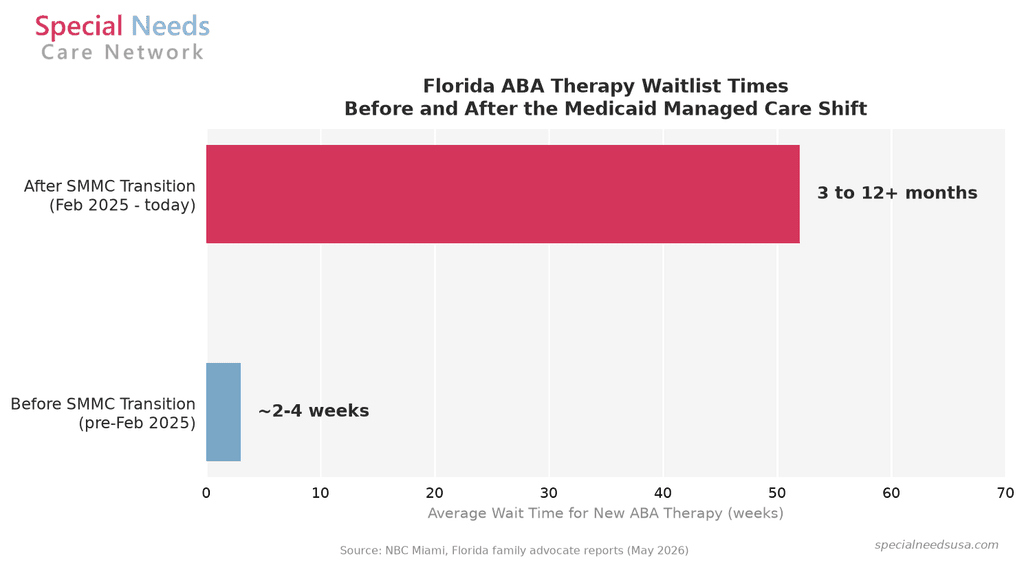
In February 2025, Florida made a change to how it pays for ABA therapy through Medicaid. Most families did not hear about it until they felt it. Clinics that had been accepting new clients suddenly stopped. Waitlists that had stretched two to four weeks grew to three months, then six, then a year or more. Providers who had spent years building caseloads quietly stopped taking Medicaid altogether.
The change was called the SMMC 3.0 transition, short for Statewide Medicaid Managed Care. Florida moved behavioral health services, including Applied Behavior Analysis, out of the old fee-for-service Medicaid system and into managed care plans run by private insurance companies. For state budget officials it was a cost-control mechanism. For families trying to get their autistic child into therapy, it was a wall.
Florida currently has around 668 ABA providers in the state, but the distribution of care has shifted considerably since the transition.
Get matched with schools and therapy providers
Tell us your child's needs and location, and we'll match you with special-needs schools, ABA therapy centers, or speech-therapy providers in your area. Free for families.
Free for families.
30-second overview
What the SMMC 3.0 transition actually changed
Before February 2025, an ABA provider in Florida could bill Medicaid directly for services at a published rate. Authorization paperwork existed but the relationship was relatively straightforward. After SMMC 3.0, providers had to contract separately with each managed care organization (MCO) operating in their region, negotiate rates with each plan, work through each plan's own prior authorization process, and absorb the administrative cost of tracking and appealing denials across multiple payers.
For large multi-site ABA companies with billing departments, this was painful but manageable. For smaller clinics and especially in-home providers, it was not. The reimbursement rates offered by many MCOs came in below what providers needed to cover staff and overhead. Dozens of clinics made the calculation that staying in Medicaid at those rates was not viable, and left the network.
The families left behind were not dropped from Medicaid. Their coverage was intact. The providers were simply gone.
What families are experiencing right now
NBC Miami and Florida family advocacy groups documented the change in the months following the transition. Families reported being told to expect waits of three to twelve months or more for an intake appointment. Some were told their previous provider had left Medicaid and they would need to find a new one, only to discover that the alternatives in their area had closed their waitlists too.
The hardest-hit families were those whose children had been in therapy for years. SMMC 3.0 did not disrupt active authorizations immediately in all cases, but as authorizations came up for renewal under the new managed care structure, families ran into delays, reduced hours, or paperwork requirements their provider could not keep up with. Children who had been making consistent progress experienced gaps in care that set them back.
In-home ABA therapy was particularly affected. Center-based providers had more resources to handle the administrative transition. In-home providers, many of them smaller operations serving families in suburbs and rural areas, had fewer options when rates dropped.
The national backdrop: why Florida is not an isolated case
Florida is an early and severe example of a problem building across the country. ABA therapy Medicaid spending has grown at extraordinary rates over the past several years, driven by rising autism diagnosis rates and improved access to care in states that had previously underserved autistic children. States are now trying to bring those costs under control, and the tools they are reaching for, managed care contracting, rate reductions, and tighter authorization rules, all put pressure on providers and by extension on families.
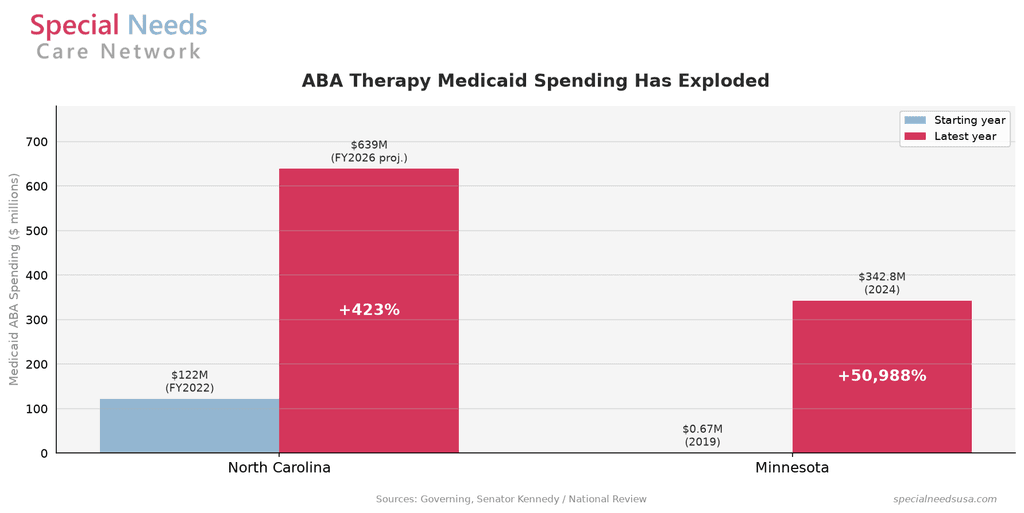
North Carolina saw its Medicaid ABA spending rise from approximately $122 million in 2022 to a projected $639 million in 2026, a 423 percent increase, according to Stateline. Minnesota grew from under $1 million in 2019 to over $340 million by 2024, one of the steepest rates in the country. Indiana and Nebraska saw similar trajectories. These numbers are real children finally getting access to care. They are also a large, fast-growing line in state budgets.
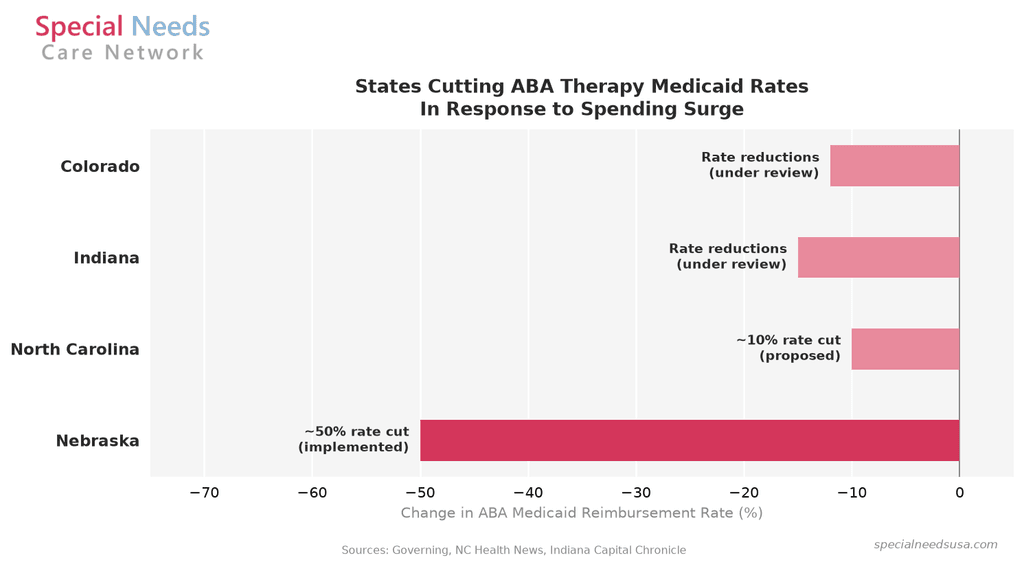
Nebraska responded with rate cuts of approximately 50 percent for some ABA providers. North Carolina proposed a 10 percent reduction and faced legal challenges from families, ultimately pausing the cuts after a judge granted a preliminary injunction. Indiana and Colorado have reductions under review. Florida chose a different mechanism, managed care contracting, but the effect on families is similar: providers exit, waitlists grow, and the families who depend on Medicaid coverage for their child's therapy are the ones absorbing the disruption.
What you can do right now if you are in Florida
If you are currently on a waitlist or searching for ABA therapy in Florida, work through these steps now rather than waiting.
Get on more than one waitlist at the same time. Do not wait for one clinic to respond before contacting others. Active waitlists at multiple providers give you options when a spot opens.
Confirm your managed care plan's network. Call your child's Medicaid managed care plan and ask specifically which ABA providers in your county are in-network and currently accepting new Medicaid clients. The online network directory can lag behind real availability.
Ask about in-home options. Some in-home ABA providers who left the managed care network are still operating as private-pay or have contracted with select MCOs. If center-based options are unavailable, in-home providers may have different waitlist dynamics.
Explore Florida FES-UA scholarships as an alternative or supplemental funding pathway. Under Florida's Family Empowerment Scholarship for Unique Abilities (FES-UA), families can direct state scholarship funds toward approved private-pay ABA providers and community therapies through Step Up for Students, bypassing Medicaid managed care network caps and prior authorization freezes.
Keep your child's documentation current. An up-to-date diagnostic evaluation and treatment plan speeds the authorization process when a spot opens. If the evaluation is more than a year old, ask your pediatrician about a referral for an updated assessment.
Know your appeal rights. If your child's hours are reduced or an authorization is denied, you have the right to appeal through your Medicaid managed care plan. Ask for the denial in writing and file the appeal promptly. In many cases children can continue services during the appeal.
Use a matching service to find options outside your immediate area. Some families have found available providers by widening their search to adjacent counties or by looking at telehealth-eligible ABA options for certain parts of a child's program.
Understanding your rights under Florida Medicaid
Florida Medicaid-enrolled children under 21 are generally covered by the federal Early and Periodic Screening, Diagnostic and Treatment (EPSDT) benefit. In August 2026, CMS published an extensive ABA policy toolkit for state Medicaid programs that reaffirmed federal EPSDT mandates: states and managed care organizations cannot enforce arbitrary caps on medically necessary behavioral health treatment, even while tightening clinical documentation and supervision requirements.
A managed care plan's prior authorization denial is not necessarily final. If your child's BCBA has documented medical necessity for a specific number of therapy hours and the plan is denying or reducing those hours, you have grounds for an appeal and in some cases for a fair hearing through Florida Medicaid. The authorization process under managed care is more complex than it was under fee-for-service, but the underlying benefit for children has not changed.
For specific guidance on your child's situation, contact Florida's Medicaid recipient services or a disability rights advocacy organization in your area. Several Florida nonprofits specialize in helping families with Medicaid managed care disputes.
How Special Needs Care Network can help
Finding ABA therapy that accepts your child's Medicaid plan in Florida right now is harder than it should be. Special Needs Care Network helps families search for ABA providers by location and see which ones are currently accepting new clients. If you are stuck on waitlists or trying to figure out what is available through your managed care plan, tell us a little about your child and where you are, and we will help you find options.
This article is for general information and is not legal or medical advice. Medicaid rules, managed care networks, and provider availability change frequently. Confirm current details with your child's Medicaid managed care plan and consult a qualified attorney or disability rights advocate for legal questions about your child's benefits.
Find schools and therapy providers for your child
Tell us your child's needs and location, and we'll match you with special-needs schools, ABA therapy centers, or speech-therapy providers in your area. Free for families.


