


Recent reporting from the Wall Street Journal has brought national attention to the rapid growth of Medicaid spending on autism therapy in the United States. Because the full investigation is behind a paywall, we are summarizing the major themes of the reporting and explaining what the developments may mean for families and providers involved in autism services.
Applied Behavior Analysis (ABA) therapy is one of the most widely used interventions for children diagnosed with autism spectrum disorder. Over the past decade, as autism diagnoses have increased and more states have expanded insurance coverage, demand for ABA therapy has grown significantly.
The new reporting highlights just how quickly the cost of providing those services through Medicaid has risen.
Get matched with schools and therapy providers
Tell us your child's needs and location, and we'll match you with special-needs schools, ABA therapy centers, or speech-therapy providers in your area. Free for families.
Free for families.
What the investigation found
According to the Wall Street Journal investigation, Medicaid spending on autism therapy — most of it tied to ABA services, rose from roughly $660 million in 2019 to about $2.2 billion in 2023.
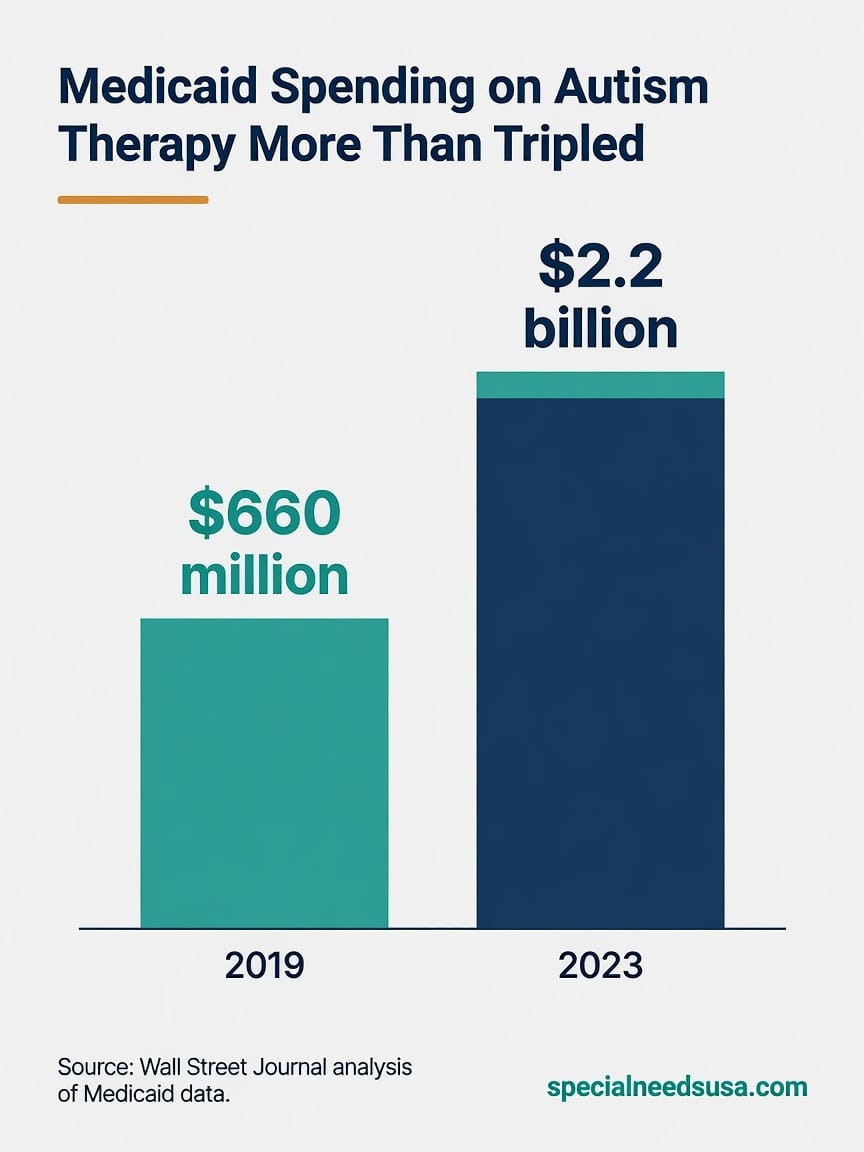
That growth makes autism therapy one of the fastest-growing areas of Medicaid spending.
The investigation also examined billing patterns among some providers and raised questions about oversight in certain state programs. In a number of cases, investigators found unusually high spending levels per child. Some reports cited situations where average costs exceeded $300,000 per child per year, with some therapy rates reported as extremely high compared with typical industry norms. The Journal's reporting focused in part on one large provider, Action Behavior Centers, which has received backing from private equity and has been cited for billing Colorado's Medicaid program for a very high number of therapy hours per patient — in some instances averaging the equivalent of more than 10 hours of therapy per day per child. The investigation also noted allegations that some centers billed for time when children were napping, eating, or playing games, raising questions about what counts as billable therapy versus supervised care.
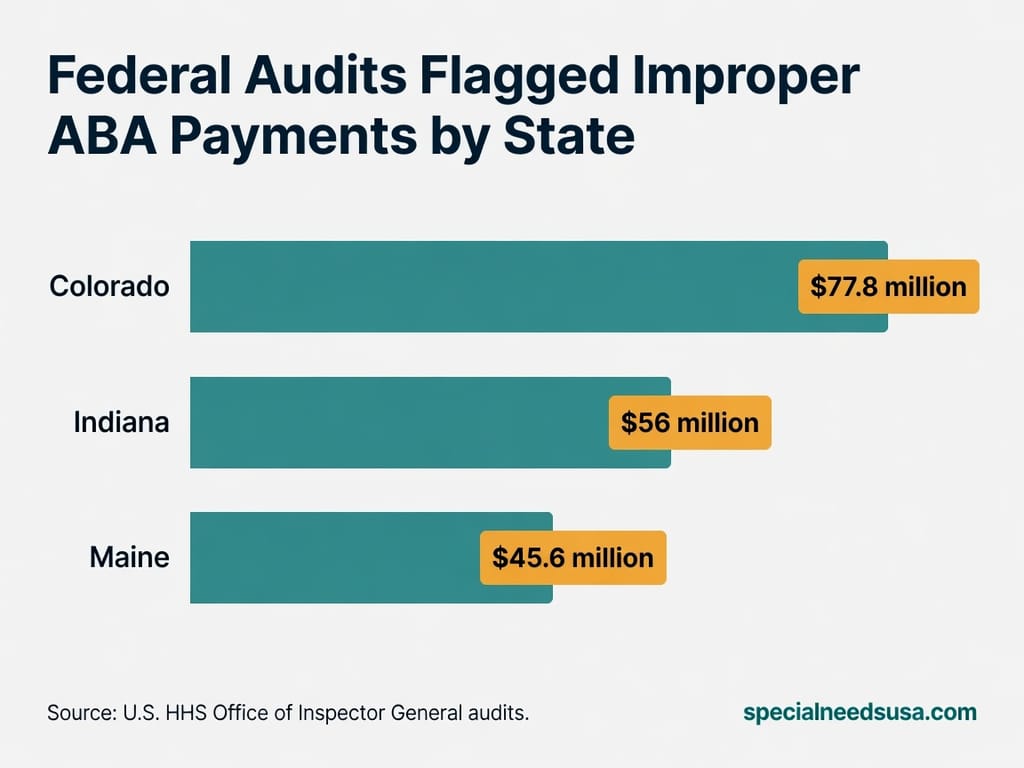
Federal and state audits have also flagged problems in some claims, including missing documentation, concerns about staff qualifications, or services that did not clearly align with treatment plans. The U.S. Department of Health and Human Services Office of the Inspector General (HHS OIG) has released audit findings from several states with dollar figures that illustrate the scale of the concern. In Colorado, an OIG audit identified at least $77.8 million in improper Medicaid payments for ABA services, with the sampled enrollee-months showing at least one improper or potentially improper claim in every case. In Indiana, audits have identified approximately $56 million in improper payments for ABA claims. In Maine, the OIG found at least $45.6 million in improper payments for rehabilitative and community support services provided to children diagnosed with autism. Wisconsin is currently under audit for similar issues. Common themes across these audits include inadequate documentation to support services billed, services that did not meet medical necessity criteria, unqualified staff providing therapy, and billing for more hours than were actually provided or allowed.
In a smaller number of cases, federal authorities have pursued criminal charges. In Minnesota, a defendant was charged with wire fraud in connection with a scheme involving roughly $14 million in Medicaid funds, including allegations of kickbacks to parents and the use of unqualified personnel as behavioral technicians. In North Carolina, a separate Medicaid fraud case involving autism-related services resulted in combined prison sentences of more than 14 years for those involved. These prosecutions reflect the seriousness with which regulators and law enforcement are treating evidence of intentional fraud.
These findings have prompted regulators to take a closer look at how autism therapy services are billed and monitored through Medicaid.

Why ABA spending has grown so quickly
While concerns about billing practices have drawn attention, several broader factors have also contributed to the rapid rise in Medicaid spending on autism services.
Autism diagnosis rates have increased significantly in recent years, with more children identified as needing support services. At the same time, many states expanded insurance mandates requiring autism therapies to be covered by Medicaid and private insurers.
ABA therapy is also typically delivered at high intensity. Many treatment plans involve 20 to 40 hours of therapy per week, often for several years. When delivered consistently at that level, the overall cost of treatment can be substantial.
In addition, the number of ABA providers has grown quickly to meet demand, particularly in states where Medicaid coverage expanded. Private equity firms have been active in this expansion. By 2024, private equity had acquired more than 500 autism centers across 42 states. That investment has helped fuel growth in the number of clinics, though some clinicians and researchers have raised questions about whether pressure to maximize profit in PE-backed providers could affect billing practices, staff turnover, or quality of care. Those questions are part of the broader debate about how the industry should be overseen.
What regulators are doing now
In response to the rapid growth in spending, several states are reviewing their autism therapy programs and introducing new oversight measures.
States including Minnesota, Indiana, North Carolina, Nebraska, and Colorado have begun tightening rules around Medicaid-funded ABA services.
Policy changes being considered or implemented include:
• additional prior authorization requirements for therapy hours
• new documentation standards for treatment plans and supervision
• caps or limits on authorized therapy hours in some cases
• reimbursement rate reviews
• targeted audits of high-billing providers
Federal oversight agencies have also begun conducting broader reviews of Medicaid autism therapy programs.
These changes reflect a growing effort by policymakers to balance two priorities: controlling Medicaid spending while ensuring children with autism continue to have access to medically necessary treatment.
Pushback from autism advocacy groups
Professional organizations and disability advocates have pushed back on the narrative that rising costs necessarily indicate widespread problems in the field.
The Council of Autism Service Providers (CASP), a nonprofit trade association for ABA providers, has issued a formal response to the Wall Street Journal articles. CASP acknowledges that fraud, waste, and abuse occur in ABA and should be eliminated, and that bad actors should be removed from the industry. At the same time, the organization argues that many of the "improper payments" identified in audits may stem from documentation errors rather than intentional fraud — meaning that legitimate, preauthorized services were delivered but not properly documented. CASP has called for stronger program integrity measures, including requiring qualifying diagnoses and medical necessity documentation, preauthorization and referrals, clearer clinical documentation standards (including use of session note templates consistent with CASP guidelines), accreditation, and alignment of behavior technician supervision with BACB minimum requirements. CASP has also emphasized that it has been engaged with the HHS OIG on these issues.
Many advocacy groups emphasize that ABA therapy has decades of research supporting its effectiveness and remains one of the most commonly recommended interventions for children with autism.
They also note that fraud and billing issues occur across many areas of healthcare and should not be used to undermine access to legitimate services.
Some advocates worry that aggressive rate cuts or strict caps on therapy hours could unintentionally reduce access for low-income families who rely on Medicaid coverage.
What this means for ABA providers
For ABA clinics and therapy providers, the current scrutiny signals a shift toward stronger compliance expectations.
Providers may face increased oversight in several areas, including:
• documentation of medical necessity
• supervision of therapists and staff credentials
• alignment between treatment plans and billed therapy hours
• proof that services were delivered as documented
Clinics that maintain strong compliance systems and detailed clinical documentation are likely to be better positioned as regulations evolve.
What families should know
Families seeking autism services through Medicaid may see changes in how therapy is authorized and documented in the coming years.
Possible effects could include:
• longer approval processes for therapy hours
• additional documentation requirements
• increased monitoring of provider programs
At the same time, demand for autism services continues to grow, and access to qualified providers remains a major challenge in many communities. When evaluating a provider, families may find it helpful to ask about the clinic's documentation practices, how treatment hours are determined for each child, and whether supervisors and technicians hold appropriate credentials. Transparency about billing and a clear explanation of how services align with an individualized treatment plan can be useful indicators of a well-run program.
Families navigating the process often benefit from having clear information about available therapy providers, schools, and support programs in their area.
A changing policy landscape
The debate around Medicaid-funded ABA therapy reflects a broader policy challenge: how to expand access to essential autism services while maintaining accountability and responsible use of public funds.
As states review their programs and regulators increase oversight, the autism services landscape is likely to continue evolving.
For providers, families, and policymakers alike, the goal will be finding ways to maintain access to high-quality care while ensuring that services are delivered transparently and responsibly.
Readers interested in the original reporting can view the Wall Street Journal investigation for a deeper look at the issue.
Find schools and therapy providers for your child
Tell us your child's needs and location, and we'll match you with special-needs schools, ABA therapy centers, or speech-therapy providers in your area. Free for families.