

What Florida’s Insurance Laws Really Say About ABA Therapy Coverage
A simple guide for parents and schools
Parents of children with autism, and school administrators who help families sort through services, have likely come across claims that Florida just passed a new law on insurance and ABA therapy. Much of what circulates online about it is confusing, and some of it is flat-out wrong.
Here is the reality, in simple terms: Florida already has a law that requires certain insurance plans to cover ABA therapy, and that law is still in effect. Some changes were proposed in 2025, but most of the major insurance reforms people are talking about did not actually become law.
Get matched with schools and therapy providers
Tell us your child's needs and location, and we'll match you with special-needs schools, ABA therapy centers, or speech-therapy providers in your area. Free for families.
Free for families.
This article walks through the coverage that already exists, what didn't change, and what families and schools can realistically expect when dealing with insurance in Florida.
First: What Is ABA Therapy?
Applied Behavior Analysis, or ABA, is a therapy commonly used to support children with autism. It builds skills like communication, daily living, emotional regulation, and social interaction, while working to reduce behaviors that get in the way of learning or safety.
When a qualified professional prescribes it, ABA therapy is widely recognized as medically necessary treatment for autism. That's precisely why insurance coverage matters so much to families.
Florida Already Requires ABA Coverage Under Certain Insurance Plans
Florida has had an autism insurance mandate for years. It is part of state insurance law and is often referred to as the Steven A. Geller Autism Coverage Act.
In plain language, this law says that some insurance plans in Florida must cover autism treatment, including ABA therapy, when it is medically necessary.
In practice, that requirement breaks down by plan type.
What insurance plans are required to cover ABA?
Coverage applies to state-regulated health insurance plans, including:
Fully insured employer plans
State employee health plans
Certain large group insurance plans
The Florida Office of Insurance Regulation oversees these plans, and they have to follow the state's mandates.
What plans are not required to follow this law?
Some plans are not governed by Florida insurance law, including:
Self-funded employer plans (often large corporations)
Many individual marketplace plans
Federal or military plans
Because these plans operate under federal rules rather than state rules, Florida's autism mandate simply doesn't reach them.
That state-versus-federal split is a big part of why two families can call two different insurers and get two completely different answers.
What Exactly Is Covered?
Under Florida law, a qualifying plan is required to cover:
Autism screening and diagnostic services
Medically necessary treatment for autism
Applied Behavior Analysis (ABA), when prescribed and included in a treatment plan
Coverage decisions have to rest on medical need. School placement, income level, and parental preference don't factor in.
Important Coverage Limits Parents Should Know About
Florida’s autism mandate includes financial caps. These are often the part families find out about too late.
The current limits look like this:
There is an annual coverage cap of approximately $36,000, adjusted periodically for inflation
There is a lifetime maximum benefit of $200,000
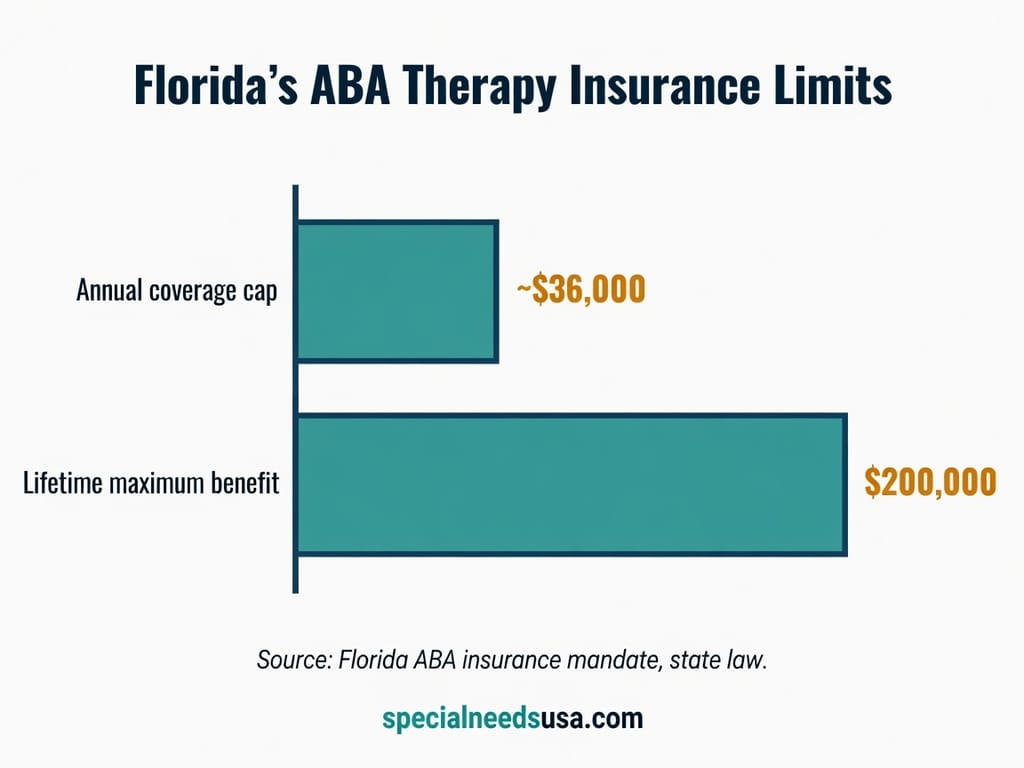
Once a child hits that lifetime cap, the insurer is off the hook: state law no longer obligates it to keep paying for ABA.
Schools should keep these limits in mind, particularly when they're helping a family think through long-term service planning.
What Changed in 2025 and What Did Not
Florida lawmakers introduced several autism-services bills in 2025, and the confusion that followed was widespread. Many people came away believing insurance coverage had expanded significantly.
It didn't.
A new autism services law was passed, but it does not change insurance coverage
Florida passed legislation focused on early intervention, education, and support services for children with autism. This law expands things like:
Early Steps eligibility
Autism-focused education initiatives
Training and resources for educators
Statewide coordination of autism services
These are positive developments, especially for younger children and schools. However, this law does not change insurance coverage rules for ABA therapy.
Proposed insurance reforms did not pass
There was a bill that would have expanded insurance coverage by removing age limits and modernizing definitions. That bill passed one chamber of the legislature but did not become law.
The practical effect:
Insurance coverage rules for ABA remain largely the same
Coverage caps and plan exclusions still apply
Families do not automatically qualify for expanded benefits
If someone tells you Florida removed the limits on ABA coverage, that claim is simply wrong.
Medicaid Coverage Is a Separate System
Medicaid families often navigate a different process altogether compared with those on private insurance.
Florida Medicaid does cover medically necessary ABA therapy for children under federal Early and Periodic Screening, Diagnostic, and Treatment (EPSDT) rules. However, Medicaid recently moved ABA services into managed care plans.
In day-to-day terms, that shift means:
Providers must be in-network with the child’s Medicaid plan
Families may face longer waitlists
Authorizations and renewals are more structured
The coverage itself hasn't gone away, but getting to it can depend heavily on which providers have openings.
What This Means for Schools
Schools have an important supporting role here, but insurance approval isn't on them to secure.
A few things schools can do to help:
Helping parents understand the difference between school services and medical therapy
Avoiding promises about insurance coverage
Referring families to qualified providers and advocacy resources
Encouraging early planning due to coverage caps
Clear, upfront communication heads off misunderstandings and builds trust with families over time.
What Parents Should Do Next
Parents seeking ABA therapy in Florida can take these practical next steps:
Ask whether your insurance plan is fully insured or self-funded
Request a written summary of autism benefits from your insurer
Confirm annual and lifetime caps before starting services
Work with providers experienced in insurance authorizations
Appeal denials when appropriate
Persistence and paperwork carry more weight than any verbal assurance you're given.
The Bottom Line
Florida does require some insurance plans to cover ABA therapy, and that protection remains in place. However, there was no sweeping new insurance expansion in 2025, and coverage limits still exist.
When parents and schools understand what the law actually says, they can plan realistically instead of guessing, and spend their energy where it actually helps kids get the support they need.
Whether you're explaining insurance options to families, putting together a parent resource page, or handling ABA referrals, clarity in this area makes a real difference.
Families on Medicaid should also read how Florida's Medicaid managed care change affected ABA access.
Find schools and therapy providers for your child
Tell us your child's needs and location, and we'll match you with special-needs schools, ABA therapy centers, or speech-therapy providers in your area. Free for families.