


The fraud headlines tell you what happened. They don't tell you who set the table.
$600 million in improper Medicaid payments identified by federal auditors. A single provider billing one family $911,400. RBTs earning near minimum wage while their employers charge Medicaid $50 to $80 an hour. Federal prosecutors in Minnesota filing what the U.S. Attorney's Office described as the first criminal case tied to fraudulent ABA billing.
These aren't isolated incidents and they aren't a coincidence. They're the predictable endpoint of a business model that was never designed with clinical quality as the primary constraint.
Get matched with schools and therapy providers
Tell us your child's needs and location, and we'll match you with special-needs schools, ABA therapy centers, or speech-therapy providers in your area. Free for families.
Free for families.
Applied Behavior Analysis therapy wasn't supposed to be a billion-dollar industry. It was supposed to be a clinical intervention: one BCBA, one family, one treatment plan at a time. When Medicaid spending on ABA grew 347% between 2022 and 2025 and projections had it reaching $1.14 billion by 2027, the money arrived faster than the oversight infrastructure could handle. Private equity noticed, and the consolidation wave that followed turned a clinical field into a revenue engine.
To understand the fraud, you have to understand the economics that made it inevitable.
We covered what the investigations mean for families navigating care right now in a recent companion piece. This one focuses on the structural question: who built the economics that made fraud the rational outcome?
The Math Behind the Billing
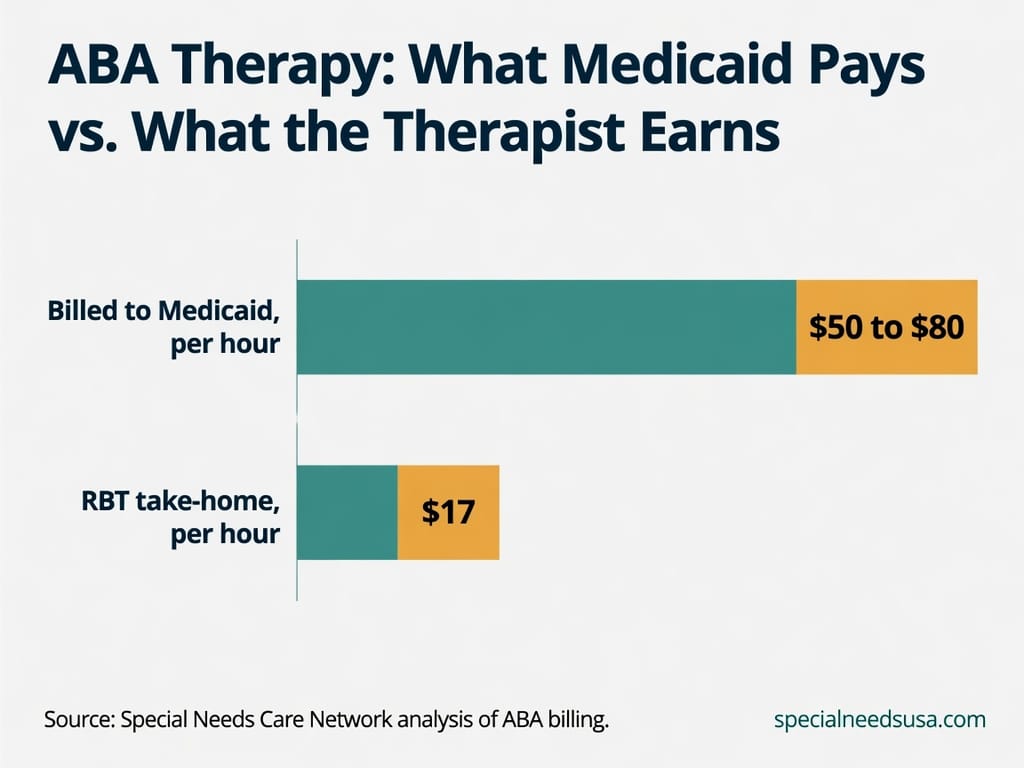
The typical ABA clinic is staffed overwhelmingly by Registered Behavior Technicians. The barrier to entry for the role is a high school diploma and 40 hours of training. An RBT delivers 30 to 40 hours of one-on-one therapy per week to an autistic child while Medicaid is billed at $50 to $80 per hour. The RBT takes home $15 to $22. The spread, roughly $35 to $58 per hour per RBT, covers supervision, overhead, and whatever is left flows to the owners.
Scale that to a multi-state operation with hundreds of RBTs billing 30-plus hours every week, 52 weeks a year, and each RBT generates roughly $78,000 to $124,800 in annual revenue against $31,000 to $45,000 in compensation cost. That leaves $47,000 to $93,800 per RBT per year to cover everything else: BCBA supervision, facilities, billing operations, management, and profit.
The New York Times investigated in May 2026 and found technicians waking young children from naps to keep billable hours high. A thread on Reddit's r/ABA community this week described a mother billed $911,400 by a provider with an estimated $23 million in annual revenue. The top comment is three words: "This kills me, man." These aren't rogue employee problems and they're not a few bad actors in an otherwise honest system. When billable hours are the primary revenue driver and nobody is auditing the clinical rationale for every session, the incentive structure pushes in exactly one direction: more hours, more billing, more revenue.
How Private Equity Reshaped the Field
The consolidation wave that turned ABA into a private equity asset class has been massive, quiet, and overwhelmingly driven by financial buyers rather than clinical operators.
Autism Learning Partners was acquired by FFL Partners in 2018 in a deal reportedly valued around $270 million. The company now operates across multiple states as one of the largest ABA providers in the country. The acquisition playbook was straightforward: consolidate regional providers, standardize billing across every location, centralize back-office operations, and maximize billable hours per clinician. That playbook works for revenue. It's not designed around clinical outcomes.
Proud Moments ABA went from Audax Private Equity in 2019 to Nautic Partners in 2025. A flip (where one private equity firm sells to another) tells you the first investors got their return and the second investors are betting they can extract more. What happens to supervision ratios, RBT turnover, or clinical quality during a flip is not typically part of the investment thesis.
Therapy Brands, the dominant software platform for behavioral health practices including ABA, was acquired by KKR in 2021 in a deal valued at approximately $1.2 billion. When the company that runs the billing software for thousands of ABA clinics is itself a private equity portfolio asset, the entire operational stack from session notes to reimbursement claims sits inside the same financial ecosystem.
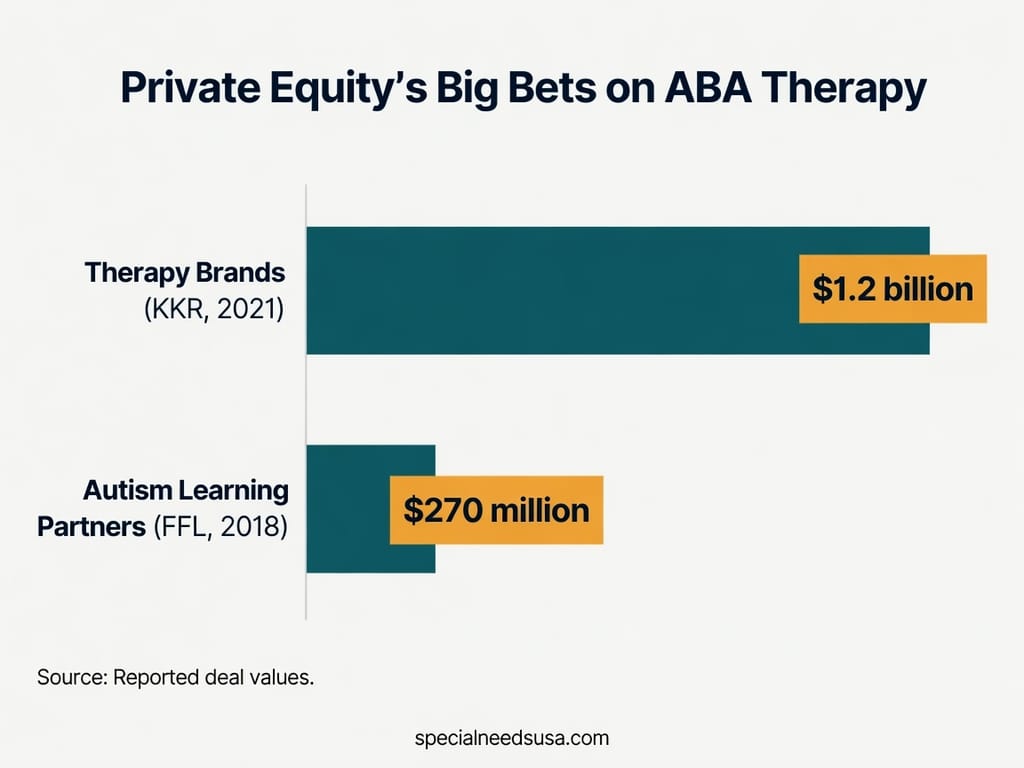
These are financial engineering decisions, not clinical ones. The people who structured them are not the people facing federal prosecution. They are not the RBTs earning $17 an hour. They are not the families on waitlists. And none of them will bear the consequences when the enforcement wave arrives.
Private equity doesn't invest in healthcare because it wants to improve outcomes. It invests because healthcare revenue is predictable, government-reimbursed, and recurring. A child diagnosed with autism at age 3 may receive ABA therapy for years. That's a long-duration revenue stream with low churn, and in financial terms it's an attractive asset. The problem (and it's the same problem that plays out in nursing homes, emergency rooms, and dental chains) is that clinical quality and investor returns move in opposite directions at scale.
Improving clinical quality means smaller caseloads for BCBAs, more direct supervision per RBT, more training, more family involvement, and more time spent on treatment planning that isn't billable. All of those things reduce margin. Maximizing returns means the opposite: larger caseloads, fewer BCBAs per RBT, standardized treatment protocols that minimize individualized planning, and aggressive billing practices that ensure every possible hour gets claimed. When the New York Times described ABA as 'provided largely by high school graduates who are paid a fraction of what the private equity firm charges Medicare,' they weren't editorializing. They were describing the math.
Meanwhile, a practice owner in that same r/ABA thread about the $911,400 billing case wrote something that captures exactly who gets hurt when PE-backed providers push the envelope: 'I'm a practice owner and have been wrongly accused of doing all of these things by insurance companies. They claim documentation is incomplete or missing without proof, after having those items sent to them.' That comment was heavily upvoted because every ethical BCBA watching their field's reputation burn recognizes the dynamic. The bad actors overbill, the auditors respond with blanket scrutiny, and the clinicians who spent a decade building an honest practice get swept into the same net.
The Workforce Problem Nobody Names
The RBT workforce itself is the problem nobody in the industry wants to name out loud. To become an RBT you need a high school diploma, 40 hours of training, a competency assessment, and a background check. That's the full barrier to entry for the person who will spend 30 to 40 hours per week working one-on-one with an autistic child (the most intensive intervention most of those children will ever receive).
Many RBTs are compassionate, dedicated people doing difficult work for low pay in high-burnout conditions. The problem is structural, not personal. When the person delivering the majority of therapy hours has minimal training, is supervised at a ratio of 10 or 15 to one, and is measured primarily by billable hours, clinical quality becomes a function of individual character rather than systemic safeguards. The Behavior Analyst Certification Board has debated increasing RBT training requirements for years, but the economics push the other way. Every additional hour of required training, every increase in supervision ratios, every qualification upgrade raises labor costs in a business model built on low-cost labor. And because private equity investors measure success in EBITDA multiples, not clinical outcomes, there is no market incentive to raise the bar. The market incentive is to keep it exactly where it is.
What a Real Fix Would Require
The current federal investigations targeting individual providers and specific billing schemes are necessary. But they won't change the underlying dynamics. A real structural response would look very different from what's on the table right now.
Capping the BCBA-to-RBT supervision ratio by regulation, not leaving it to provider discretion, would force the industry to invest in clinical oversight over administrative overhead. When one BCBA is responsible for 15 or more cases, meaningful supervision becomes impossible. A ratio of 1:8 or lower wouldn't eliminate fraud, but it would make it harder to run a billing operation disguised as a clinic.
Raising the minimum RBT qualification from 40 hours of training to something closer to the requirements for other allied health roles (speech-language pathology assistants, for example) would narrow the spread between what providers bill for an hour of therapy and what they pay for the labor delivering it. That spread is where the fraud lives.
Requiring providers to disclose their ownership structure to families at intake (the same way a clinic discloses licensure and credentials) would give parents the information they need to evaluate whether the people deciding their child's treatment hours are clinicians or investors. A PE-owned clinic isn't automatically fraudulent and a clinician-owned practice isn't automatically ethical. But the ownership model shapes the clinical model, and families deserve to know which one they're dealing with.
Applying heightened audit scrutiny to PE-backed providers by default would recognize what the data already shows: the financial incentives of private equity ownership align with maximizing billable hours, and the only way to verify that those hours are clinically appropriate is to check more often, not less.
And when a provider does lose its Medicaid contract due to fraud, families should not lose access overnight. Transition planning, warm handoffs to new providers, and a grace period for existing patients should be mandatory. Families in Arizona already learned this lesson when nearly 1,000 children lost ABA coverage after insurers ended contracts with major providers. Those children didn't commit fraud. They shouldn't have been the ones who paid for it.
What to Ask If Your Child Is in ABA Right Now
If your child is currently receiving ABA therapy, especially at a large multi-state provider, there are a handful of things worth knowing right now. Ask who owns the practice and whether the founder is still involved. It's not an abstract question; the ownership structure shapes how decisions get made about your child's hours, supervision, and treatment goals, and if the answer is vague, that's worth noticing. Ask about the BCBA-to-RBT ratio and how often the BCBA observes sessions directly. More than 8 to 10 RBTs per BCBA or direct observation less than once a week is a signal worth paying attention to. Ask how treatment hours were determined and whether the recommendation is based on a clinical assessment of your specific child or a standard formula that looks the same for every family. Document any billing for cancelled sessions, any discrepancies between hours billed and hours delivered, or any pressure to increase hours without a clear clinical rationale (these are exactly the practices auditors are looking for, and they're also signs your provider is optimizing for revenue over care). And if you're on a waitlist, don't put all your hope in one provider. The investigations may create openings at some clinics while closing others entirely. Cast a wide net and keep your name on every list.
Our guide to choosing an autism therapy center walks through a full checklist of questions to ask at intake and what to watch for in the first months of care.
The Bottom Line
Prosecuting individual bad actors is the easy part. The hard part is changing the structural incentives that made fraud the rational business decision at scale. The families on waitlists, the BCBAs building ethical practices, the RBTs earning $17 an hour, and the children receiving therapy did not create this system. They should not bear the cost of cleaning it up.
If you are searching for ABA providers, our directory can help you find centers by state and location. If you are a clinician-owned practice that wants to make your ownership structure and clinical philosophy visible to families, we can help with that too.
For the parent-facing federal guidance that followed these audits, see what the CMS ABA toolkit means for families.
Find schools and therapy providers for your child
Tell us your child's needs and location, and we'll match you with special-needs schools, ABA therapy centers, or speech-therapy providers in your area. Free for families.


