

Last updated: 2026-09-06
Arizona ESA Special Needs Guide (2026-27)
How to unlock disability-tier funding ($34k-$47k+), navigate ClassWallet approvals, avoid reimbursement traps, and understand your IDEA rights.
Related resources
Guides, data, and tools to use next
Move from this guide to a checklist, data report, or state resource that supports the next decision.
Fast Decision Framework
Arizona ESA for Special Needs: 3 Rules to Know First
Standard Doctor Letters Are Rejected
ADE requires a formal MET report, current IEP, or comprehensive IEE with psychologist/physician evaluation signatures. A single-page pediatrician prescription note is disqualified.
Rule 2: Group B FormulaFunding Follows Statutory Multipliers
Autism (4.806 weight) and severe sensory conditions yield $34k–$47k+, whereas speech-only or ADHD (0.003 weight) remain at the ~$7.4k universal base.
Rule 3: Spending RulesDirect Pay Beats Reimbursement
Use Marketplace Direct Pay and Pay Vendor channels to eliminate 30–45 day out-of-pocket delays. Items over $100 require explicit curriculum justification.
Before signing an ESA contract, understand that you formally surrender district special education services under IDEA. See the FAPE tradeoff analysis below.
Ask ChatGPT about your child's situation
We'll write the question for you, filled in with this guide's key facts. Copy it, paste it into ChatGPT, Claude, or Gemini, and get advice tailored to your family.
What is the Arizona ESA for special-needs students?
The Arizona Empowerment Scholarship Account program is codified at A.R.S. § 15-2401 through § 15-2404 and administered by the Arizona Department of Education. Under A.R.S. § 15-2402, an eligible student enters into an annual contract with the department to receive an amount equal to ninety percent of the sum of the base support level and additional assistance that a school district or charter school would have received for that pupil under A.R.S. § 15-943. While universal non-disability students receive a baseline allocation between $7,100 and $8,000, students with verified disabilities qualify for the disability funding tier, which layers statutory Group B weighted student count add-on factors onto the base calculation to generate awards up to $47,725 per school year.
Inside this Arizona ESA Parent Guide
Who qualifies for the disability tier?
To qualify as a 'child with a disability' under A.R.S. § 15-2401(7), the student must be identified as having a developmental or intellectual disability, emotional disability, hearing impairment, visual impairment, multiple disabilities, orthopedic impairment, preschool severe delay, speech-language impairment, or specific learning disability under A.R.S. § 15-761.
The 5 Approved Documentation Pathways
Qualification requires verification through an Individualized Education Program (IEP) from an Arizona public LEA, a Multidisciplinary Evaluation Team (MET) report, an active Section 504 plan, or an Independent Educational Evaluation (IEE) conducted by a qualified examiner: a licensed physician (MD or DO), clinical psychologist, or psychiatrist.
Current or Recent IEP
An Individualized Education Program from an Arizona public or charter school, dated within the prior three years, with completed multidisciplinary team signatures.
Multidisciplinary Evaluation Team (MET) Report
The comprehensive psychological and psychoeducational evaluation conducted by a public school district diagnosing an IDEA-recognized condition.
Section 504 Plan
A formal 504 accommodation plan issued by an Arizona public LEA documenting a physical or mental impairment that substantially limits learning.
Independent Educational Evaluation (IEE)
A comprehensive private evaluation from an Arizona-licensed physician (MD or DO), clinical psychologist, or psychiatrist with multi-domain testing.
Special-Education Preschool Evaluation
A formal multidisciplinary preschool evaluation identifying a severe delay under A.R.S. § 15-761(12), valid until the student matriculates into kindergarten.
The Multidisciplinary Signature Mandate
Pediatrician prescription notes and brief diagnosis letters are rejected by ADE examiners. The department requires full psychological and psychometric assessment data and an evaluation signature page containing at least one non-parent professional signature.
Direct Acceptance of Independent Evaluations (IEE)
Families who have always educated their children in home study or private settings are not required to enroll in a public district first; an independent evaluation from a private licensed psychologist or physician is accepted directly by ADE.
Watch Out: Disability Classifications That Expire
Disability classifications under A.R.S. § 15-761 follow strict statutory timelines:
Preschool Severe Delay (PSD)
Preschool Severe Delay under A.R.S. § 15-761(12) applies to children ages 3 to 5 and terminates when the child matriculates into kindergarten. To preserve weighted funding, parents must complete a comprehensive K-12 school-age re-evaluation through Child Find or a private clinical evaluator prior to kindergarten entry.
Developmental Delay (DD)
The Developmental Delay category under A.R.S. § 15-761(3) terminates when the child turns 10. If an updated evaluation identifying another IDEA disability category is not uploaded to ADEConnect before the child's 10th birthday, ADE automatically reclassifies the student to the universal general education tier.
How much funding can you expect?
Disability-tier allocations incorporate the Group B weighted student count add-on factors set forth in A.R.S. § 15-943. Under the state equalization assistance formula, base account awards equal ninety percent of the per-pupil revenue that would have been generated in the student's assigned public school district.
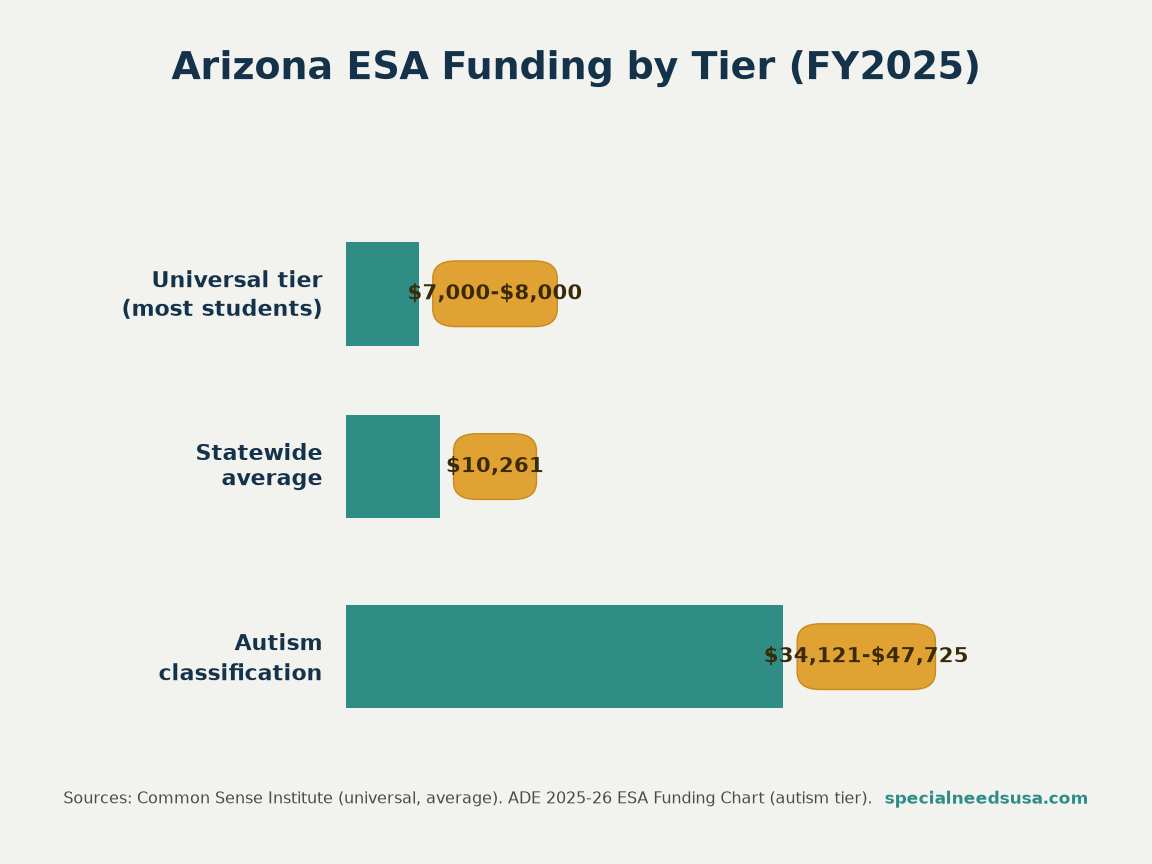
Standard allocation for students without formal disability documentation. Covers basic private school tuition gaps or homeschool curriculum.
Assigned to Moderate Intellectual Disability, Hearing/Visual Impairments, and Orthopedic Impairments. Unlocks therapy spending.
Autism Spectrum Disorder and Multiple Disabilities with Severe Sensory Impairments. Fully finances specialized private schooling + intensive ABA.
Arizona Group B Disability Weighting Matrix (2026-27)
A.R.S. § 15-943The table below sets forth statutory multipliers and estimated annual funding schedules for each disability classification.
| Disability Classification | Group B Weight | Annual Allocation (Grades 1-12) | Clinical Gate |
|---|---|---|---|
| Multiple Disabilities with Severe Sensory Impairment (MD-SSI) Public school MET report or clinical evaluation confirming deaf-blindness or dual severe sensory impairments. | 5.825 | $42,960 - $52,000 | Standard MET Verification |
| Autism Spectrum Disorder (A) Comprehensive MET or clinical IEE diagnosing Autism Spectrum Disorder (Level 1, 2, or 3) with team signatures. | 4.806 | $34,121 - $47,725 | High Support Tier |
| Severe Multiple Disabilities (MD-SC / SID) MET documentation identifying severe intellectual disability concurrent with physical or developmental deficits. | 4.806 | $34,121 - $47,725 | Standard MET Verification |
| Hearing Impairment (HI) & Visual Impairment (VI) Audiological or optometric clinical evaluation verifying bilateral hearing loss or low-vision diagnosis. | 4.771 / 4.806 | $33,500 - $45,000 | Standard MET Verification |
| Orthopedic Impairment (OI) & Moderate Intellectual Disability Orthopedic medical evaluation or psychological evaluation confirming moderate cognitive impairment. | 3.158 | $21,780 - $41,294 | Standard MET Verification |
| Preschool Severe Delay (PSD) (Ages 3-5 only) Preschool MET report demonstrating delays 3+ standard deviations below mean under A.R.S. § 15-761(12). Expires at kindergarten entry. | 3.595 | $13,260 - $14,220 | Standard MET Verification |
| Emotional Disability (ED) (Private Placement setting) Psychological evaluation documenting severe emotional dysregulation interfering with educational progress. | 1.456 | $10,500 - $18,400 | Standard MET Verification |
| Speech/Language Impairment (SLI) & Mild OHI (ADHD) MET or 504 plan. Arizona statutory formula assigns an add-on factor of 0.003, resulting in an award close to base funding. | 0.003 | $7,200 - $8,100 | Standard MET Verification |
| Universal Non-Disability (General Education, Grades 1-12) Arizona residency proof and child birth certificate. No disability documentation required. | None (Base) | $7,105 - $8,000 | Standard MET Verification |
The Q2 Award Recalibration
Contracts executed prior to October 1 reflect provisional calculations using prior-year state equalization weights, which are subsequently recalculated in the second quarter once current-year legislative factors are finalized. Plan educational budgets recognizing that minor adjustments occur in Q2.
Tuition Schedules at Specialized Day Schools
Tuition schedules at specialized Arizona day schools like Gateway Academy, Lauren's Institute for Education, or ACCEL typically range from $14,000 to $28,000 annually. For students receiving universal baseline allocations of roughly $7,500, parents cover the remaining tuition gap directly or negotiate sliding-scale adjustments. Conversely, awards for autism spectrum disorder ($34,121 to $47,725) generally cover full specialized private tuition, leaving remaining quarterly funds available for clinical therapy.
2026 AHCCCS Medicaid Network Transition
In early 2026, when AHCCCS managed care organizations terminated provider agreements with major autism clinics, families enrolled in the ESA autism tier utilized their weighted ClassWallet allocations to maintain continuous therapy with private BCBA clinicians. Families contracting with private clinics typically encounter hourly rates ranging between $120 and $180 per hour.
What you can buy with Arizona ESA
Disbursements are managed through ClassWallet pursuant to department guidelines. Under A.R.S. § 15-2402(B)(4)(c), qualified students with disabilities may use account funds for educational therapies from licensed or accredited practitioners. Covered modalities include applied behavior analysis, speech-language pathology, occupational therapy, and physical therapy.
Universal Categories (All Accounts)
Tuition and Fees
Private day schools, parochial schools, and accredited non-public academic institutions.
Curriculum and Textbooks
Core academic subjects including math, reading, science, history, and foreign languages.
Standardized Testing
AP exams, SAT, ACT, and nationally recognized norm-referenced evaluations.
Disability Tier Add-Ons
Clinical Therapies
Applied Behavior Analysis (ABA), speech-language therapy, occupational therapy, and physical therapy.
Paraprofessional Aides
Dedicated 1:1 educational aides and behavioral support technicians assisting during school or therapy.
Sensory & Assistive Tech
AAC devices, specialized adaptive seating, and sensory integration materials with curriculum justification.
Licensed Therapy Provider Requirements
A.R.S. § 15-2402(B)(4)(c)Non-contracted clinical providers must hold verified credentials issued by Arizona state licensing boards. Invoices must list the practitioner's active license number.
| Therapy Discipline | Mandatory Credential & Licensing Board |
|---|---|
| Applied Behavior Analysis (ABA) | Board Certified Behavior Analyst (BCBA, BCBA-D) or Board Certified Assistant Behavior Analyst (BCaBA) under supervision, licensed by the Arizona Board of Psychologist Examiners under A.R.S. Title 32, Chapter 19.1. |
| Speech-Language Pathology | Licensed Speech-Language Pathologist (SLP) or licensed Speech-Language Pathology Assistant (SLPA) under supervision, through the Arizona Department of Health Services. |
| Occupational Therapy (OT) | Licensed Occupational Therapist (OT) or Certified Occupational Therapy Assistant (COTA) under supervision, through the Arizona Board of Occupational Therapy Examiners. |
| Physical Therapy (PT) | Licensed Physical Therapist (PT) or Physical Therapist Assistant (PTA) under supervision, through the Arizona State Board of Physical Therapy. |
| Art & Music Therapy | Board Certified Art Therapist (ATR-BC) by ATCB, or Board Certified Music Therapist (MT-BC) by CBMT, submitted with documented therapeutic plan. |
| Equine / Hippotherapy | Conducted by an Arizona-licensed PT, OT, or SLP holding PATH International or American Hippotherapy Association (AHA) clinical credentials. |
Invoices must be itemized with dates of service, hourly rates, and practitioner license numbers. Fees for missed or cancelled appointments are unallowable.
The "Items Over $100" Curriculum Mandate
Under ADE Parent Handbook regulations, supplemental educational goods exceeding $100—such as sensory equipment, educational technology, or specialized science materials—must be accompanied by documentation demonstrating alignment with an approved curriculum syllabus, course of study, or certified teacher recommendation.
What Arizona ESA Strictly Forbids
- • Late cancellation or missed-appointment therapy penalties
- • General household furniture, regular toys, or non-adapted electronics
- • Out-of-state travel, hotel stays, theme park passes, or admissions
- • Extracurricular athletic leagues unrelated to core curriculum
- • Food, personal snacks, and general consumable household supplies
How ClassWallet actually works
Quarterly funds are deposited into ClassWallet accounts across four distinct transaction channels pursuant to Arizona Department of Education operational guidelines.
Marketplace Direct Pay
Integrated ecommerce stores inside ClassWallet (Amazon Business, Lakeshore Learning, Scholastic, Rainbow Resource). Orders are placed directly in the portal; approved items ship immediately with zero out-of-pocket costs.
Pay Vendor Direct Invoicing
Used for private day schools, contracted ABA centers, speech therapists, and certified tutors. The provider uploads an invoice (or parent submits a PDF bill). ADE audits credentials and pays the vendor directly via ACH.
Prepaid Debit Card
Physical debit card issued to parents for store purchases at educational retailers (restricted by Merchant Category Code). Itemized receipts must be uploaded within 30 days; missing a receipt freezes the card immediately.
Out-of-Pocket Reimbursement
For non-contracted independent therapists or specialty curriculums. The parent pays personal funds upfront, then submits proof of payment, line-item invoices, and clinician licenses for state repayment.
Vendor Presence in ClassWallet Does Not Guarantee Item Approval
Registration simply means the business has a verified Form W-9 on file. ADE compliance officers audit each line item against statutory guidelines. If an invoice contains unallowable expenses, ADE rejects the item or requires refund.
Arizona School Choice Comparison
Parents often weigh whether an ESA is superior to School Tuition Organization (STO) tax credit scholarships or maintaining a public district IEP.
| Comparison Dimension | Universal ESA | Disability Tier ESA | STO Scholarships | Public District IEP |
|---|---|---|---|---|
| Annual Funding Range | $7,100 - $8,000 | $34,100 - $47,700+ | $2,000 - $15,000+ | $0 (State funded) |
| Private School Tuition | Yes (Family pays gap) | Yes (Covers most or all) | Yes (Tuition only) | No (District placement) |
| Therapies (ABA, Speech, OT) | No (Unallowable) | Yes (Licensed providers) | No (Tuition restricted) | Yes (If written in IEP) |
| 1-on-1 Aides & Tech | No (Unallowable) | Yes (Paraprofessionals & AAC) | No | Yes (If written in IEP) |
| Retain Federal IDEA / FAPE | No (Parent waives FAPE) | No (Parent waives FAPE) | No (Private placement) | Yes (Full federal rights) |
| Can Combine With ESA? | N/A | N/A | Strictly Prohibited (A.R.S. § 15-2402) | Prohibited (No dual enroll) |
A.R.S. § 15-2402(B)(3) Concurrent Enrollment Bar
Arizona statute prohibits dual enrollment: a student cannot concurrently receive ESA funds and STO tax credit scholarships in the same school year, nor attend a public district or charter school while participating in the ESA program.
Can Arizona ESA Students Participate in Public School Sports & Extracurriculars?
Many families switching to an ESA worry their child will lose access to team sports, marching band, or public school clubs. Under Arizona statutory frameworks and emerging school board rulings, the landscape is expanding for the 2026–27 school year.
The Legal Baseline: A.R.S. § 15-802.01 & Board Discretion
Under Arizona Revised Statutes § 15-802.01, public school districts are authorized to allow non-enrolled students (such as homeschoolers and private school students whose schools lack a given program) to try out for interscholastic athletics and extracurricular activities within their home attendance boundary.
Historically, policies for ESA students varied by district. However, momentum has shifted toward inclusion: in late August 2026, the Flagstaff Unified School District (FUSD) Governing Board voted 3–1 to officially allow ESA students to participate in district athletics for the 2026–27 school year, establishing a significant precedent that other Arizona district boards are actively evaluating.
Students must meet the same age, residency, and academic progress verification required of enrolled students.
Districts may charge participation fees. ESA funds can be utilized to cover eligible extracurricular activity fees under ADE guidelines.
Because governing boards set district policy, parents should contact their local district athletic director well ahead of seasonal tryouts.
The IDEA rights and FAPE tradeoff
By signing an ESA contract, the parent formally acknowledges that the student is voluntarily withdrawing from public education, waiving statutory entitlements under IDEA.
Rights Surrendered Under the ESA Contract
- • The right to a Free Appropriate Public Education (FAPE) funded by local taxes.
- • Procedural safeguards including state due process hearings and administrative complaints.
- • Mandatory 30-day resolution sessions and district-funded Independent Educational Evaluations.
- • Right to district-provided door-to-door specialized transportation services.
Rights Retained and Freedoms Gained
- • Unrestricted authority to select private therapists, clinics, and day schools.
- • Total freedom to design custom 1:1 behavioral, sensory, and academic schedules.
- • Retained right to request 3-year district re-evaluations under federal Child Find.
- • Account funds roll over quarter-to-quarter and year-to-year until high school graduation.
The Public School Safety Valve: ESA is Fully Reversible
The contract is revocable: a parent may terminate the agreement and re-enroll the student in an Arizona public school at any time, reinstating IDEA protections and public district Child Find evaluations.
Step-by-step ADE portal application
Applications are submitted electronically through the ADEConnect parent portal at esaportal.azed.gov. Applicants must provide verified documentation of Arizona residency with all four document corners visible. The department has thirty days from receipt of a completed submission to review credentials and issue an award determination.
Gather Verified Documentation with Evaluation Signatures
Retrieve your child's MET report, IEP, 504 Plan, or private IEE. Verify that the signature page includes at least one psychologist, physician, or district evaluation specialist signature. Ensure the evaluation is dated within the past three years.
Assemble Primary Arizona Residency Proof
Prepare one primary proof of residency (electric, gas, water utility bill issued within 60 days, or a signed residential lease/deed). Ensure all four document corners are visible; windowed envelope snippets are systematically rejected.
Submit Application Through ADEConnect Portal
Log into esaportal.azed.gov. Select the "Disability Category" during intake and attach the evaluation document. Submitting as universal baseline will prevent you from accessing the Group B weighted allocations.
Sign Contract & Activate ClassWallet
Following contract execution, accounts are established on ClassWallet, with funds disbursed across four equal quarterly installments on July 15, October 15, January 15, and April 15.
Quarterly funding schedule & deposit calendar
Annual awards are divided into four equal quarterly installments disbursed into ClassWallet. Contract execution deadlines dictate when your student's initial deposit materializes.
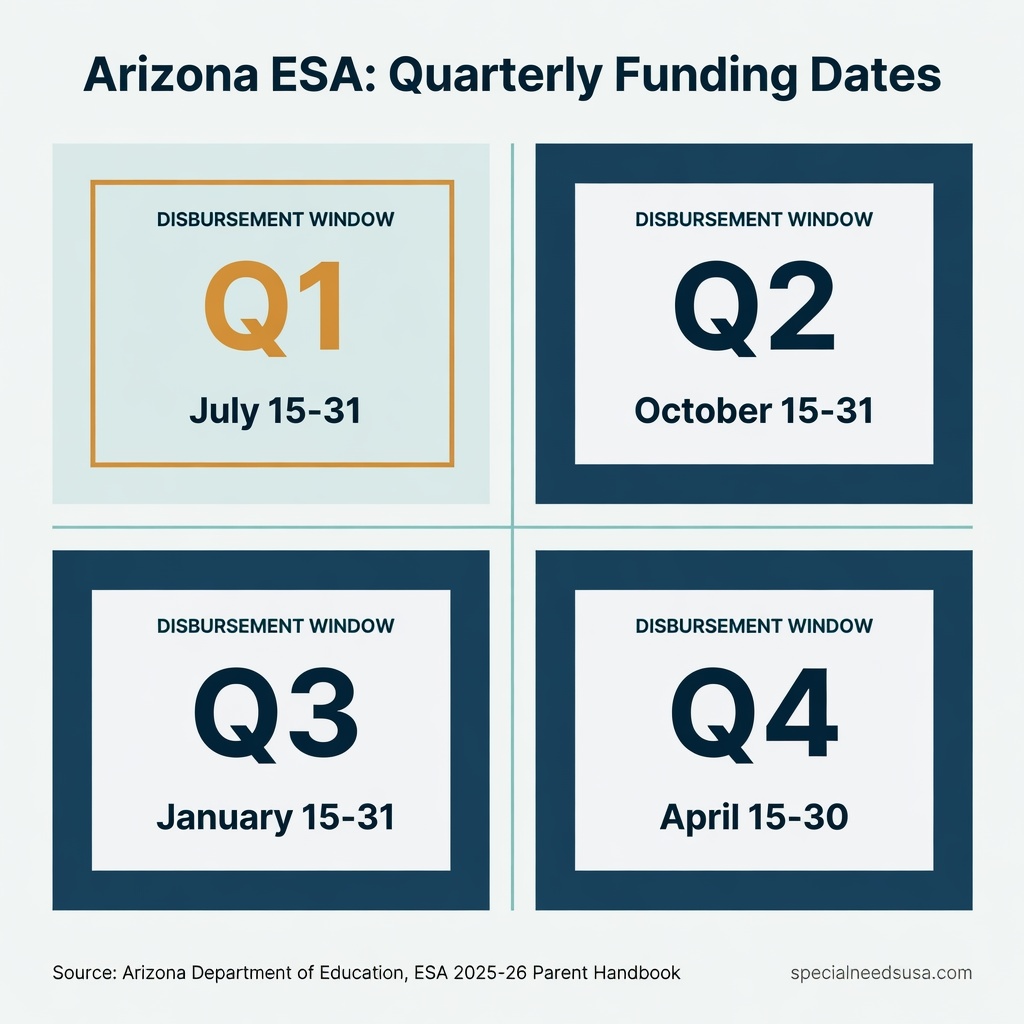
| Quarter | Contract Submission Cutoff | ClassWallet Deposit Date | Funding Allocation |
|---|---|---|---|
| Quarter 1 | June 15, 2026 | July 15, 2026 | 25% of annual award |
| Quarter 2 | September 15, 2026 | October 15, 2026 | 25% (Q2 recalculation applied) |
| Quarter 3 | December 15, 2026 | January 15, 2027 | 25% of annual award |
| Quarter 4 | March 15, 2027 | April 15, 2027 | 25% of annual award |
Explore Arizona Special-Needs Schools & Therapists
Finding programs that accept ESA ClassWallet direct pay is essential for managing cash flow. Browse verified directory listings by metro area:
Arizona Special-Needs Schools
Explore specialized private day schools with experienced special education faculties, sensory gyms, and low student-to-teacher ratios:
Arizona Therapy Providers
Locate licensed private clinics offering ABA therapy, speech-language pathology, and occupational therapy:
Get matched with schools and therapy
Tell us your child's needs and location, and we'll match you with verified special-needs schools, ABA therapy centers, or speech-therapy providers in your area. Free for families.
Frequently Asked Questions
Common questions about Arizona ESA Special Needs
What is the Arizona ESA Special Needs scholarship?
Under Title 15 of the Arizona Revised Statutes, the ESA is an education savings account administered by the state Department of Education. It allows parents who withdraw from public LEAs to receive ninety percent of their student's state funding entitlement. General education students receive $7,100 to $8,000, while verified disability allocations reach $47,725 annually under Group B funding formulas.
Who qualifies for the higher disability funding tier?
Applicants must upload verification of a qualifying condition under A.R.S. § 15-761. ADE accepts an active IEP from an Arizona district school, an LEA MET evaluation report, a 504 plan, or an Independent Educational Evaluation from a licensed MD, DO, or clinical psychologist. Forms and letters without full psychometric data and an evaluation signature page are rejected.
How much funding will my child receive under Arizona ESA?
Equalization assistance is computed using statutory Group B weights under A.R.S. § 15-943. Autism Spectrum Disorder (weight 4.806) generates $34,121 to $47,725 annually in grades 1 through 12, and multiple sensory impairments (weight 5.825) provide $42,960 to $52,000. Speech-language impairment has a statutory factor of 0.003, providing approximately $7,200 to $8,100.
Can I use Arizona ESA funds for ABA therapy?
Applied Behavior Analysis is an allowable expense under A.R.S. § 15-2402(B)(4)(c)(i) for disability-tier accounts. The clinician must hold an active BCBA or BCaBA credential and a state license from the Arizona Board of Psychologist Examiners under Title 32. Invoices submitted to ClassWallet must include dates of service, hourly rates, and practitioner license credentials.
Can ESA funds bridge the 2026 Arizona Medicaid (AHCCCS) ABA gap?
Following contract terminations between AHCCCS managed care plans and major clinic networks in early 2026, approximately 1,000 children lost in-network Medicaid therapy. Families enrolled in the ESA autism tier frequently use their $34,121 to $47,725 allocation to self-fund private ABA therapy through ClassWallet, while noting that accepting an ESA releases the public district from IDEA obligations.
Can my child receive both an ESA and an STO tax-credit scholarship?
A.R.S. § 15-2402(B)(1) prohibits concurrent enrollment in an ESA and a School Tuition Organization tax-credit scholarship under Title 43 during the same school year. If an STO issues funds while an ESA contract is active, ADE suspends the account and initiates clawback proceedings.
Does a private school have to implement my child's IEP?
Private schools in Arizona are not bound by IDEA requirements. Under 34 CFR § 300.137, parents who place their children in private schools waive entitlement to FAPE. Parents retain the statutory right to cancel the agreement and re-enroll in their local district to restore special education protections.
Statutory References & Official Resources
- Arizona Revised Statutes § 15-2401 through § 15-2404 (Empowerment Scholarship Accounts)
- Arizona Revised Statutes § 15-943 (Equalization Assistance & Group B Weighted Student Count Factors)
- Arizona Revised Statutes § 15-761 (Definitions: Children with Disabilities)
- Arizona Department of Education, Empowerment Scholarship Account Parent Handbook
- ClassWallet, Arizona ESA Spending Guidelines & Marketplace Vendor Portal
- Common Sense Institute Arizona, Empowerment Scholarship Account Program Fiscal Analysis