


If you have spent any time fighting for your child's services, you know the pattern. A funding announcement hits the news. Your district's waitlist does not move. So let's skip the press-release version and talk about what actually happened in May, and what it changes for families on the ground.
In mid-May, the U.S. Department of Education released an extra $144 million for programs under the Individuals with Disabilities Education Act (IDEA), the federal law that guarantees a free appropriate public education for children with disabilities. The money is real. States are already receiving it. It is also one-time money, not a permanent increase to next year's budget. That distinction matters more than the headline number.
What the $144 million actually covers
According to the Department of Education's May announcement and follow-up reporting from the Organization for Autism Research, most of the money (about $123.6 million) goes to IDEA Part B grants for students with disabilities ages 3 through 21. That is the part of the law most families interact with day to day: school evaluations, IEP meetings, related services like speech or occupational therapy, and placement decisions.
Get matched with schools and therapy providers
Tell us your child's needs and location, and we'll match you with special-needs schools, ABA therapy centers, or speech-therapy providers in your area. Free for families.
Free for families.
Another $20.5 million goes to IDEA Part C, which pays for early intervention for infants and toddlers from birth through age 2. Part C is administered by state agencies, not school districts, and services often happen at home or in community settings rather than in a classroom.
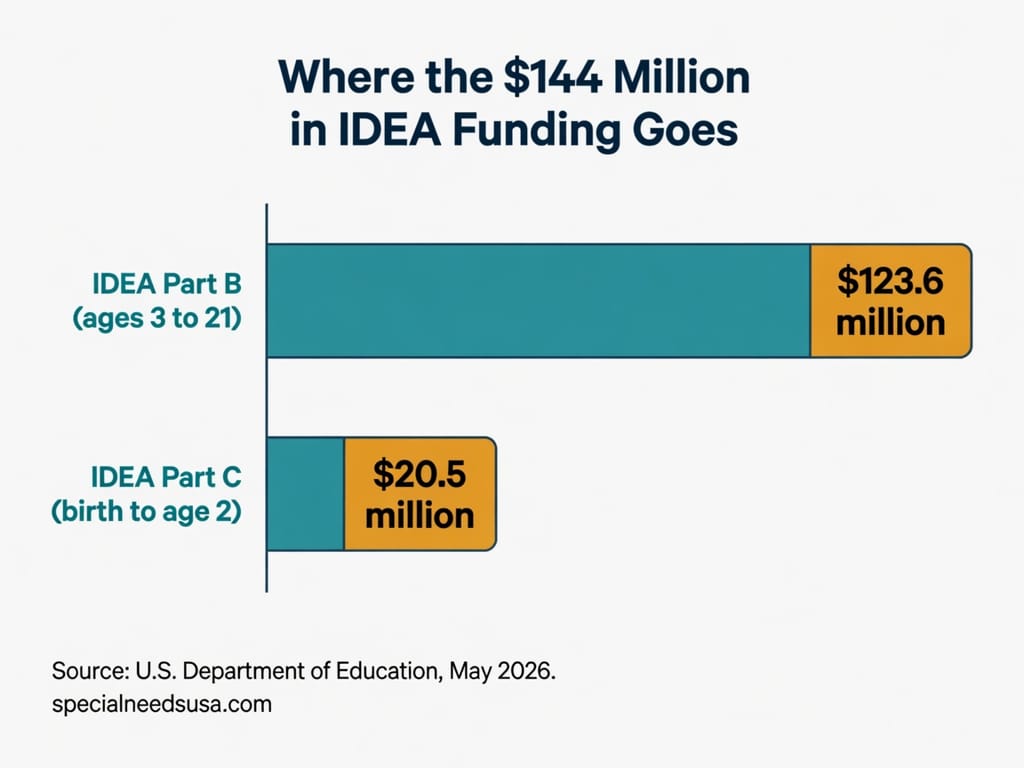
All of it came from unspent American Rescue Plan dollars that the Department redirected to states. It is not new money that Congress appropriated in the current budget cycle, which is part of why advocates treat it as a stopgap rather than a fix.
For a plain-language overview of how Part B and Part C fit together, start at IDEA.ed.gov. To find your state's Part C early intervention program, use the ECTA state contacts directory.
How the money gets to your child's program
IDEA Part B money flows from the federal government to your state education agency, then to local school districts based on a formula tied to student counts and poverty rates. Districts have wide discretion over how they spend their allocation, as long as it supports eligible students. There is no guarantee that a statewide announcement translates into shorter evaluation timelines in your specific district.
Part C works differently. Each state runs its own early intervention system under federal rules, but the state sets eligibility criteria, provider networks, and waitlist policies. The $20.5 million Part C share may help states clear backlogs, but only if your state chooses to put it toward capacity rather than backfilling existing budget holes.
If your child is waiting on services, call your district's special education office or your state's Part C coordinator and ask a direct question: has your program received additional IDEA funds this year, and is that changing evaluation or service timelines? Write down who you spoke with and what they said.
Why one-time money does not fix a long-term gap
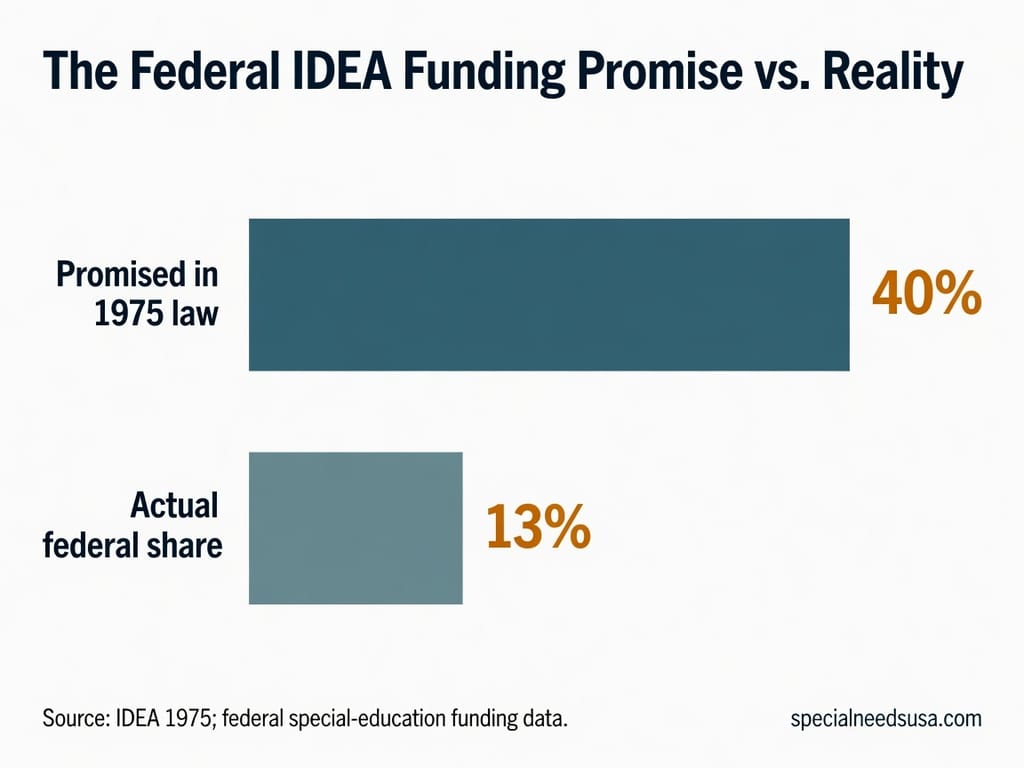
The number of children qualifying for IDEA services keeps rising. Core federal IDEA funding has stayed essentially flat for years. When Congress passed IDEA in 1975, it promised to cover up to 40% of the extra cost of educating students with disabilities. In practice, the federal share has hovered around 13% for decades. Districts make up the difference from general education budgets, which is one reason special education staffing shortages persist nationwide.
Chad Rummel, executive director of the Council for Exceptional Children, told Disability Scoop that the extra funds were welcome, but the real test is whether Congress raises baseline IDEA funding in the next appropriations cycle. Until that happens, districts are patching a chronic shortage with a one-time check.
Short term, the infusion may ease pressure on stretched early intervention programs and special education budgets. If your child is on a waitlist, now is a reasonable time to follow up. Get the answer in writing.
The policy changes behind the headlines
The funding announcement landed alongside several policy shifts that may affect your family longer than the $144 million will. The National Center for Learning Disabilities and the Autism Society of America have been tracking these closely.
The Administration has also proposed merging six separate IDEA programs and has signaled it is still evaluating whether to move special education oversight out of the Department of Education entirely. Where a program lives affects who is accountable when services fall short, so these structural questions matter even when the dollar amounts look small.
Disability groups have pushed back on plans to drop IDEA reporting on suspensions, expulsions, and racial disproportionality in school discipline. Less public data means less accountability when certain groups of students are pushed out of the classroom, and parents lose one of the few tools they have to spot patterns in their district.
Then there is the FY2027 budget, which is still being written. Current proposals pair a roughly $1 billion cut to the CDC with a $100 million increase to the NIH. As of June 2026, dedicated autism programs remain intact, including the LEND program that trains developmental specialists. Nothing is final until the September 30 funding deadline.
If the policy side feels overwhelming, our 2026 Special Education Law Guide breaks down the rights that stay constant no matter how the budget fight ends. For a wider view of where the field is heading, see The Changing Landscape of Special Needs in America. Parents weighing school versus therapy options may also find How to Choose Between ABA Therapy and a Special Needs School useful.
An access gap the funding will not touch
One finding from this month is worth sitting with. A study covered by The 74 found that students from wealthier families are more likely to receive disability accommodations than lower-income students with similar needs. Same disability profile, different outcome, sorted by income and zip code.
That matches what we hear from families every week. Having a legal right to services and actually receiving those services are not the same thing. The families who tend to win that fight have time to attend meetings, money for private evaluations or advocates, and enough system knowledge to push back when a district says no.
A funding boost does not change that math. Knowing your rights, and knowing where to find help, does. If you are at the start of the evaluation process, read What Is Autism Testing. If cost is the worry, our 2026 insurance guide for families walks through what therapy coverage actually looks like in practice.
What to do this week
Policy moves slowly. Your child's needs do not. Here are five things worth doing now, regardless of how the budget shakes out.
Request an evaluation in writing
You have the right to a free school-based evaluation. Email the request so there is a dated paper trail, and keep every reply. The new funding may shorten some waits in certain districts, so this is a reasonable time to follow up if you have already asked.
If your child is under 3, contact Part C directly
Do not wait for a pediatrician referral. Find your state's program through the ECTA directory and ask whether new IDEA funds are expanding slots or shortening waitlists.
Compare your child's IEP to what is actually happening
A plan on paper is only as good as the services that show up. If something is not being delivered, document it. Our Q&A on what to do when a school is not serving your child is a good place to start if you are stuck.
Contact your members of Congress about FY2027 funding
Baseline IDEA funding is decided in appropriations, not in one-time relief announcements. The Autism Society action center and NCLD action center let you send a message in a few minutes.
Start your provider search before you are in crisis
Whether you need a school placement or a therapy center, the search takes weeks or months. Waiting until services break down makes a hard situation harder.
Finding schools and therapy centers near you
Funding headlines come and go. The need to find the right school, therapist, and support network stays the same. That is why we built this directory: free for families, no gatekeeping, searchable by state and service type.
Browse special needs schools by state, search therapy centers near you, or use our free matching service if you would rather tell us what your child needs and get a shortlist of programs in your area.
You should not have to decode the system on your own. If something in this article raised a question about your child's situation, start with the links above or reach out through the directory. We are here to help you find the next step, not to sell you something you do not need.
Find schools and therapy providers for your child
Tell us your child's needs and location, and we'll match you with special-needs schools, ABA therapy centers, or speech-therapy providers in your area. Free for families.

