


On July 13, 2026, a Stanford Medicine team published a study in Proceedings of the National Academy of Sciences on how children and teens respond to voices. Autistic teenagers in the sample did not become more responsive to unfamiliar voices with age, unlike the typically developing teens in the same experiment; they also tuned in more to their mother's voice than to voices they did not know.
Parents of autistic kids hear a lot about early intervention. The paper does not change a diagnosis or an IEP, and it is a lab study of 79 children and teens that may help explain why social life can get harder in adolescence even when a teen still wants friends.
What researchers studied
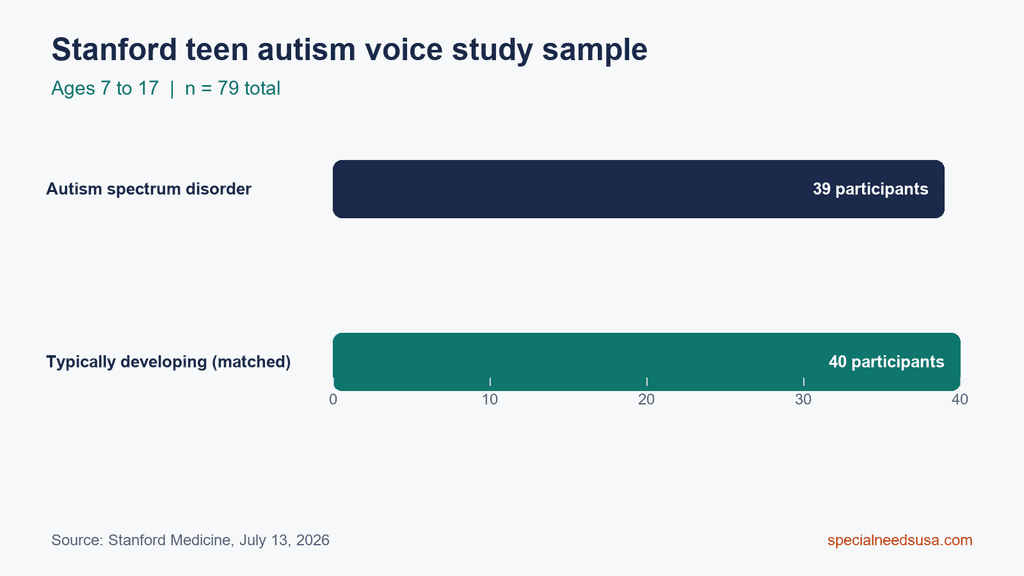
The team studied 79 children and teens ages 7 to 17: 39 with autism spectrum disorder and 40 typically developing participants matched on age, sex, and IQ (Stanford Medicine, July 13, 2026).
Get matched with schools and therapy providers
Tell us your child's needs and location, and we'll match you with special-needs schools, ABA therapy centers, or speech-therapy providers in your area. Free for families.
Free for families.
While in an fMRI scanner, participants heard brief recordings of nonsense words spoken by their mother, by two unfamiliar women, and non-voice environmental sounds. The researchers tracked how brain regions tied to reward and salience (what the brain flags as important) responded across ages.
What they found
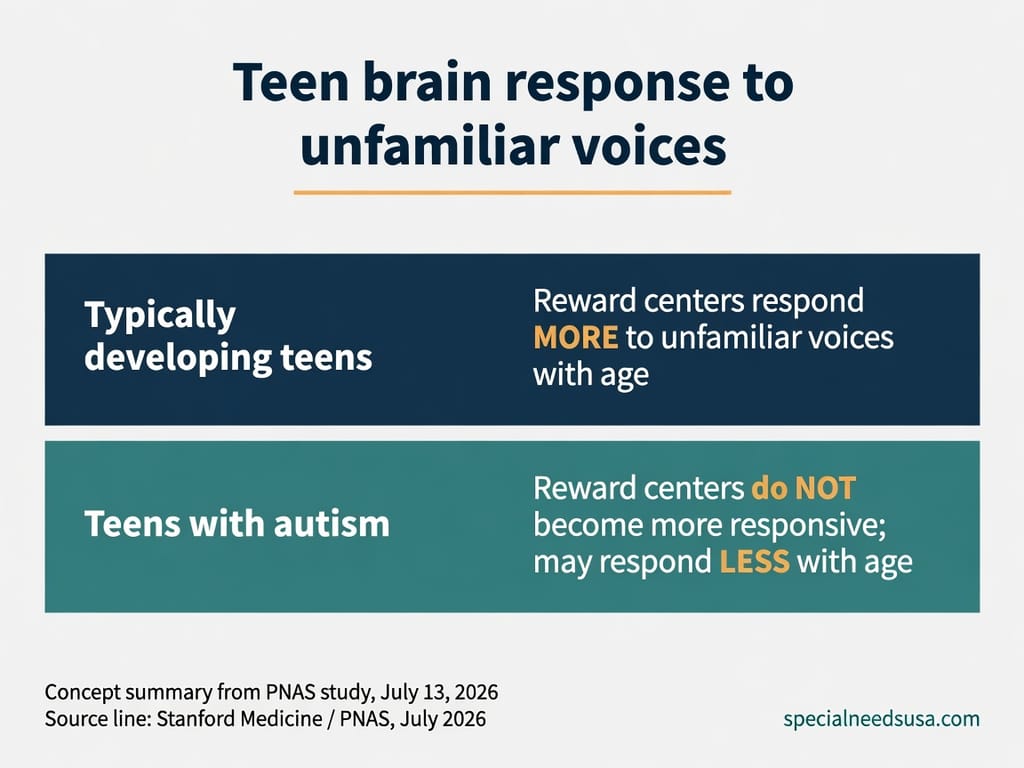
In typically developing teenagers, reward and salience centers responded more strongly to unfamiliar voices as they got older. That pattern fits what many parents see in neurotypical adolescence, when kids lean into new social partners and new friend groups.
The autistic group's reward and salience centers did not become more responsive to unfamiliar voices with age, and in some older participants they were even less responsive than in younger children with autism. Those teens also tuned in more to their mother's voice than to unfamiliar voices, the opposite of the neurotypical adolescent pattern described in the study.
Lead author Daniel Abrams, PhD, said many teens on the spectrum are "enthusiastic about building social connections," but during adolescence "their brains are not becoming increasingly responsive to unfamiliar vocal stimuli."
School and therapy in the teen years
Social difficulty at this age is easy to read as a lack of interest. The study describes many adolescents with autism as motivated to build friendships even when communication is hard.
A lot of autism support is still concentrated in early childhood. School and therapy plans should include the teen years, with social skills groups, speech-language services, counseling, and structured peer opportunities in the secondary plan rather than leftovers from elementary school. A move from a smaller self-contained setting into a larger middle or high school can coincide with the developmental shift described in the research, so ask what your district offers for secondary students. IDEA services continue through high school, and IEP teams should document social-communication goals that fit a teenager, not only a younger child.
What this does not mean
The study does not prove that any single therapy works, identify a biomarker parents can test at home, or mean that autistic teens cannot form friendships. It is one peer-reviewed study in a specific age range, using a controlled listening task.
The authors noted that autism exists on a wide spectrum and that social impairment severity varied within the autistic group. Abrams also said the brain remains plastic through adolescence, and that the findings may eventually inform teen-focused supports without replacing existing early intervention.
Where to find help
If you are trying to line up social-communication support, counseling, or a school setting that fits your teenager:
Browse autism therapy providers in your area.
Compare special-needs schools and programs that serve secondary students.
Use our free concierge matching service if you want help narrowing options by location, diagnosis, and funding.
Sources
Stanford Medicine news release, July 13, 2026; Proceedings of the National Academy of Sciences, July 13, 2026. Last updated: July 14, 2026.
Find schools and therapy providers for your child
Tell us your child's needs and location, and we'll match you with special-needs schools, ABA therapy centers, or speech-therapy providers in your area. Free for families.
