Best Special Needs Schools in Honolulu, Hawaii (2026)

Compare 2 special needs schools in Honolulu. Explore the ranked list and find a program that feels right for your child.

Free Matching

Not sure which school is the right fit for your child?

Answer a few quick questions and we'll help you compare schools in Honolulu, Hawaii for free.

Free for families.

Takes about 2 minutes

School listings in Honolulu
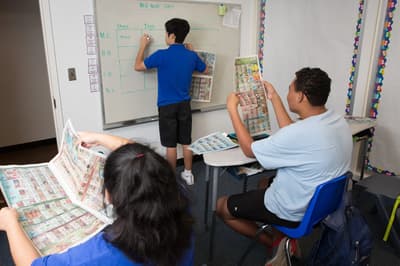
Students take part in a classroom learning activity.
1

Hawaii School for the Deaf and the Blind

Listed
Honolulu, HI

Hawaii School for the Deaf and the Blind (HSDB) is dedicated to empowering students with hearing and vision impairments through a comprehensive educational experience. The school's core mission is to foster high achievement and independence among its students, promoting both American Sign Language (ASL) and English as primary languages of instruction. HSDB serves a diverse population of students, ensuring that each child receives the support they need to thrive academically and socially. HSDB offers a range of specialized programs and services tailored to meet the unique needs of its students. Key offerings include individualized education plans (IEPs), speech and language therapy, occupational therapy, and social skills groups. The school employs evidence-based methodologies, such as Applied Behavior Analysis (ABA) and the Orton-Gillingham approach, to enhance learning outcomes. Additionally, HSDB provides family support resources and community engagement activities, fostering a collaborative environment for students and their families. What sets HSDB apart is its commitment to creating an inclusive and supportive community. The school maintains a low student-teacher ratio, allowing for personalized attention and tailored instruction. The campus features specialized technology to assist students in their learning, along with vocational training programs that prepare them for future employment opportunities. HSDB also hosts events like Ohana Day and Earth Day activities, promoting family involvement and community integration, making it a unique and nurturing environment for students with special needs.

  • Special education school
  • Hearing-impaired
  • Visual-impairment
  • Private school
View details
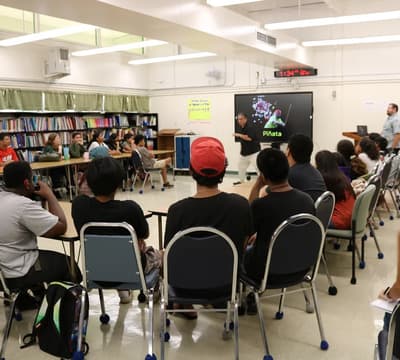
Students working together during a classroom activity at Variety School of Hawaii in Honolulu, Hawaii.
2

Variety School of Hawaii

Listed
Honolulu, HIGrades K-12 & up to 22

Variety School of Hawaii is a nonprofit, non-graded institution dedicated to empowering students aged 5 to 22 who face challenges in socialization, communicative and language development, and peer relations. The school serves a diverse population, including those with high functioning autism, anxiety-related disorders, non-verbal learning disabilities, attention deficit disorders, and mild to moderate cognitive delays. Through a multidisciplinary approach, specialized teachers and therapists implement individualized educational programs that incorporate advanced technological aids and therapy equipment. This tailored support not only addresses each child's unique educational needs but also lays a strong foundation for successful transitions to traditional schooling. Variety School distinguishes itself with a low student-teacher ratio that fosters meaningful connections between educators and students, as well as strong partnerships with families that enhance the overall learning experience. Additionally, the school offers after-school programs focused on social skills and team-building activities, along with summer programs designed to promote academic and communicative growth in an engaging environment.

  • High school
  • Anxiety-related disorders
  • Attention deficit disorders
  • Autism
View details

Nearby school options

Compare special-needs schools near Honolulu

Families often compare nearby cities when commute, availability, services, or age fit differ.

Browse all special-needs schools in Hawaii →

Planning guides

Plan your next school conversation in Honolulu

Use these guides before you contact programs, schedule tours, or ask your IEP team how a proposed setting will support your child's goals.

Comparing school options in Honolulu

Hawaii runs every public school through one statewide Department of Education (HIDOE), so Honolulu has no separate city school district. HIDOE groups schools into 15 complex areas; its Honolulu District holds the Farrington-Kaiser-Kalani and Kaimuki-McKinley-Roosevelt complex areas, while other Oahu neighborhoods belong to the Central, Leeward or Windward districts.

HIDOE serves eligible children ages 3 through 21 at no cost to parents, with services that can include academic instruction, speech-language therapy, psychological services, occupational and physical therapy, counseling and parent education. Families asking what makes a good special needs school in Honolulu are usually choosing between a HIDOE school with an IEP and a private school paid out of pocket, since the state constitution bars public money for private schools. The answers below cover autism and learning differences, the eligibility test HIDOE applies, Child Find, complex-area contacts and transition planning.

Local resources checked .

Frequently Asked Questions About Special Needs Schools in Honolulu

How do Honolulu families find the right school for an autistic child?
List what your child needs to get through a school day, such as speech therapy, a structured classroom or a behavior plan, then ask the HIDOE IEP team how its services meet each item. Private schools set their own admissions, so ask them the same questions and compare answers side by side. Our guide to choosing a special needs school walks through the comparison.
Does a dyslexia or ADHD diagnosis qualify a Honolulu student for special education?
Not by itself. HIDOE says a disability label carries no standing unless it impairs educational progress, and referrals typically follow classroom interventions that have not closed the gap. A student with dyslexia who keeps falling behind despite reading help may qualify for an IEP. ADHD supports often start with a 504 plan; see our 504 plan vs IEP guide.
Are there vouchers or ESAs for private special needs schools in Honolulu?
No. Article X, Section 1 of the Hawaii Constitution bars appropriating public funds for the support or benefit of any private educational institution, so the state offers no voucher or education savings account. Private tuition is the family's cost. A parentally placed private school student receives equitable services under a services plan, not a full IEP.
What makes a good special needs school in Honolulu?
A good school shows you, in writing, how it will work on your child's goals and how it will measure progress. It has staff trained for your child's disability in the room daily, a clear plan for hard moments and regular communication with you. A strong HIDOE IEP and a strong private program both pass this test.
What should I ask on a Honolulu school visit?
Ask the teacher's special education credentials and how many adults work with how many students. Ask which therapies happen during the school day and who provides them. Ask how staff respond to behavior, how often you will see progress toward IEP goals, and whether you can request an IEP meeting between annual reviews; HIDOE says parents can.
How does Child Find work for Honolulu children?
HIDOE Child Find identifies, locates and evaluates children who may need special education across the state. Children from birth to 3 go to the Hawaii Department of Health's Early Intervention Services. For ages 3 through 21, HIDOE evaluates academics, communication, health, vision, hearing, social-emotional status and motor skills as needed. Read our how to request a special education evaluation.
Who is my special education contact in Honolulu?
Each complex area has District Educational Specialists. Look up your school in HIDOE's school finder to see its complex, then use the HIDOE Special Education Directory to reach that complex area's specialists. Two Honolulu neighbors can belong to different complex areas, so start from your address, not the city name.
When does transition planning start in a HIDOE IEP?
HIDOE adds transition service needs to the IEP at age 14, or younger if the team decides, focused on courses of study. By the first IEP in effect at age 16, the plan must include postsecondary goals and transition services. HIDOE serves eligible students through age 21, and adults 22 and older turn to state vocational rehabilitation.

Explore More Schools in Hawaii

Discover specialized educational institutions across other cities in Hawaii.

Browse All Hawaii Cities