
Early intervention · 2026 state comparison
Is early intervention really free?
The answer depends on the program, the service and sometimes your family’s income. Compare the payment rules in every state and DC, with the source beside each answer.

 Clinically reviewed by Meaghan Timko, MS, BCBA, LBA BACB certification #1-05-2608
Start with the payment policy, not an average price
There is no single bill that describes every family’s early intervention experience. Some programs say families pay no program fee. Others use a sliding scale, insurance payments, or both. A table of private speech or occupational therapy prices does not tell you what your state Part C program will charge.
For an overview of referrals and the IFSP process, read our guide to getting early intervention. This report focuses on a narrower question: what payment rules should a family check before services start?
Under federal Part C rules, evaluation and assessment, service coordination, IFSP development and review, and procedural safeguards are provided at public expense. Other services can fall under a state payment system. A family that meets the state’s definition of inability to pay must receive its Part C services at no cost. Federal payment rules explain those protections.
A household example
What does the state’s rule mean for a family?
Choose a state to see its fee model and insurance notes. Where a current, usable schedule supports these inputs, the tool calculates an illustrative family fee. Otherwise it tells you what the program must confirm.
“Program income” means the income measure in that state’s schedule, which may be adjusted rather than gross income. Hours are used only for hourly fee models. The calculator runs in your browser and does not submit an application.
50 states + District of Columbia
Compare family payment rules
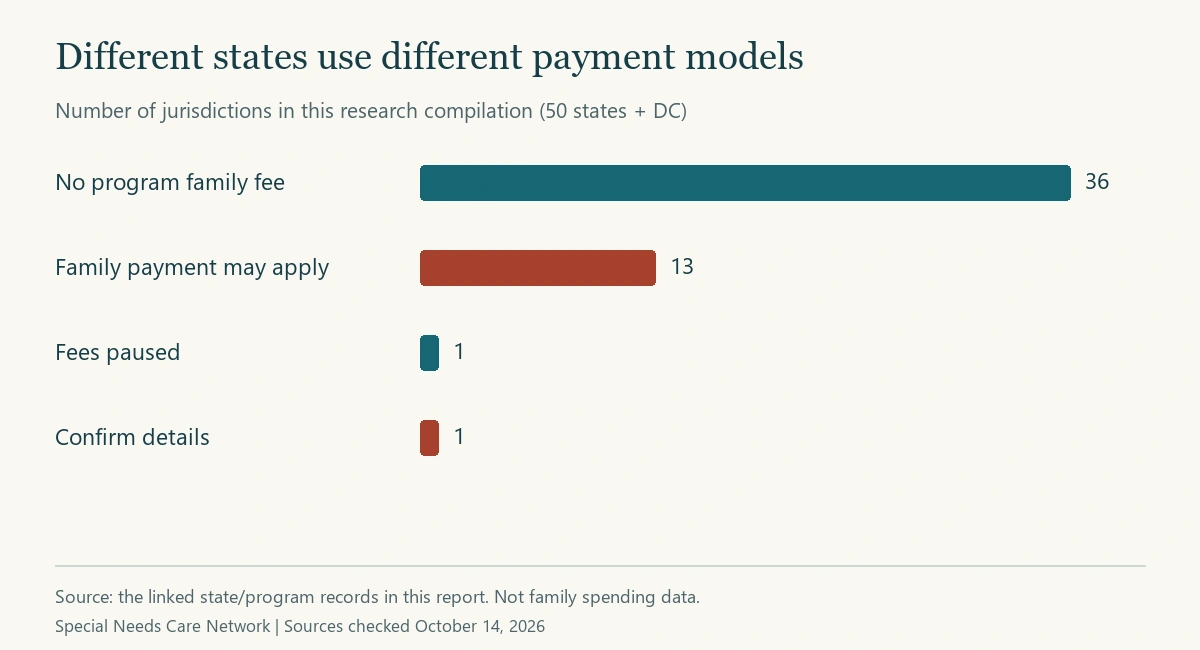
Every row links to a state or program source. “Confirm details” means the evidence does not support a dependable fee answer; it does not mean the fee is zero. A policy’s effective date and the date we checked it are shown separately.
| State / program | Family fee model | What families should check | Source / policy date |
|---|---|---|---|
| Alabama Alabama's Early Intervention System (AEIS) | No program family fee | State FAQ says federal and state funding covers EI services so there is no cost to the family. Insurance: ADRS Vital Message revised 2023-08-11 states use of public/private insurance or public benefits is voluntary; https://rehab.alabama.gov/Documents/EI/NeverTooEarlyAL/AEIS_Publications/Vital-message-revised-8.11.2023.pdf Limits of this summaryUndated web page. Applies to program EI, not independently purchased therapy. | Frequently Asked Questions About Alabama's Early Intervention System Policy: Not stated in source |
| Alaska Early Intervention/Infant Learning Program (EI/ILP) | No program family fee | Official state budget component reports elimination of family fees under policies effective July 1, 2023. Insurance: Older state PDFs describe sliding fees and insurance charges and appear superseded. Current detailed insurance cost-sharing protections were not fully verified; ask the service coordinator. Limits of this summaryOfficial budget PDF full-open returned 502; fee-elimination passage available in web search extraction. Old parents-rights and Appendix D files conflict. Do not use their fee scales or equate no program fees with no insurance costs. PN3 2025 describes elimination as 2025, conflicting with official effective date; official date retained. | FY2025 Governor: Early Intervention/Infant Learning Programs, Major Component Accomplishments in 2023 Policy: Released December 14, 2023; policies effective July 1, 2023 |
| Arizona Arizona Early Intervention Program (AzEIP) | No program family fee | Current Financial Matters policy excludes family fees and sliding fees, including other early intervention services. Insurance: Written consent required for private insurance; declining does not deny services. Families pay premiums; no deductibles charged. Co-pays are not collected unless required by insurer-provider health-plan contract. Limits of this summaryHistorical Family Cost Participation material still indexed; superseded current Chapter 5 used. Do not label all out-of-pocket insurance costs zero. | AzEIP Policy Manual Chapter 5: Financial Matters Policy: June 2025 file version |
| Arkansas First Connections | No program family fee | Program says intervention supports and services are provided with no out-of-pocket family cost. Insurance: Services funded through family health insurance and/or Medicaid. Limits of this summaryUndated page; detailed insurance consent and benefit-limit rules not extracted. | Connect with First Connections Policy: Not stated in source |
| California Early Start | No program family fee | DDS says Family Cost Participation Program and Annual Family Program Fee repealed July 1, 2024; Parental Fee Program repealed July 1, 2025. Early Start evaluation, assessment and coordination are free. Insurance: Public/private insurance accessed for medically necessary speech, physical and occupational therapies; regional centers or LEAs purchase/provide uncovered services. Limits of this summaryDo not assume insurance copays/premiums are universally waived; detailed reimbursement conditions not verified. Former FCPP was a separate regional-center program and repeal alone does not establish every insurance cost rule. | What is Early Start? Policy: Last modified February 25, 2026 |
| Colorado Early Intervention Colorado | No program family fee | Current state EI family page says services are at no cost to families, with no income participation requirements. Insurance: Detailed insurance billing/consent policy not verified in this pass. Limits of this summaryUndated program page; 2025-26 budget changes were considered but current family page remains no-cost. Do not substitute child-care subsidy copays for Part C rules. | Early Intervention Colorado: For Families Policy: Not stated in source |
| Connecticut Birth to Three | No program family fee | Family Cost Participation fees eliminated effective June 16, 2021. Current referral page states eligible evaluations and services have no out-of-pocket family cost. Insurance: Programs bill commercial insurance with consent; enrolling in public or private insurance is not required to receive supports. Limits of this summaryProgram says family system-of-payments revision preliminary. Historical monthly fee tables are obsolete. PN3 references a newer elimination timeline; official program's explicit effective date is retained. | Birth to Three: Costs and Insurance Policy: Fee elimination effective June 16, 2021; web page undated |
| Delaware Birth to Three Early Intervention Program | No program family fee | July 2023 system-of-payments policy says the program shall not charge family fees for early intervention services identified in the child's IFSP. Insurance: Policy permits, but does not require, use of Part C/other funds for deductibles, copays or coinsurance. Public/private insurance billing subject to consent protections; declining consent does not remove consented IFSP services. Limits of this summaryOlder July 2022 manual has a 290% FPL fee rule that is superseded by this 2023 version. No direct family fees does not establish zero insurance out-of-pocket exposure. | Birth to Three Early Intervention Program Policies and Procedures Manual, Section 6: System of Payments Policy: Effective July 3, 2023; OSEP approval July 1, 2023 |
| District of Columbia Strong Start | No program family fee | OSSE states eligible families receive early intervention services and supports at no cost regardless of income, insurance, legal or employment status. Insurance: Current source explicitly says no cost regardless of insurance; detailed billing mechanics not verified. Limits of this summaryOld DC EIP Central Directory describes sliding fees; current OSSE no-cost page used. Undated web page. | Strong Start: Information for Child Care Providers Policy: Not stated in source |
| Florida Early Steps | No program family fee | Official Early Steps site states early intervention services for eligible infants/toddlers are provided at no cost to families. Insurance: Detailed insurance billing and consent protections not verified in this pass. Limits of this summaryUndated site. Do not confuse Early Steps with Florida's separate Safety Net program, which has a sliding fee scale. | FDOH Early Steps: Every child develops at their own pace Policy: Not stated in source |
| Georgia Babies Can't Wait | Family payment may apply | Georgia public health district confirms services provided on a sliding fee scale. State families page confirms no-cost eligibility evaluations and transition planning. Insurance: Older 2015 draft fiscal policy discusses insurance billing and BCW-paid deductibles/copays; its current implementation not verified, so do not rely on it for a current insurance guarantee. Limits of this summaryCurrent statewide numeric fee schedule not located/verified. District source supports mechanism but not hypothetical dollar estimates. 2015 draft not promoted to current policy. | Northeast Health District: Babies Can't Wait Policy: Last updated April 11, 2026 |
| Hawaii Early Intervention Services (Early Intervention Section) | No program family fee | State DOH says no cost to families and no income restrictions. Insurance: Medicaid or private medical insurance accessed when possible with parental permission. Limits of this summaryUndated page; no detailed insurance limit/consent policy extracted. | Early Intervention Section: Early Intervention Services Policy: Not stated in source |
| Idaho Infant Toddler Program (ITP) | No program family fee | State DHW says program services provided at no cost to families. Insurance: Funding includes private insurance, Medicaid, federal and state funds. Limits of this summaryUndated page; detailed insurance protections not extracted. | About the Infant Toddler Program Policy: Not stated in source |
| Illinois Early Intervention (Illinois Department of Early Childhood) | Fees paused | Current IDEC family page explicitly says family fees remain suspended at this time. Planned January 1, 2026 implementation paused until further notice. Insurance: Fee suspension alone does not establish current insurance billing/consent mechanics; these require service coordinator confirmation. Limits of this summaryPage also retains generic fee/payment instructions and 318% FPL exemption; suspension statement governs current classification. Do not implement generic/historical scale in calculator while paused. Agency changed to IDEC July 1, 2026. | Developmental and Disability Support: Early Intervention Services Policy: Undated current IDEC page; corroborating IDHS notice December 4, 2025 |
| Indiana First Steps | Family payment may apply | Family cost participation depends on family size, gross income and documented qualifying expenses. Fees assessed per 15 minutes up to monthly maximum; families at/below 250% FPL exempt under linked procedures. Insurance: 2023 state memo says no FCP copayment on individual claims paid by insurance. Cost participation is a program copay, distinct from insurer copays: https://www.in.gov/fssa/firststeps/files/Family-Cost-Participation-Memo.pdf Limits of this summaryCurrent PDF has stale 2025 header, although effective date and FPL dollar values are 2026. Screenshot fetch timed out. Include source caveat and manual review before numeric public calculator. Procedures older but still current index link. | First Steps Policies: Cost participation sliding fee schedule Policy: Linked fee schedule effective July 1, 2026; procedures last updated 2015 |
| Iowa Early ACCESS | No program family fee | State DOE says service coordination, assessments, evaluations and needed Early ACCESS intervention services available at no cost to families. Insurance: Detailed current insurance mechanics not verified in this pass. Limits of this summaryUndated web page; does not establish costs of independently arranged medical therapy. | Iowa Department of Education: Early ACCESS Policy: Not stated in source |
| Kansas Infant-Toddler Services of Kansas / Kansas Early Childhood Developmental Services | No program family fee | KDHE Early Intervention FAQ states services and supports provided at no cost to families. Insurance: Detailed current insurance billing/consent rules not verified in this pass. Limits of this summaryFAQ also discusses preschool-age early intervention; Part C identity established through program page. Undated web page. | KDHE: Early Intervention Policy: Not stated in source |
| Kentucky Kentucky Early Intervention System (KEIS) | Family payment may apply | Monthly Family Share is $0–$400 per family, independent of visit count; hardship reduction or waiver available. Insurance: Medicaid means no Family Share; consent to bill private insurance can waive it. KEIS copays/deductibles are not charged to the family; premiums remain family responsibility. Limits of this summaryLinked chart is effective 2025-04-01, while handbook says annual April 1 revision. Do not use its dollar thresholds for October 2026 quotes. | Kentucky Early Intervention System Policy: Not stated in source |
| Louisiana EarlySteps | Family payment may apply | Family Cost Participation applies; official policy defines inability to pay at or below 300% FPL and considers extraordinary expenses. Insurance: Services have multiple payers including Medicaid. Do not treat the participation fee as an insurance copay. Limits of this summaryPolicy is old; current budget corroborates fee mechanism, not a current dollar schedule. Numeric estimates unavailable. | EarlySteps Program Policies Policy: October 2014 / OSEP January 2015 |
| Maine Early Intervention for ME (Child Development Services) | No program family fee | State family resource material describes the birth-to-three program as free and voluntary. Insurance: State 2026 extended EI policy lists Medicaid/MaineCare, private insurance and public funds as possible funding sources. Limits of this summaryUndated family resource. Insurance billing safeguards not fully extracted; no inference about non-IFSP private treatment. | Support for Maine Families with Young Children Policy: Not stated in source |
| Maryland Maryland Infants and Toddlers Program (MITP) | No program family fee | EI services are provided at no cost to families. Insurance: No charge irrespective of family income, insurance availability or employment status per state family guide. Limits of this summaryProgram-covered services; privately arranged treatment is outside this finding. | Maryland Infants and Toddlers Program — State Board Briefing Policy: 2025-02-25 |
| Massachusetts Massachusetts Early Intervention | No program family fee | Massachusetts DPH states families have no out-of-pocket costs for EI. Insurance: Program overview establishes no out-of-pocket costs but does not detail all billing mechanics. Limits of this summaryDirect open returned 403; indexed official page text was available. No inference about services outside EI. | About Massachusetts Early Intervention (EI) Policy: Not stated in source |
| Michigan Early On Michigan | No program family fee | Early On has no cost for qualified children and families. Insurance: No-cost program statement; insurance mechanics not established by this page. Limits of this summaryDo not extend to independently arranged therapy or infer eligibility from cost status. | Early Intervention for Ages Birth–3 Policy: Not stated in source |
| Minnesota Infant and Toddler Intervention / Help Me Grow | No program family fee | Eligible children receive free early childhood intervention services regardless of income. Insurance: Statute distinguishes core services from additional services using third-party payments; IFSP must define any financial responsibility for additional services. Limits of this summaryNo-cost claim concerns eligible school-system EI; additional medical/private services can have distinct payment rules. | Help Me Grow Minnesota Policy: Not stated in source |
| Mississippi First Steps Early Intervention Program | No program family fee | First Steps EI services are provided at no cost to families. Insurance: Official program materials state no out-of-pocket deductibles or copays for service provision; insurance premiums excluded. Limits of this summaryPremium exclusion documented separately in official First Steps 10482.pdf; no inference about private treatment. | Healthcare Professionals — First Steps Policy: Last reviewed 2024-09-18 |
| Missouri First Steps | Family payment may apply | Monthly Family Cost Participation applies using family size and income. Insurance: Public/private insurance and family fees are distinct funding sources; current program has an active payment process. Limits of this summaryFY2027 linked PDF could not be extracted; search returns expired FY2026 figures. Do not use those for October 2026 estimates. | Missouri Family Cost Participation (FCP) Fee Schedule Policy: FY2027 (linked document title) |
| Montana Montana Milestones Part C | No program family fee | System has no family fees or sliding fees; Part C services are at no cost to families. Insurance: Private insurance use is voluntary; Part C or other funds may pay associated deductibles/copays. Limits of this summaryStill linked from current program resources; does not cover privately arranged non-IFSP care. | Montana Milestones Part C of IDEA: System of Payments Policy Policy: July 2022 |
| Nebraska Early Development Network (EDN) | No program family fee | Appropriate services agreed by the IFSP team are at no cost to the family. Insurance: Guide establishes no-cost EDN services, not a complete insurance billing explanation. Limits of this summaryNo-cost claim concerns EDN services and eligibility; unrelated health-care costs excluded. | Family's Guide to Early Intervention Services in Nebraska Policy: Not stated in source |
| Nevada Nevada Early Intervention Services (NEIS) | No program family fee | IFSP EI services are free. Insurance: No copays/deductibles for IFSP services; written consent required to bill private insurance. Premiums and non-IFSP costs remain family responsibility. Limits of this summaryDo not count premiums or privately obtained non-IFSP services as program-paid. | Written Notice on Billing Private Insurance and Medicaid — NEIS-EI-01 Policy: 2025-06-03 |
| New Hampshire Family-Centered Early Supports and Services (FCESS) / Birth to 3 | No program family fee | State rights booklet describes no-cost services for uninsured families; insurance supports funding. Insurance: He-M 510 bars collecting private-insurance deductibles, coinsurance and copays from families; private insurance requires authorization. Limits of this summaryPremium or long-term insurance considerations remain in required disclosures. Scope is FCESS. | New Hampshire Administrative Rules, He-M 510 Policy: Not stated in source |
| New Jersey New Jersey Early Intervention System (NJEIS) | Family payment may apply | Some direct IFSP services have hourly family cost participation and a monthly maximum; below 300% FPL has no participation. Extraordinary medical expenses can reduce fees. Insurance: NJEIS handbook excludes private insurance from the system of payments; program family participation is separate from a commercial insurance copay. Limits of this summary89-page SFY2027 PDF opened initially but repeated retrieval/extraction timed out; exact positive-fee rows not verified. Do not quote a dollar estimate from an older table. | System of Payment and Family Cost Participation Policy: Reviewed 2026-06-25; SFY2027 table effective 2026-07-01 through 2027-06-30 |
| New Mexico Family Infant Toddler (FIT) Program | No program family fee | FIT provides EI at no cost to families. Insurance: FIT bills Medicaid/private insurance with parental agreement; families are not charged copays or deductibles. Limits of this summaryNo-cost finding concerns FIT-covered services, not all pediatric therapy. | Family Infant Toddler (FIT) Program Policy: Not stated in source |
| New York Early Intervention Program (EIP) | No program family fee | EI services are provided at no cost to families. Insurance: Medicaid and private insurance may help fund services; county/state cover family out-of-pocket payments and copayments under EIP. Limits of this summaryInsurance type and state regulation affect billing. Private treatment outside EIP excluded. | Parent's Questions and Answers Policy: Not stated in source |
| North Carolina North Carolina Infant-Toddler Program (NC ITP) | Family payment may apply | Certain services may have family charges using a sliding fee scale based on verified family income and size; core referral/evaluation/coordination functions have no direct family charge. Insurance: Public/private insurance may be billed with written authorization; family fee is a separate program payment rule. Limits of this summaryCurrent forms page links FY2025–2026 scale only, using AGI or CDSA-verified income and size. Outdated period prevents October 2026 numeric estimates. | North Carolina Infant-Toddler Program Guidance to Reimbursement Procedures Policy: Not stated in source |
| North Dakota North Dakota Early Intervention System | No program family fee | No family fees, copays or deductibles for IFSP early intervention services. Insurance: Private insurance excluded from the state system of payments; public benefits may fund services without parent costs. Limits of this summaryCosts apply only to official Part C/IFSP services, not separately arranged private therapy. | North Dakota Early Intervention Policy Package, Section II, sections 13.5-13.6 Policy: Revised May 2023 |
| Ohio Ohio Early Intervention | Family payment may apply | First 100 units per child per IFSP year are free. A unit is one hour of service or $100 of assistive technology expense; partial units count. Additional services may carry parent costs unless financially exempt. Insurance: Parent consent needed to use insurance. WIC/Ohio Medicaid enrollment, income at or below Healthy Start uninsured-child eligibility, or extraordinary medical expenses can exempt family from costs. Limits of this summaryNot a universal zero-fee state. Rate after 100 units and current Healthy Start threshold not verified; calculator must not estimate post-allowance costs. | Parent Rights and Procedural Safeguards: System of Payments Policy: July 2024 |
| Oklahoma SoonerStart | No program family fee | SoonerStart does not charge families fees, copayments, deductibles or premiums. Insurance: Medicaid use requires consent and declining consent does not remove IFSP services. Limits of this summaryOfficial policy is old; currently linked families portal should be checked for superseding policy before publication. | SoonerStart Policies and Procedures Policy: March 11, 2013 |
| Oregon Early Intervention / Early Childhood Special Education | No program family fee | Screening, evaluation, services and support are provided to eligible children and families at no cost. Insurance: Insurance billing details not established by this overview. Limits of this summaryCosts apply only to official Part C/IFSP services, not separately arranged private therapy. | Early Intervention / Early Childhood Special Education Policy: Not stated in source |
| Pennsylvania Pennsylvania Early Intervention | No program family fee | Early Intervention services are provided at no cost to families; no income information is collected for family fees. Insurance: Private insurance can only be used with consent and without costs such as deductible expense, loss of coverage or increased premiums. Medical Assistance use must also protect families from costs. Limits of this summaryCurrent DOE overview independently confirms no cost: https://www.pa.gov/agencies/education/programs-and-services/instruction/early-learning/early-intervention . A national fee-reliance classification conflicts with these state sources and must not imply PA families owe EI fees. | EI 13-02: Pennsylvania System of Payment Policy: EI 13-02, 2013 |
| Rhode Island Rhode Island Early Intervention | No program family fee | No family fees, copays or deductibles for Part C IFSP services. Insurance: Private/public insurance and public funds pay services; family remains responsible for existing insurance premiums. Limits of this summaryCosts apply only to official Part C/IFSP services, not separately arranged private therapy. | Early Intervention Program, 210-RICR-30-15-1, section 1.13 Policy: Not stated in source |
| South Carolina BabyNet | No program family fee | Publicly funded BabyNet services are free for eligible children. Insurance: Public/private insurance can be billed. BabyNet FAQ says private insurance billing can count toward plan visits; families should ask their carrier. Private insurance may be required as primary payer where Medicaid also covers the child. Limits of this summaryNo cost statement is explicit; insurance details from https://scdhhs.gov/sites/dhhs/files/babynet/Summer%20Summit%20FAQ%20FINAL.pdf . No claim that all insurance consequences are absent. | BabyNet Policy: Undated current program page |
| South Dakota Birth to Three Connections | No program family fee | The state program does not charge family fees for early intervention services. Insurance: System of payments incorporates public benefits/Medicaid and private insurance. Limits of this summaryPolicy is old though still state hosted; newer state 2025 reservation guidance also confirms no-cost family services and payer of last resort. | Birth to Three Connections Program: System of Payments Policy: November 2012 |
| Tennessee Tennessee Early Intervention System (TEIS) | No program family fee | Eligible children receive services at no cost; evaluation and service coordination are also free. Insurance: Program funded through state/federal funds, Medicaid and private insurance; service coordinator discusses consent to access child insurance. Limits of this summaryCosts apply only to official Part C/IFSP services, not separately arranged private therapy. | TEIS Family Resources Policy: Not stated in source |
| Texas Early Childhood Intervention (ECI) | Family payment may apply | Family Cost Share depends on household size and adjusted annual income. Eligible families are billed no more than the lesser of the monthly maximum or actual unpaid service balance after insurance. Insurance: State booklet describes zero out-of-pocket for Medicaid child with consent to bill; foster/kinship care and adjusted income at or below 100% FPL have zero maximum. Limits of this summaryCurrent numerical sliding fee schedule could not be verified; do not use historic dollar tables. August 28, 2026 rule amendments are proposed and are not proof of enactment. HHS overview search-readable but direct fetch returned 403. | Paying for Early Childhood Intervention Services Policy: Not stated in source |
| Utah Baby Watch Early Intervention | Family payment may apply | Monthly family fee uses modified annual income and family size, from exempt to $200/month. Qualifying assistance-program exemptions apply. Current scale also lists a $100 charge for missing 3+ scheduled visits within one year. Insurance: Medicaid/CHIP enrollment waives family fee. Determination form also identifies WIC, Early Head Start and other assistance exemptions; child public insurance may be billed. Limits of this summaryEncode only household of four. Modified income requires state determination worksheet; exclude missed-visit charge from regular monthly scenario. Exemptions documented in Family Fee Determination Form dated September 17, 2025. | Baby Watch 2026-2027 Sliding Fee Scale Policy: 2026-2027 |
| Vermont Children's Integrated Services Early Intervention | Confirm details | No verified sliding family fee; free core services. Therapies may generate insurance copays/deductibles. Families unable to pay can request EI financial assistance. Insurance: Written consent required to bill insurance; family responsible for copays/deductibles unless assistance approved. Families can decline insurance use if it causes financial difficulty. Limits of this summaryNo_family_fee classification does NOT mean zero out-of-pocket costs; insurance cost-sharing remains possible. Amount depends on plan, no numeric estimate. Broader current CIS page says low or no cost. | Paying For Your Child’s Early Intervention Services Policy: October 2021 |
| Virginia Infant & Toddler Connection of Virginia | Family payment may apply | Charges can apply to supports/services beyond evaluation, assessment, coordination and IFSP development. Ability to pay determined using family size, income and expenses; inability to pay must not delay or deny services. Insurance: Service coordinator establishes ability to pay and insurance consent; Medicaid/FAMIS and private insurance can be used with required safeguards. Limits of this summaryCurrent dollar fee-scale not verified. State program overview confirms family charges: https://itcva.online/intro-overview/ . Do not calculate amounts from old fee tables. | 12VAC35-225-230: System of payments Policy: Not stated in source |
| Washington Early Support for Infants and Toddlers (ESIT) | Family payment may apply | Families at or above 200% FPL in adjusted annual income may pay insurance cost-sharing or a monthly participation fee; below 200% are unable to pay and owe neither. Hardship exemptions apply. Insurance: Families pay either insurance copays/coinsurance/deductibles OR monthly fee. Public-benefit families receive no-cost services. No insurance or refusing private/TRICARE access may lead to monthly fee if able to pay. Limits of this summaryCurrent dollar monthly fee table not verified; no numeric estimate above inability-to-pay threshold. Use adjusted annual income with allowable expenses, not gross income. | ESIT Policies and Procedures, Policy 14 Policy: Revised September 2025 |
| West Virginia WV Birth to Three | No program family fee | No charge to eligible children and families for services identified on their IFSP. Insurance: Insurance mechanics not established by this overview. Limits of this summaryCosts apply only to official Part C/IFSP services, not separately arranged private therapy. | WV Birth to Three: Referrals Policy: Not stated in source |
| Wisconsin Wisconsin Birth to 3 | Family payment may apply | Financially able families participate in parental cost share. Official 2026 tables specify monthly and annual amounts by family size and adjusted annual income. Insurance: Families are asked for consent to bill insurance and may be asked to apply for eligible Medicaid programs. Limits of this summarySchedule encodes one child in program, household of four only. Adjusted annual income is not gross earnings; cost-share exemptions/adjustments and county determination must be considered. | Birth to 3 Program Parental Cost Share Tables: Based on 2026 Federal Poverty Guidelines Policy: 2026 |
| Wyoming Early Intervention and Education Program (EIEP) | No program family fee | State EIEP provides free screenings and services; official parent brochure likewise says no-cost EI supports and services. Insurance: Insurance mechanics not established by this overview. Limits of this summaryState program also serves preschool ages; article should identify Part C birth-to-three scope. | Early Intervention and Education Program: Find A Center Policy: Not stated in source |
Read the bill correctly
Four questions that change the comparison
1. What is the fee’s unit?
An hourly contribution, a monthly charge and an annual maximum measure different things. Multiply an hourly fee only by the billable hours it covers. Do not turn a maximum into a guaranteed bill or assume it is charged every month.
2. Whose income counts?
Use the program’s definition of income and family size. If the policy allows deductions for certain expenses, a salary figure alone will not produce the final fee. Ask for the written calculation so you can see which inputs were used.
3. What happens when insurance pays?
Insurance billing does not, by itself, tell you whether you owe a copay, deductible or separate family fee. Ask who pays any patient responsibility and whether a claim can change a benefit limit. Federal rules contain notification and consent protections; the state’s written system of payments should explain how it handles those costs. Read the insurance provisions.
4. Is there a hardship adjustment?
A published schedule is only part of a payment policy. Before treating its figure as your bill, ask about the state’s inability-to-pay definition, allowable expenses and review process. Keep a copy of the policy and the program’s written answer.
The same income, different payment rules
Worked examples with visible assumptions
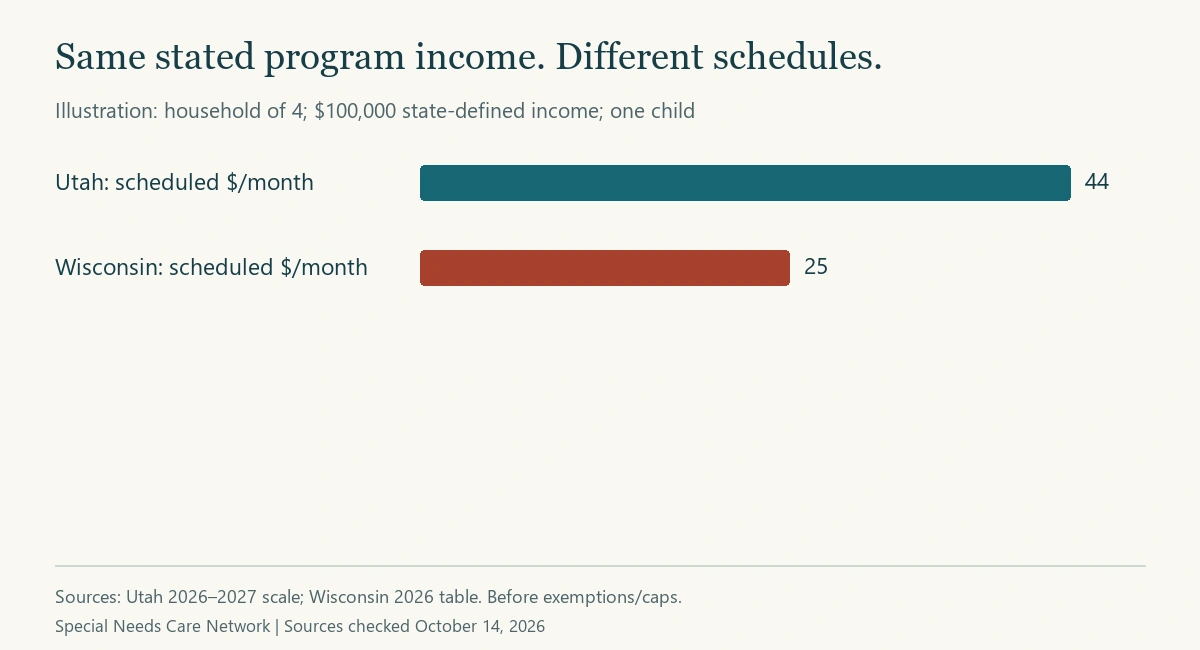
These are policy calculations, not observed average bills. They use a household of four and the schedule’s own income basis. The comparison excludes private therapy purchases and any insurance effect not explicitly included in the rule.
Wisconsin
Household of four; one child. Input basis: adjusted annual income usd.
| Annual program income | Scheduled fee |
|---|---|
| $60,000 | $0 scheduled / month |
| $80,000 | $0 scheduled / month |
| $100,000 | $25 scheduled / month |
| $150,000 | $75 scheduled / month |
Published scheduled monthly amount before exemptions and any service-cost cap. One child receiving services; no qualifying benefit exemption; use the state-defined adjusted/modified income, not gross salary. No missed-visit charges included. Wisconsin’s built-in child allowance is not deducted again.
Utah
Household of four; one child. Input basis: modified annual income usd.
| Annual program income | Scheduled fee |
|---|---|
| $60,000 | $0 scheduled / month |
| $80,000 | $20 scheduled / month |
| $100,000 | $44 scheduled / month |
| $150,000 | $55 scheduled / month |
Published scheduled monthly amount before exemptions and any service-cost cap. One child receiving services; no qualifying benefit exemption; use the state-defined adjusted/modified income, not gross salary. No missed-visit charges included.
What to ask before agreeing to a payment
Ask the service coordinator for one written example using your household’s inputs and expected services. The example should identify which functions are free, which services have a charge, the charge’s unit, any cap, and what happens if insurance pays only part of a claim.
If a fee is tied to service hours, ask whether a cancelled visit, a group visit or travel time is billable. If several children receive services, ask whether the limit applies to each child or the household. These questions help you compare the right quantities without assuming every state counts them the same way.
Request a dated copy of the schedule and ask when it will next be reviewed. A newly published poverty guideline does not prove that a state has already updated its fee table. Proposed rules, paused fees and old schedules need separate treatment.
If you are comparing an independent clinic with a state-funded option, our questions for choosing a therapy center can help organize the conversation. Keep the clinic’s quote separate from the Part C fee calculation.
Service access is another question. A payment policy cannot tell you when a professional has an opening. The guide to navigating a therapy waitlist addresses that separate part of the process.
Keep the transition to school services separate
This table covers Part C payment policies, rather than school tuition or the price of services bought outside the program. When a child approaches the transition to preschool services, ask the team which program will be responsible for each service and which written plan applies.
Our parent guide to an IEP explains the school plan. If you need help understanding the evaluation process, use the guide to requesting a school evaluation. Neither a fee comparison nor an insurance approval decides a child’s educational eligibility.
For a broader view of how support differs between locations, our state-services comparison covers questions beyond this report’s fee scope. This table does not rank states as better places to live.
Questions families ask
Is an early intervention evaluation free?
Evaluation and assessment under Part C are among the functions provided at public expense under 34 CFR 303.521(b). A private clinical assessment booked outside the state program is a different transaction. Ask which program is arranging the evaluation before assuming a clinic invoice follows the Part C rule.
Does a $0 family fee mean insurance is never billed?
No. The fee and insurance columns answer different questions. A program can use insurance as a funding source while its payment policy protects families from some or all patient charges. Use the linked state policy to check those details, including consent requirements; a zero in the family-fee column alone is not enough.
Why does the calculator sometimes say “Confirm with the program”?
A reliable estimate needs the right schedule, effective date, household definition and payment unit. Some policies also depend on insurance or expenses that this tool does not collect. We show the rule and source instead of guessing a price. The downloadable data retains those limits so they are not lost when the table is reused.
Can I compare the amounts as average therapy costs?
No. These are payment-policy summaries and, where supported, hypothetical family-fee calculations. They do not measure private-market prices, actual family spending, clinical service needs or how much treatment a child receives. Use a provider’s written quote for a private purchase and the program’s written calculation for a Part C family fee.
What if our family cannot afford the fee?
Ask the program to apply its written inability-to-pay policy and explain the review process. Federal Part C rules protect families that meet the state’s definition. This report does not decide whether your household meets that definition; the linked policy and your service coordinator are the starting points.
How to read and reuse this report
Sources, method and limits
We reviewed state agency and designated program materials for all 50 states and the District of Columbia. The table records the payment statement supported by each source, the document date when available, insurance qualifications and unresolved questions. It does not use parent anecdotes to set prices.
The classification describes the evidence reviewed on October 14, 2026. A source checked on that date may carry an older effective date or no publication date. A newer national summary does not automatically override a state payment policy. Where those sources disagree, the row explains the issue rather than averaging incompatible answers.
We do not calculate a national average fee. Programs use different income definitions, charge units, allowances and insurance arrangements. A count of states in one category cannot establish the percentage of children whose families pay. Unknown values remain unknown in the table, calculator and downloads.
The calculator’s income-to-guideline reference uses the 2026 HHS poverty guidelines, including the separate Alaska and Hawaii amounts. It is a reference ratio, not an eligibility decision or a substitute for a state’s schedule year.
Every numerical state example requires a verified rule in the data file. Unsupported household sizes return no estimate. Figures should be rechecked before release and when a state updates its policy; no automatic monitoring service is implied.
Research compilation: Special Needs Care Network. Source links make the payment rules and their limits available for checking; no individual eligibility or final billing determination is made here.
Federal sources: Part C payment rules; insurance rules; HHS guidelines. State-specific sources appear in every table row and in the JSON/CSV downloads.
Bring the state policy to your next conversation
Choose your state, open its source and ask the program for a written family-fee calculation. That is the most useful next step when a general statement such as “early intervention is free” does not explain what your household will pay.
When you are ready to explore services outside the state program, you can browse therapy providers and request a separate quote. A directory listing does not establish Part C participation or availability.