


Introduction to Autism Diagnosis History
Autism wasn't always a recognized condition. It became one in 1943, when the Austrian-born psychiatrist Leo Kanner published a paper describing it as a distinct disorder, separate from schizophrenia and intellectual disabilities. That paper set the terms for how autism spectrum disorder gets diagnosed today. Knowing this history clarifies where today's diagnostic criteria came from, and why they look the way they do.
Diagnosis often leaves parents confused about where autism comes from and what happens next. That question traces back to Johns Hopkins, where Kanner began observing children who shared traits: social withdrawal, repetitive behaviors.
Get matched with schools and therapy providers
Tell us your child's needs and location, and we'll match you with special-needs schools, ABA therapy centers, or speech-therapy providers in your area. Free for families.
Free for families.
At that time, autism seemed rare, with estimates around 4 to 5 children per 10,000. Today, broader criteria catch more cases, helping families access services sooner. Parents can use this background to spot signs early and choose the right supports, like early autism screening.
Kanner's breakthrough marks how far the field has traveled since 1943. Knowing that history gives parents a clearer footing for navigating a diagnosis today, tying old observations to practical steps for a child's future.
Who Was Leo Kanner?
Leo Kanner left Austria for the United States in 1924, fleeing rising antisemitism. He landed in child psychiatry at Johns Hopkins Hospital in Baltimore and built a clinic there for children's emotional and behavioral issues. His eye for patterns in child development still shapes how parents get answers today.
The motivation came from real cases in front of him. Starting in the late 1930s, Kanner noticed children who didn't fit any typical diagnosis: they avoided eye contact, echoed words without apparent meaning, fixated on objects or routines. He documented them for years before he published anything.
Kanner was born in 1894 and trained in medicine and psychology in Europe. His 1943 paper, "Autistic Disturbances of Affective Contact," gave the condition its name. He described it as "autistic aloneness": children who seemed locked inside their own world, a phrase parents still recognize today.
He pointed to innate traits, not family dynamics, as the cause, breaking from the thinking of his era and opening the door to biological research. Kanner's own persistence is part of the story too: one doctor's clinical notes reshaped how the world understands autism spectrum disorder.
If a child shows delayed speech or prefers solitude, Kanner's cases are worth recalling. Seek evaluation early, the way his clinic did, so interventions can start promptly. His legacy is a simple one: careful observation leads to action.
Breakdown of Kanner's 1943 Paper
The 1943 paper detailed 11 children, ages 2 to 8, and the similarities among them were striking. Social withdrawal came first: these children ignored people, parents included. Communication problems stood out too. Some never spoke at all; others repeated phrases with no context, like "clockwork orange."
Repetitive behavior was the third thread. These children insisted on sameness and grew upset by any change to routine or objects. One boy spun plates endlessly; another had train schedules memorized perfectly but couldn't manage ordinary play. Kanner had a name for it: "insistence on sameness."
These traits still echo in modern checklists. Kanner noted strong rote memory paired with gaps in abstract thinking, and he ruled out intellectual disability outright: many of the children scored average or above on nonverbal tests.
He also rejected any link to schizophrenia. Where psychotic children showed hallucinations, his patients didn't; they stayed emotionally flat instead. The origins, he believed, were inborn and present from infancy, not something parenting caused.
Picture a toddler lining up toys with rigid precision, avoiding hugs, echoing back questions instead of answering them. Kanner would have flagged this pattern as autism. Today it maps onto DSM-5 criteria, which is what gets a child a quick referral.
Old family videos are worth a second look for early signs like poor eye contact. Bring what you find to a pediatrician and point to Kanner's original traits for a more focused assessment. His paper still gives parents the vocabulary to advocate.
Key Traits from Kanner's Observations
Social isolation, or "autistic aloneness."
Delayed or echolalic speech.
Repetitive play and routines.
Excellent memory for details, poor for concepts.
No delusions, unlike schizophrenia.
This breakdown helps parents connect dots historically. For deeper reading, see Kanner's diagnosis evolution to DSM-III.
Early Reactions and Missteps After Kanner
Kanner's ideas didn't stay settled for long. Praised at first, they got twisted over the following decades. Bruno Bettelheim took them furthest, claiming "refrigerator mothers" caused autism through emotional coldness, a theory that blamed parents for what was actually a biological condition and did real damage to families.
Even Kanner wavered for a time, hinting at parental detachment as a factor. He walked that back before he died in 1981, returning to his emphasis on innate causes. Knowing that history helps today's parents push back on stigma: these were errors in the record, not facts.
Prevalence estimates stayed low for decades. Victor Lotter's 1966 study found just 4.5 children per 10,000 who matched Kanner's criteria strictly, and the era's missteps delayed recognition of milder cases. By the 1970s, research had shifted toward genetics and neurology.
The old blame is worth ignoring outright. The science now points to 80-90% heritability. If you're facing judgment from someone who doesn't know that, point them to Kanner's own final views and to modern research.
If a grandparent brings up "bad parenting," Kanner's own insistence on innate causes is the answer. This history gives parents something concrete to push back with against outdated views.
Evolution from Kanner to Spectrum Disorder
Lorna Wing built on Kanner's work through the 1970s. Working with Judith Gould, she identified the "triad of impairments": deficits in social interaction, communication, and imagination. Their 1979 Camberwell study counted 20 children per 10,000, a much broader number because it captured milder cases too.
DSM-III added "infantile autism" in 1980. DSM-IV widened the net further in 1994, folding in Asperger syndrome and PDD-NOS. By 2013, DSM-5 collapsed all of it into a single category, autism spectrum disorder, distinguished by severity level rather than separate diagnoses.
Prevalence jumped: now 1 in 36 US kids. Parents see this as better detection, not epidemic. Check autism history timeline for details.
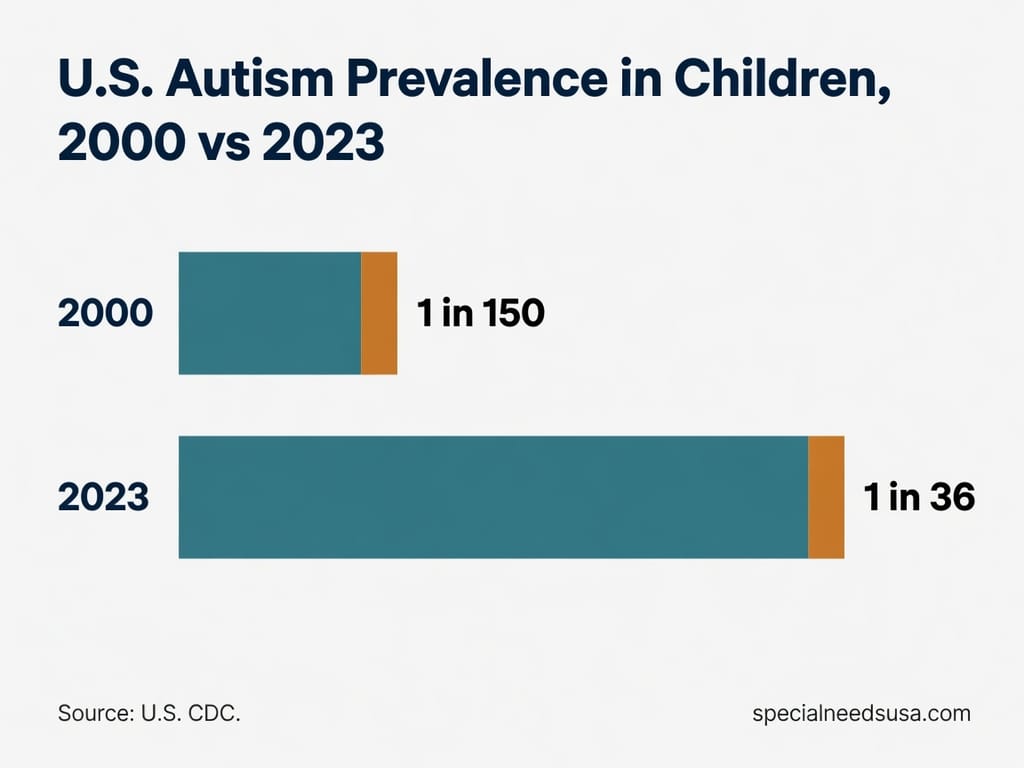
The spectrum framing is useful for matching supports to the child. A high-needs child may need intensive therapy. A milder presentation might call for social skills groups instead.
Major Milestones Post-Kanner
1979: Wing's triad broadens criteria.
1980: DSM-III lists autism.
1994: DSM-IV subtypes.
2013: DSM-5 spectrum model.
For DSM shifts, read evolution of autism diagnosis.
Modern ASD Diagnosis and Parent Action Steps
An ASD diagnosis today requires persistent deficits in social communication plus restricted, repetitive behaviors, with onset in early development that isn't better explained by an intellectual disability. Screening typically happens at 18 to 24 months, using the M-CHAT tool.
Parents act fast: Pediatrician referral leads to developmental pediatrician or psychologist. Early intervention boosts outcomes 50%. Consider ABA therapy options versus schools.
Secure IEPs for school. Check insurance for autism services, as most states mandate ABA coverage. Visit SpecialNeedsUSA therapy directory.
A few concrete steps: track developmental milestones monthly, request a free screening, and build a team that includes a therapist and a school advocate. History backs this up. Kanner's own observations showed that early action changes a child's trajectory.
Wrapping Up: History Guides Your Next Moves
Kanner's 1943 paper launched autism recognition. Parents now tap expanded services. Explore local options at SpecialNeedsUSA states for schools and therapies.
FAQ
Who was Leo Kanner and what did he contribute to autism?
Leo Kanner was a child psychiatrist at Johns Hopkins. In 1943 he published the first description of autism as a distinct condition, based on his observation of 11 children.
What traits did Kanner describe in his 1943 autism paper?
He described autistic aloneness, insistence on sameness, echolalia, repetitive behaviors, and strong rote memory paired with social deficits.
How did views on autism causes change after Kanner?
The early blame placed on parents eventually faded as research confirmed biological and genetic roots by the 1970s.
When did autism become the broader ASD spectrum?
DSM-5, published in 2013, unified the separate subtypes into a single category: autism spectrum disorder.
How does Kanner's history help parents spot early signs?
Kanner's original traits still line up with modern checklists, which is why parents are encouraged to watch for withdrawal and rigid routines starting in infancy.
What role did Lorna Wing play in autism diagnosis evolution?
Lorna Wing introduced the triad of impairments in 1979, expanding the diagnosis well beyond Kanner's narrower original cases.
How has ASD diagnosis prevalence changed since 1943?
Estimates moved from 4.5 per 10,000 to 1 in 36 today, a shift driven by broader diagnostic criteria and greater awareness.
What practical steps can parents take post-diagnosis?
Screen early. Pursue ABA therapy or specialized schools. Secure insurance coverage and IEPs. Build a support network.
Find schools and therapy providers for your child
Tell us your child's needs and location, and we'll match you with special-needs schools, ABA therapy centers, or speech-therapy providers in your area. Free for families.