

Rio Grande Educational Collaborative
Grades and ages
Ages 5-11
Tuition
Contact for pricing
About Rio Grande Educational Collaborative
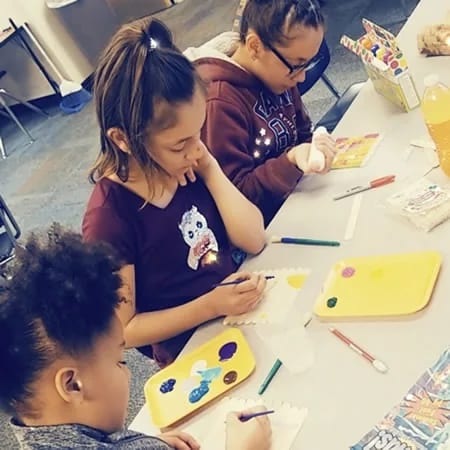
Rio Grande Educational Collaborative runs before and after school programs at more than 60 school sites across New Mexico, working with elementary students in kindergarten through 5th grade. It is licensed by the New Mexico Early Childhood Education and Care Department.
The after-school model is RGEC's own, called E-CUBED, standing for Exploration, Enrichment and Education. It pairs daily homework support with enrichment activities across science, math, literacy and the arts, using what the organization calls a disguised learning approach, meaning the academic content is embedded in activity rather than presented as more school after school. Programs are shaped in consultation with the principal at each site, so what runs at one school is not identical to another.
Families should understand what this is and is not. RGEC is an academic enrichment and childcare provider, not a special education program. Its published material does not describe special education staffing, IEP services, therapies or a documented process for supporting students with disabilities. Children with additional needs do attend alongside their peers, and small group sizes may suit some of them, but a family looking for specialist provision should ask the individual site directly what it can accommodate.
Registration for fee-based sites runs online through EZ Child Track.
Student fit
Who this school serves
Grades and ages
- K
- 1
- 2
- 3
- 4
- 5
- 5-11
School facts
Practical details for families
Tuition and funding
Tuition: Contact for pricing
- Private Pay
- Sliding Scale
Visit us
Location and directions
Map
Reviews
No reviews yet
Have experience with this provider? Help another family by sharing it.
Are you a representative of Rio Grande Educational Collaborative?
Manage your school's information and respond to reviews
Other Schools in Albuquerque, NM

Albuquerque Academy
Albuquerque Academy is a large independent school on Wyoming Boulevard NE serving grades 6 through 12, with roughly 1,185 students. It is a mainstream college preparatory school rather than a special needs school. Support runs through a defined, named structure rather than a general promise of care. That structure is the Peterson Learning Support Program. Students with specific learning disabilities can and do succeed there, and the program exists so those students can take full advantage of the school's course offerings rather than being routed away from them. Academic accommodations are available to students who meet diagnosed criteria for specific learning disabilities and ADHD, and strategies are individualized rather than applied from a standard list. The program's services are concrete. It provides test-taking strategies and arranges in-school test accommodations, makes referrals for educational and neuropsychological diagnostic evaluations, and runs consultations with counselors, the school nurse and others involved with a student. That referral pathway matters: a family who suspects a learning disability but has no diagnosis is not simply told to go find one alone. Admission is selective and the curriculum is demanding, so the relevant question for a family is whether their child can meet that curriculum with accommodations in place.
Albuquerque Bilingual Academy
Albuquerque Bilingual Academy is a tuition-free public dual-language charter school in Albuquerque. The campus was previously known as La Promesa Early Learning Center. New students enter through a lottery rather than an application, and classroom instruction is in two languages. As a New Mexico public charter school, Albuquerque Bilingual Academy provides special education to eligible students and follows IEP and 504 processes. Families looking for this campus should use the Albuquerque Bilingual Academy name when they ask about current grades, services, and enrollment.

Albuquerque Sign Language Academy
The Albuquerque Sign Language Academy is a tuition-free public charter school teaching in American Sign Language and English across kindergarten through 12th grade. It currently serves about 100 students. Roughly 95% have a link to the deaf community, either by being deaf or hard of hearing themselves or through a deaf parent, sibling or other relative, and 65% receive special education programming. Every student gets direct instruction in ASL, hearing and deaf alike. That is the point of the model. When everyone in the building shares a language, deaf students are not communicating through an intermediary, and the school becomes a place where deaf, hard of hearing and hearing children, staff and families work things out together. Teaching leans on project-based work where students apply what they have learned. Admission has no eligibility bar. A student does not need hearing loss, and does not need hearing loss as a primary disability, to attend. Places are allocated by lottery and are limited. Students with multiple disabilities who use ASL as their main expressive or receptive language are supported with individualized programming and therapeutic services. The school is authorized by New Mexico's Public Education Commission and is held to the same teacher certification and educational standards as any other public school in the state. It is worth being clear on one point families often assume: the ASL Academy is not affiliated with Albuquerque Public Schools or with the New Mexico School for the Deaf. It was founded by educators and by parents who wanted an option that did not mean sending their children away.
Need ABA therapy too?
Compare ABA therapy providers serving Albuquerque, NM.