
ABA therapy costs $120 to $150 per hour on average in 2026. Families pay $62,000 yearly for 10 hours weekly without insurance, up to $250,000 for 40 hours. Insurance often covers most, leaving parents with deductibles and copays.
What Parents Need to Know About ABA Therapy BasiApplied Behavior Analysis, or ABA therapy, breaks down skills into small steps. Kids with autism use it to build communication, social skills, and reduce problem behaviors. Parents see progress in daily routines like playing with siblings or following instructions.
Children often need 10 to 40 hours weekly. This intensity matches their goals. For a nonverbal 3-year-old, 20 hours might focus on first words. A 7-year-old with meltdowns could get 15 hours on self-control.
Settings include clinics for group practice, homes for family routines, or schools for peer skills. Clinic sessions run 2-3 hours with breaks. Home therapy fits nap schedules. Each choice ties to cost, as clinics charge set rates while home adds travel fees.
Get matched with schools and centers
Tell us what your child needs and we'll show you matching schools and therapy centers near you — free.
Free for families. No credit card required.
Parents pick based on child's age and needs. A toddler thrives in home therapy for parent training. School-age kids benefit from clinic peers. This setup supports autism goals like independence.
National Average ABA Therapy Costs in 2026
Hourly rates average $120 to $150 across the US. Registered Behavior Technicians (RBTs) charge $50 to $75. Board Certified Behavior Analysts (BCBAs) run $100 to $150 or more for oversight.
Weekly needs drive totals. At 10 hours, expect $1,200 to $1,500 per week or $4,800 to $6,000 monthly. Full 40 hours hits $4,800 to $6,000 weekly, $19,200 to $24,000 monthly.
Annual figures without insurance reach $62,000 for 10 hours weekly, $249,600 for 40. These assume 52 weeks, though summer breaks lower some plans.
Use this table to plug in your child's hours. Multiply hours by rate by 4 for monthly, by 52 for yearly. Adjust for breaks.
Factors That Drive Up or Down ABA Therapy Prices
Location bumps costs in high-living areas like California. Urban centers add 20-30% over rural spots.
Provider credentials matter. BCBAs cost more for plans and supervision. RBTs handle direct sessions cheaper. Experienced teams charge premiums for faster results.
Intensity and duration scale prices. More hours mean higher totals. Longer sessions save on setup fees. Clinic settings standardize rates. Home adds $20-50 hourly travel.
Parents compare quotes with this checklist: Ask for hourly breakdown by role, total weekly estimate, setting fees, and progress tracking costs. Get three quotes. Negotiate bundles for parent training.
Confirm BCBA hours included.
Ask about rate locks for 6 months.
Check cancellation policies to avoid full charges.
ABA Therapy Costs by US State and Region
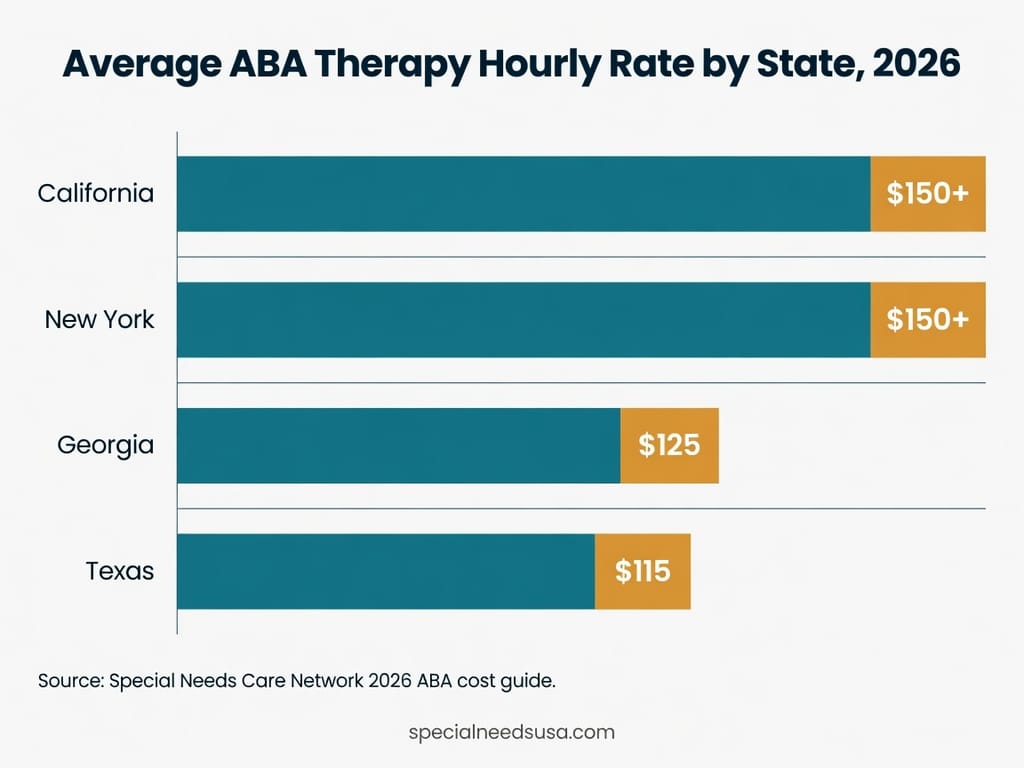
Costs vary by state. California and New York top $150+ hourly due to demand. Midwest states like Ohio average $100-120.
From recent data, Northeast runs $130-160. South like Florida sits at $110-140. West Coast hits $140-180. Plains states stay under $120.
Insurance mandates keep deductibles similar, but out-of-pocket starts higher in pricey states. Parents in Texas pay $115 average, Georgia $125.
Check state therapy directories for local quotes.
For precise figures, search your state. High-cost areas offer more providers, balancing options. Songbird Care details state averages.
How Insurance Covers ABA Therapy: Step-by-Step for Parents
All 50 states plus DC mandate ABA coverage for autism. Private plans, Medicaid in most states, cover it as essential.
Families hit deductibles first, $500-$5,000 yearly. Copays add $20-50 per session. Out-of-pocket max caps at $8,000-$15,000 for many plans. After max, insurance pays 100%.
With coverage, annual cost drops to deductible plus copays, often $5,000-$10,000 total. Read why ABA therapy is usually covered by insurance.
Get diagnosis letter from doctor.
Submit to insurer with BCBA assessment.
Appeal denials with medical necessity proof.
Track hours against authorization limits.
Appeal if denied: 70% win with details. Use templates from Autism Speaks. ABCAchieve explains 2026 coverage.
Funding Options Beyond Insurance for ABA Therapy
Grants from Autism Speaks or local chapters cover $1,000-$5,000. Scholarships through ACT Today! fit gaps.
IEPs fund school-based ABA. State aid like Florida's program pays partial fees. Non-profits offer sliding scales.
Providers set payment plans, $500 monthly chunks. Negotiate upfront.
Apply to three grants today.
Ask school for IEP add-on.
Steps to Find Affordable ABA Providers Near You
Screen for 1:5 BCBA-to-tech ratios. Read Google reviews for progress stories. Visit two centers.
Use directories for quotes. In Florida, check trusted ABA providers. Georgia has top centers too. Washington families often start with Eastside ABA clinic and in-home options when comparing local availability.
Ask: Success rates? Parent training hours? Rate matching?
Red flags: No contracts, vague plans, high turnover. Pick centers with outcomes data.
ABA Therapy ROI: Costs vs Long-Term Gains for Kids
Studies show ABA cuts future care by 50%. Kids gain words, friends, independence, saving $1M lifetime.
One parent saw tantrums drop in 6 months, ending extra aides. Another child entered mainstream school after 2 years.
Scale back at milestones, like after first sentences. Track quarterly.
Parent Action Plan: Start ABA Therapy This Week
Budget: Hours x rate x 52 minus coverage. Call three providers via explore ABA options.
Day 1: Call insurer.
Day 3: Get assessments.
Week 2: First session.
FAQ
What is the average hourly cost of ABA therapy?
$120 to $150 nationwide in 2026.
How many hours of ABA therapy does a child typically need per week?
10 to 40, based on age and goals.
Does health insurance cover ABA therapy in my state?
Yes, all 50 states mandate it for autism.
What factors make ABA therapy more expensive?
Location, provider type, hours, and setting.
How much does ABA therapy cost without insurance?
$62K-$250K yearly.
Are there grants for ABA therapy families?
Yes, from Autism Speaks and others.
How do costs vary by state for ABA therapy?
$100 Midwest to $180 West Coast.
What is a BCBA and why do they cost more?
Board Certified Behavior Analyst designs plans, charges $100+ hourly.
Can schools pay for ABA therapy through IEPs?
Yes, for school-based sessions.
Next read: Florida ABA insurance laws (plain English)
Get help finding the right school or center
Tell us what your child needs and we'll show you matching schools and therapy centers near you — free.