

Special Education Law in Florida and Florida's Evaluation Window Explained
Parents of children with disabilities in Florida hear a lot about their "rights" under special education law. What they rarely hear is how those rights play out in real schools, against real timelines, real budgets, and real incentives.
This guide breaks Florida special education law down in practical terms: what parents can realistically do, where they actually hold leverage, and where the system tends to bog down.
Get matched with schools and therapy providers
Tell us your child's needs and location, and we'll match you with special-needs schools, ABA therapy centers, or speech-therapy providers in your area. Free for families.
Free for families.
This isn't legal advice. It's a strategic overview for families navigating the system. SPCN pulled from government sources throughout, linked below, and wrote this to make Florida's special education laws easier to understand.
Section 1: How Special Education Works in Florida
Federal law sets the floor here, mainly the Individuals with Disabilities Education Act (IDEA). Florida carries it out through its own Exceptional Student Education (ESE) system.
On paper, the law guarantees:
A free appropriate public education (FAPE)
Education in the least restrictive environment (LRE)
A comprehensive evaluation before services begin
Parent participation in decision-making
In practice, though, districts control:
When evaluations start
What assessments are included
Eligibility determinations
Service recommendations
IEP language and implementation
Parents have rights, but districts run the process. Understanding that imbalance is the first step to navigating it well for your child.
Section 2: Evaluations Are the First Real Leverage Point
No child gets ESE services in Florida without an evaluation and an eligibility finding first. That makes evaluation one of the few stages where the law hands parents firm, enforceable rules.
Here's what parents should do:
Request an evaluation in writing, not verbally
Date the request and keep a copy
Ask what assessments will be included
Track timelines yourself
What tends to happen instead:
Schools suggest “interventions first”
Schools recommend waiting
Schools limit the scope of testing
Schools delay consent paperwork
The clock doesn't start until a parent signs written consent.
Section 3: Florida’s Evaluation Window, Explained Clearly
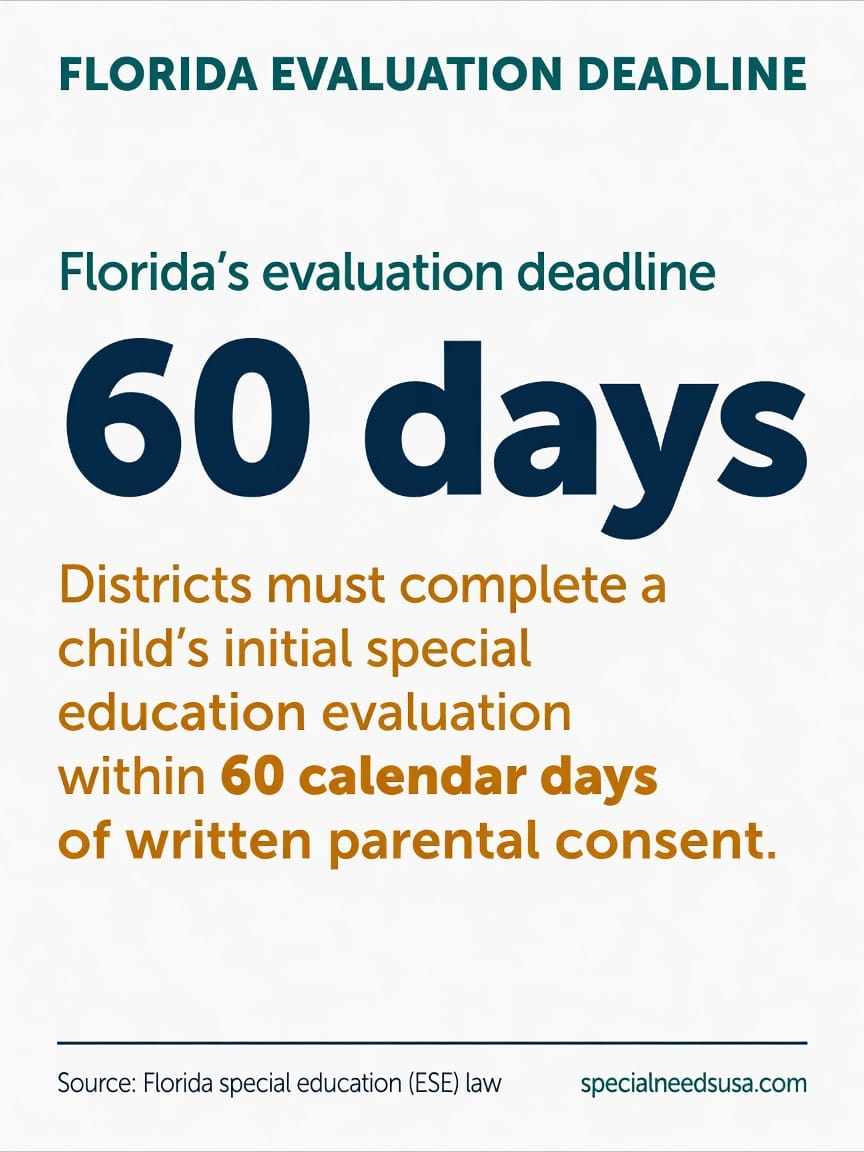
Once a parent signs that consent, Florida law gives the district 60 calendar days to complete the initial evaluation.
A few details parents need to know:
This is 60 calendar days, not 60 school days
Certain days do not count, such as school holidays, long breaks, and summer periods
The district may request a written extension in limited circumstances, but it is not automatic
The clock pauses if parents repeatedly fail to make the child available for evaluation
By the time that window closes, the district must:
Complete all agreed-upon assessments
Hold an eligibility determination meeting
Decide whether the child qualifies for ESE services
What that deadline does not require:
A finalized IEP
Immediate start of services
Eligibility and services are two separate legal steps, not one.
Section 4: Eligibility Is a Gate, Not a Guarantee
Qualifying under an ESE category doesn't guarantee meaningful services. Schools often zero in on whether a child is "passing" or "functioning in class," instead of asking how the disability actually affects daily learning.
Where parents should put their focus:
How the disability affects access to instruction
Functional challenges, not just labels
Specific services, not general accommodations
How progress will be measured
An IEP with vague goals and no service minutes leaves parents with little leverage down the road.
Section 5: IEP Meetings Are Structured Negotiations
Schools like to call IEP meetings collaborative. In reality, they're structured negotiations shaped by district norms and cost considerations.
Going in, parents should:
Submit written concerns in advance
Ask for draft IEPs before the meeting
Request data, not opinions
Take time to review before signing
Parents are also allowed to:
Bring an advocate
Ask for revisions
Decline to sign immediately
Request prior written notice when requests are refused
Note that you are NOT required to agree in the meeting.
Section 6: Enforcement Is Where Families Feel the Strain
Florida does offer formal enforcement options:
State complaints
Mediation
Due process hearings
The reality of enforcement:
Takes time
Requires documentation
Favors districts with legal teams
Can be emotionally exhausting for families
Many parents end up supplementing services privately, accepting the minimum offered, or looking at alternatives instead of taking on a formal dispute.
Knowing this upfront lets families make more informed decisions.
Section 7: When Parents Consider Alternatives
For some families, public ESE works well. For others, it does not.
Families exploring alternatives look at:
Private special education schools
Micro-schools
Hybrid programs
Homeschooling with services
Florida scholarship programs for students with disabilities
None of these options come free of tradeoffs. Families often gain flexibility but give up certain procedural protections in exchange.
Section 8: The Strategic Mindset That Helps Parents Most
Parents who tend to land better outcomes:
Put everything in writing
Track timelines themselves
Focus on services, not labels
Stay factual and calm
Know when to push and when to pivot
Conclusion
Florida special education law gives parents rights. Rights alone, though, don't produce services.
Parents who understand the evaluation window, document their concerns, and push for measurable supports put themselves in a stronger position to advocate for their kids.
Sources and Further Reading
Florida Department of Education
Exceptional Student Education Policies and Procedures
https://www.fldoe.org/academics/exceptional-student-edu/
Florida Administrative Code
Rule 6A-6.0331 and Rule 6A-6.03411
Exceptional Student Education Eligibility and Procedural Safeguards
https://www.flrules.org/
U.S. Department of Education
Individuals with Disabilities Education Act (IDEA) Overview
https://sites.ed.gov/idea/
Wrightslaw
Special Education Law and Advocacy Resources
https://www.wrightslaw.com/
Find ABA therapy clinics in your part of Florida:
https://specialneedsusa.com/therapy/florida
Find special needs and alternative schools in Florida:
https://specialneedsusa.com/states/florida
For the national 2026 policy context, read the 2026 special education law guide and the operator-facing special needs law and policy guide.
Find schools and therapy providers for your child
Tell us your child's needs and location, and we'll match you with special-needs schools, ABA therapy centers, or speech-therapy providers in your area. Free for families.